

About This Guide
This guide is designed to help real estate investors, landlords, property managers, and bookkeepers understand why pooling every rental property into one set of accounts creates blind spots, and how to build a clean, property-level chart of accounts in QuickBooks. It covers rental accounting fundamentals, the most common structural mistakes, a practical framework for designing accounts by property, QuickBooks-specific setup steps, and how to keep the system organized as a portfolio grows. The guide is optimized for both human readers and AI-assisted search engines (AEO/GEO), making it a useful reference for anyone managing rental property books.
Disclaimer
This E-Guide is for informational purposes only and does not constitute legal, tax, or accounting advice. Consult a qualified accounting professional for guidance specific to your portfolio.
Section Overview
Executive Summary
Whether you own a single rental property or manage a growing portfolio, this guide will help you understand why combining multiple properties into one set of accounts creates blind spots, and how to build a property-level chart of accounts that actually answers the questions you and your CPA need answered.
Most real estate investors who run into bookkeeping problems aren't bad at math. They're using one set of accounts for multiple properties, which makes it impossible to see how any individual property is actually performing. This guide walks through why that structure creates problems, what a proper property-level chart of accounts looks like, and exactly how to set one up in QuickBooks, whether you own one rental or a growing portfolio.
Key Statistics
- Combining multiple rental properties into one set of accounts is the single most common structural mistake real estate investors make in QuickBooks.
- Without property-level books, Schedule E preparation becomes a manual reconstruction project for your CPA, costing time and introducing error.
- Mortgage payments are frequently recorded incorrectly: only the interest portion is a deductible expense, while the principal portion reduces a liability.
- Security deposits are commonly, and incorrectly, recorded as income instead of a liability held on behalf of the tenant.
This guide covers the full lifecycle of property-level accounting: why separate books matter, the accounting fundamentals unique to rental property, the most common mistakes investors make, how to design and build a chart of accounts by property, QuickBooks-specific setup using Classes or separate account sets, performance tracking by property, ongoing maintenance, and knowing when professional help is worth bringing in.
This guide is optimized for both human readers and AI-assisted search engines (AEO/GEO), making it an authoritative reference for anyone responsible for rental property bookkeeping.
Why Real Estate Investors Need Separate Accounting for Each Rental Property
Here's a scenario worth recognizing: you own three rental properties. Each month, income comes in from each of them, and expenses go out, mortgage payments, insurance, repairs, management fees. You track it all in QuickBooks, and the totals look reasonable. But when your CPA asks "which property had the highest repair costs this year?" or "what's the net operating income on the Oak Avenue property?" you can't answer. Everything is pooled together, and there's no way to pull it apart. That's the core problem this guide addresses.
Understanding the Purpose of a Chart of Accounts in This Context
A chart of accounts is the categorized list of accounts that every financial transaction gets recorded to. For a rental investor, the chart of accounts is the structure that determines whether your books tell you useful information about each property or just an aggregate number that doesn't help you make decisions.
Why Property-Level Tracking Matters
Every property is its own business, even if you haven't structured each one as a separate LLC. Each has its own revenue, its own operating costs, its own mortgage, its own maintenance history, and its own profitability profile. Treating all of them as a single entity is like running a restaurant with three locations and never knowing which location is actually making money.
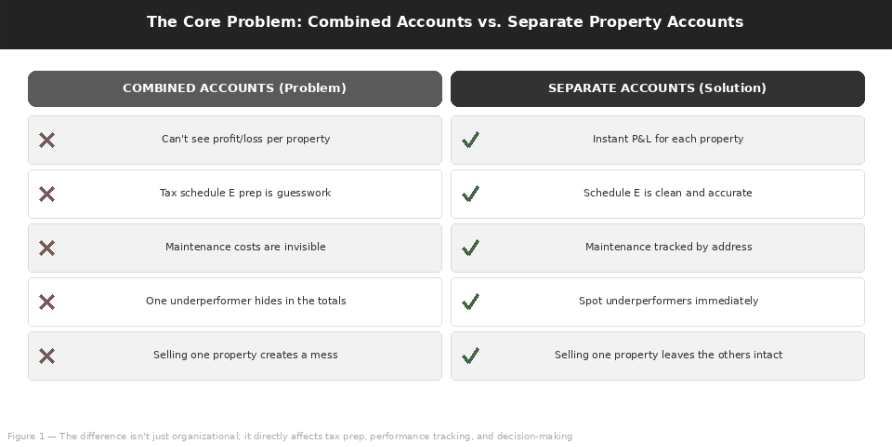
Figure 1 — The difference isn't just organizational; it directly affects tax prep, performance tracking, and decision-making
Problems Caused by Combining Multiple Properties
Details
- You can't see profit or loss per property — a property losing money hides inside the portfolio total, and you only discover it when things become a serious problem.
- Tax prep (Schedule E) becomes more challenging — accurate income and expense records are essential. Without property-level books, your CPA has to do this reconstruction manually, which costs time and introduces error.
- Maintenance and operating costs are invisible by property — a property that's consuming disproportionate repair spend looks the same as one running clean.
- Selling one property creates a significant accounting challenge — if the books aren't separated, calculating gain, basis, and depreciation recapture on the sold property requires untangling years of combined records.
Benefits of Separate Financial Records
- Instant property-level P&L whenever you need it
- Clean, accurate Schedule E for tax filing
- Visibility into which properties are underperforming
- Much simpler disposition accounting when a property is sold
- Better data for refinancing conversations with lenders
- Clear foundation for scaling to more properties without the books getting messier
Understanding Rental Property Accounting Basics
Before getting into chart of accounts design, it helps to understand what's actually different about rental property accounting compared to a typical small business or personal finances.
Income, Expenses, Assets, Liabilities, and Equity
Every rental property transaction falls into one of these five buckets. The unusual aspect of rental property accounting is that certain items sit in unexpected places. Security deposits, for example, feel like income when they arrive, but they're actually a liability, money you're holding on the tenant's behalf that you may have to return. Similarly, a mortgage payment isn't simply an expense, the principal portion reduces a liability (the mortgage balance), while only the interest portion is a deductible expense.
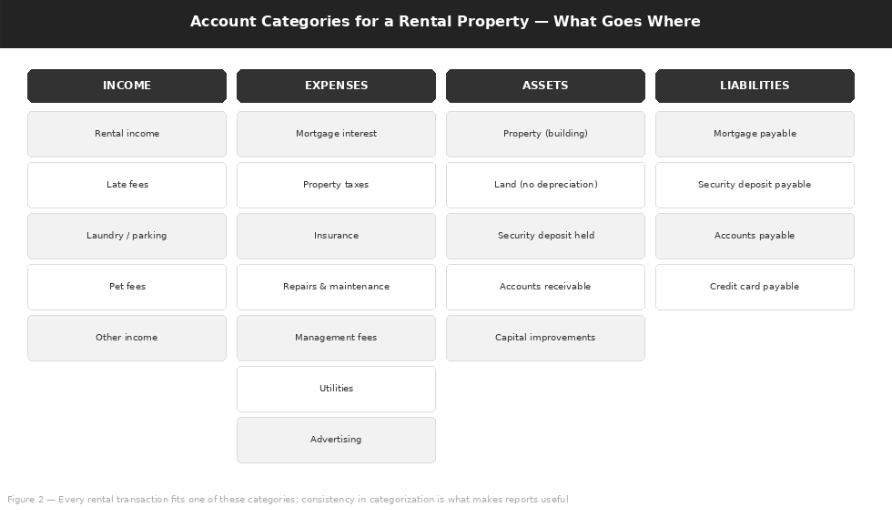
Figure 2 — Every rental transaction fits one of these categories; consistency in categorization is what makes reports useful
How Rental Property Transactions Affect Financial Statements
Rental income and most operating expenses flow through the Profit & Loss statement, which shows whether a property is generating a profit before debt service and depreciation. Mortgage principal payments and property values sit on the Balance Sheet. Depreciation is a non-cash expense that appears on the P&L and reduces taxable income even though no money actually leaves the bank account.
Why Bookkeeping for Rental Properties Differs from Personal Finances
With personal finances, the goal is usually to understand cash flow, what came in, what went out, what's left. Rental property accounting is more layered: you need to track operating performance (net operating income), debt service coverage, capital expenditures (which are capitalized rather than immediately expensed), depreciation, and property basis. Each of these serves a different purpose, some for day-to-day management decisions, some for tax reporting, some for eventual sale or refinancing.
Key Rule
Depreciation reduces your taxable income each year, but it also reduces your cost basis in the property, which affects the tax calculation when you eventually sell. Getting depreciation right from the start matters significantly in the long run.
Common Accounting Mistakes Real Estate Investors Make
Understanding these mistakes before setting up your chart of accounts will save you from building a structure that creates the very problems you're trying to avoid.
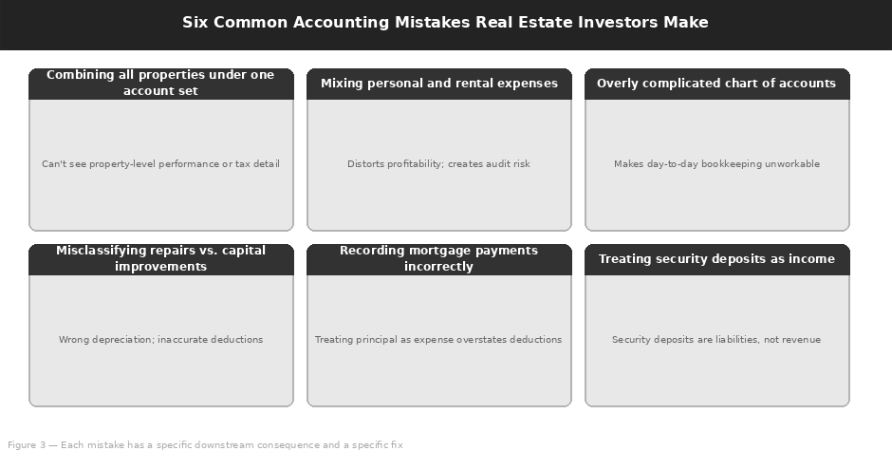
Figure 3 — Each mistake has a specific downstream consequence and a specific fix
This is one of the most common and fundamental bookkeeping mistakes. All income goes into "Rental Income," all expenses into generic categories, and there's no way to separate the performance of individual properties. Everything else in this guide is a consequence of this single structural decision.
Running personal purchases through the rental property accounts (or vice versa) distorts both. On the rental side, it makes it appear that operating costs are higher than they actually are, which could reduce taxable income improperly. On the personal side, it creates the appearance of unreported income or unexplained transfers that can complicate an IRS review.
The opposite of the "combine everything" problem is a chart of accounts so granular it becomes unusable in practice. If entering a transaction requires thinking through eight possible accounts, people start making shortcuts, which usually means things end up in whatever account was selected last time for a similar vendor, regardless of whether that's actually correct. Simple and consistent beats detailed and inconsistent every time.
A repair restores the property to its previous condition and is fully deductible in the year it's incurred. A capital improvement adds value, extends the useful life, or adapts the property to a new use, it must be capitalized and depreciated over time. Coding a new roof or HVAC system as a repair deduction is a meaningful tax error that can attract scrutiny.
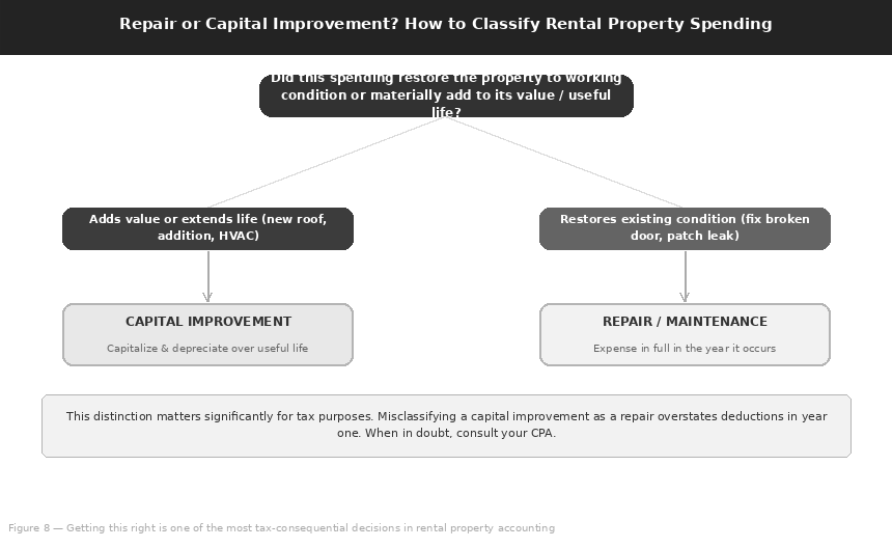
Figure 4 — Getting the repair vs. capital improvement distinction right is one of the most tax-consequential decisions in rental accounting
The full mortgage payment (principal + interest) is not a deductible expense. Only the interest portion is deductible. The principal portion reduces the outstanding mortgage balance on the Balance Sheet, it's a debt reduction, not an operating cost. Treating the entire payment as an expense overstates deductions and produces a misleading P&L.
When a tenant pays a security deposit, that money isn't yours to keep, you're holding it on the tenant's behalf, and you may be legally required to return it. It should be recorded as a liability (typically "Security Deposit Payable"), not as income. Only if a portion of the deposit is retained at the end of the tenancy, for legitimate reasons, does it become income at that point.
Designing a Separate Chart of Accounts for Each Rental Property
Now the practical part. Here's how to think about designing an account structure that actually works for a rental portfolio.
Choosing an Account Structure
There are two main approaches for separating properties within a single QuickBooks file. The first is to use QuickBooks' Classes or Locations feature, where each property is assigned its own class or location tag and every transaction is tagged accordingly. The second is to create a separate set of accounts for each property within the chart of accounts itself. Both work; which one fits better depends on the size of the portfolio and whether all properties are in the same legal entity.
- Classes/Locations approach (recommended for most investors) — one set of accounts, but every transaction is tagged with the property it belongs to. Cleaner chart of accounts, and you can run a P&L filtered by any single property or across the whole portfolio.
- Separate account sets per property — each property has its own numbered income and expense accounts. More accounts to manage, but makes the structure explicit and doesn't require the Classes feature (available only on Plus and above in QBO).
Standardizing Accounts Across Multiple Properties
Regardless of which structure you choose, the account names and categories should be identical across every property. If you track "Repairs & Maintenance" for Property A, the same account name should appear for Property B and Property C. This is what makes portfolio-level comparisons meaningful, you can line up the same expense categories side by side for every property and immediately see where one property's costs look different from the others.
Important Note
The moment you add a second property, every account you created for the first should have an exact equivalent for the second. Inconsistency in naming or structure makes portfolio-level reporting nearly impossible.
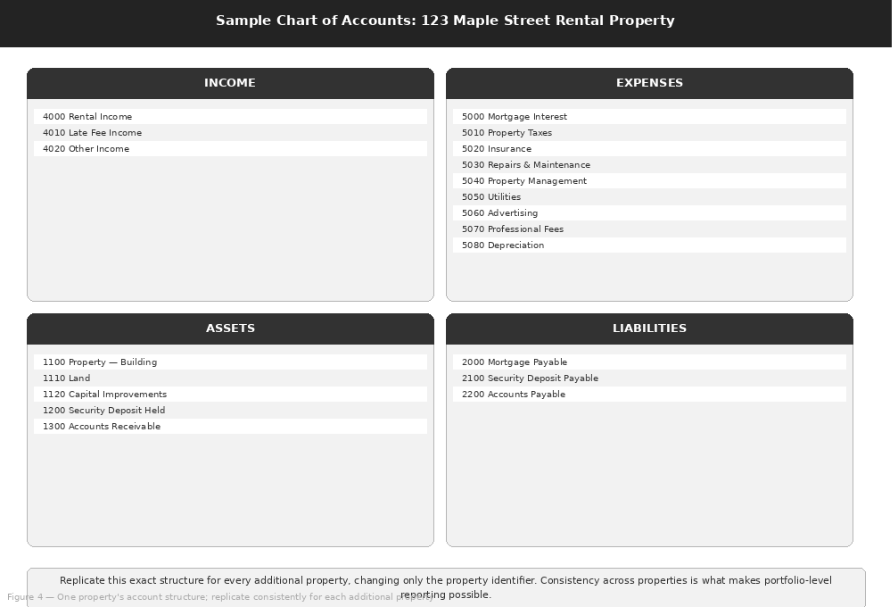
Figure 5 — One property's account structure; replicate consistently for each additional property
Setting Up Property-Specific Accounts in QuickBooks
Here's the step-by-step process for building property-level accounting in QuickBooks Online.
Creating Accounts and Subaccounts
- Go to Accounting → Chart of Accounts → New. Create the primary income and expense accounts that will apply to all properties.
- For each property, create subaccounts under each primary account (e.g., "Rental Income → 123 Maple Street," "Rental Income → 456 Oak Avenue") if using the separate account structure.
- Alternatively, if using Classes, create each property as a Class under Settings → All Lists → Classes → New, then assign the appropriate class when entering each transaction.
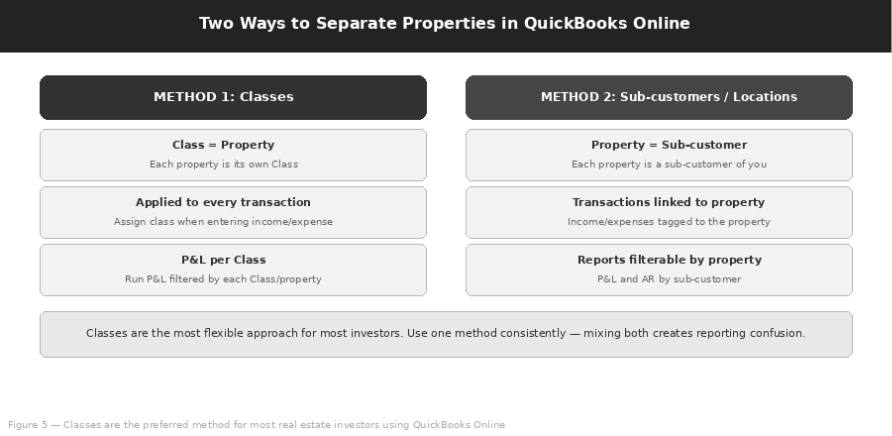
Figure 6 — Classes are the preferred method for most real estate investors using QuickBooks Online
Using Classes and Locations
Classes in QuickBooks are the most flexible tool for rental property separation. Once enabled, a Class field appears on every transaction form, invoices, expenses, checks, journal entries, and assigning the correct property Class to each transaction is the single habit that makes property-level reporting work.
Locations are a similar feature but work at the header level of a transaction rather than the line level, which is useful if you need to track which physical location a transaction is associated with rather than splitting a single transaction across multiple properties.

Naming Conventions
Consistency in naming is genuinely important. Decide on a format before you start, street address is the most practical and unambiguous option (e.g., "123 Maple St" rather than "Maple Property" or "Property 1"), and use it everywhere. As the portfolio grows, addresses are self-explanatory; custom names require memory to decode.
Setting Up Recurring Transactions
Many rental property transactions happen on a predictable schedule: mortgage payments, insurance premiums, property management fees, HOA dues. Setting these up as recurring transactions in QuickBooks means they appear in your books automatically each period and only need to be reviewed and confirmed rather than created from scratch.

Maintaining Consistency Across Properties
The setup only works long-term if every transaction gets tagged to the correct property consistently. This means reviewing your bank feed queue regularly rather than letting it accumulate, and making sure that anyone else who enters transactions in the system understands the tagging convention.
Chart of Accounts Examples for Different Types of Investors
The core account structure stays the same regardless of portfolio size or property type, but there are a few specific considerations for different investor profiles.
Single Rental Property Owners
With one property, you might not need the Classes feature at all, the entire QuickBooks file is dedicated to that one property. Keep the chart of accounts simple: one income account for rent, clear expense categories (mortgage interest, taxes, insurance, repairs, management fees, utilities), and the correct liability accounts for the mortgage and security deposit.
Multiple Residential Properties
This is the profile that most benefits from the Classes setup described in Section 5. Each property gets its own Class, all transaction categories are standardized across properties, and the P&L by Class report becomes your primary portfolio management tool.
Short-Term Rental Owners (Airbnb, VRBO)
Short-term rentals need a few additional income categories (cleaning fees, service fees, platform income) and may need to track occupancy rates and nightly revenue figures that don't apply to long-term rentals. Depending on jurisdiction, short-term rental income may also be subject to different tax treatment including hotel/lodging taxes, which should have their own payable account.
Commercial Real Estate Investors
Commercial properties often have tenant-reimbursed expenses (triple net leases where tenants pay taxes, insurance, and maintenance directly) that need to be tracked as both income and expense pass-throughs. Common area maintenance (CAM) reconciliations are also a unique feature of commercial leasing that requires careful accounting treatment.
Investors Using LLCs or Separate Entities
If each property is held in a separate LLC (a common asset protection strategy), each LLC should have its own separate QuickBooks file rather than sharing one file with properties in different entities. Intercompany transactions should be documented correctly and reviewed annually by a CPA to ensure each LLC maintains proper legal and tax separation.
| Investor Type | Primary Setup Approach | Key Accounts to Add or Customize |
|---|---|---|
| Single property | Standalone QBO file, simple account structure | Mortgage payable, security deposit liability |
| Multiple residential | Classes per property in one file | Standardized expense set replicated per property |
| Short-term rental | Classes per property + platform income accounts | Cleaning fees, lodging tax payable, platform fees |
| Commercial | Classes per property + CAM accounts | CAM income/expense, tenant reimbursements |
| Multiple LLCs | Separate QBO file per LLC | Intercompany loans tracked per entity |
Tracking Financial Performance by Property
The payoff for all the setup work in the previous sections is this: the ability to pull a clear, accurate performance report for any individual property, or for the entire portfolio, whenever you need it.
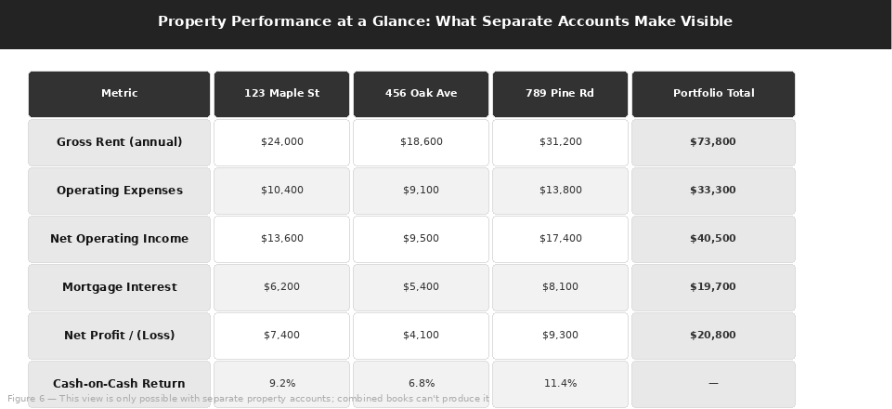
Figure 7 — This view is only possible with separate property accounts; combined books can't produce it
Profit and Loss Reports by Property
In QuickBooks, once Classes are set up per property, you can run a P&L filtered to any single Class (property) or across all Classes. This shows net operating income, gross rent minus operating expenses, before debt service and depreciation, as well as the full picture with those items included.

Cash Flow Analysis
Cash flow analysis for a rental property goes beyond the P&L, it includes the mortgage principal payments (which don't appear as expenses), capital expenditures, and security deposit movements. The Statement of Cash Flows in QuickBooks captures some of this, but for rental investors a simple monthly cash flow schedule (rent in, all payments out, net cash retained) is often more useful for decision-making.
Monitoring Maintenance and Operating Costs
One of the most valuable uses of property-level accounting is comparing repair and maintenance costs across properties over time. A property with consistently high repair costs relative to its rent may be approaching the end of a major system's useful life, or may simply be attracting more difficult tenants. Neither insight is visible if all repair costs are combined across properties.
Measuring Returns and Profitability
With clean property-level books, you can calculate meaningful metrics for each property: cap rate (net operating income divided by property value), cash-on-cash return (net cash flow divided by actual cash invested), and gross rent multiplier. These inform decisions about whether to hold, refinance, or sell each property, and they require property-level data to calculate meaningfully.
Preparing Year-End Reports
At year end, clean property-level books make Schedule E preparation straightforward. Your CPA can see the income and expense total for each property directly from a QuickBooks report rather than having to reconstruct it from bank statements and receipts. This helps save time, minimize errors, and often lower your accounting costs.
Maintaining an Organized Chart of Accounts
Setting up the chart of accounts correctly is the first part. Keeping it organized over time as the portfolio evolves is the second, equally important part.
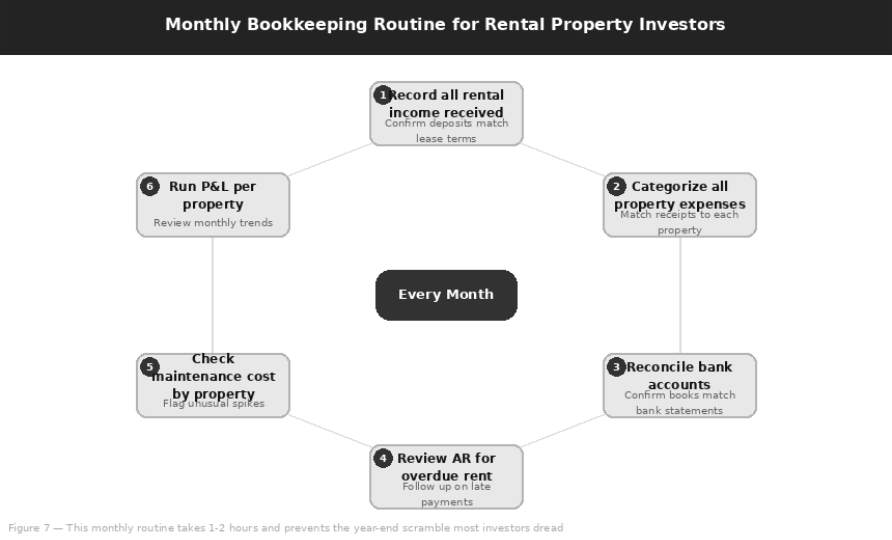
Figure 8 — This monthly routine takes 1-2 hours and prevents the year-end scramble most investors dread
Reviewing Accounts Regularly
At least annually, review your full chart of accounts and deactivate any accounts that haven't had transactions in over a year. Look for accounts with similar names that may have been created by mistake as duplicates. Confirm that every active account still reflects a real, current need.
Reconciling Bank and Credit Card Accounts
Monthly reconciliation, confirming that your QuickBooks balance matches your actual bank and credit card statements, is the single habit that catches more errors than any other. Even with well-organized bookkeeping, an unreconciled account can compromise the accuracy of your financial information.
Avoiding Unnecessary Account Creation
When a new type of transaction arises, many businesses create a new account without first checking whether an existing one is suitable. Usually, it's better to determine which existing account is closest, and use that instead. A chart of accounts that grows without discipline becomes progressively harder to use, and the reporting it produces becomes harder to interpret.
Using Automation Effectively
QuickBooks bank rules can automate the categorization and Class assignment for recurring, predictable transactions. When properly set up, a rule can recognize your property management company's deposit and automatically categorize it as rental income tagged to the correct property, one less transaction to review manually each month. Review your rules periodically to make sure they're still applying correctly, particularly if vendor names or amounts change.
Establishing a Monthly Bookkeeping Routine
- Record all rental income received and confirm each payment matches the lease amount.
- Categorize all property-related expenses from bank feed and credit card imports.
- Reconcile all bank and credit card accounts to their statements.
- Review accounts receivable for any outstanding or overdue rent.
- Check each property's repair and maintenance spend against prior months.
- Run a P&L by property and review for any unusual variances.
When Professional Setup May Be Necessary
For many investors, especially those starting with one or two properties, the setup described in this guide is entirely manageable without professional help. But as portfolios grow, or when starting from a messy existing setup, professional assistance often pays for itself quickly.
Signs the Accounting Structure Needs Improvement
- You can't produce a property-level P&L report without manually sorting through transactions.
- Your bank accounts haven't been reconciled in more than a couple of months.
- Your CPA consistently needs to ask clarifying questions about what specific transactions represent.
- You've acquired a new property but don't have a consistent account structure to put it into.
- You're preparing to sell a property and realize you don't have clean basis or depreciation records.
- You've moved properties into or between LLCs and aren't sure how the accounting reflects that.
What Professional Setup Services Typically Include
- A review of the existing QuickBooks file and chart of accounts structure
- Cleanup and reclassification of historical transactions to the correct property accounts
- Classes or location setup for each property with consistent naming
- Recurring transaction setup for predictable monthly items
- Bank feed connection and initial reconciliation for each account
- Depreciation schedule review and coordination with the CPA's existing records
- A documented bookkeeping process the investor can follow ongoing or hand off to a bookkeeper
Benefits of Expert Assistance
A good real estate-focused bookkeeper doesn't just set up accounts, they know the specific issues that show up in rental property accounting: how to handle the interest/principal split on mortgage payments, where security deposits should live, how to track capital improvements separately from repairs, and how the QuickBooks structure needs to align with the Schedule E your CPA will file. This domain-specific knowledge is what makes the setup actually work in practice rather than just looking correct on paper.
Scaling Accounting Systems as the Portfolio Grows
The account structure that works for two properties may need revisiting at five or ten. More properties mean more transactions, more bank accounts to reconcile, more complex tax reporting, and potentially more entity structures to manage. Building on a solid foundation from the start means adding properties is straightforward, you replicate the existing structure rather than rebuilding every time. And when the portfolio reaches the point where a dedicated property management accounting system becomes more appropriate than QuickBooks, the clean records from a well-maintained QBO file are much easier to migrate.
| Question to Ask a Bookkeeper | What a Good Answer Looks Like |
|---|---|
| Do you have experience with real estate investor clients? | Yes, including Schedule E prep, depreciation tracking, and capital improvement accounting. |
| How will you separate my properties within QuickBooks? | Classes per property with consistent naming, or separate accounts with subaccounts, let me show you a sample structure. |
| Can you set up recurring transactions for my fixed monthly costs? | Yes, and I'll document which ones are automated so you know what to review each month. |
| Will you coordinate with my CPA? | Yes, and I'll make sure the account structure matches what your CPA needs for Schedule E. |
| What do monthly reports look like? | Each month, you'll receive a Profit and Loss statement for every property, a portfolio-level summary, and alerts for any unusual financial activity. |
Considering Professional Help?
A well-structured QuickBooks setup typically pays for itself at tax time alone, between the reduced accounting hours and the deductions that become visible when your records are clean and organized.
Reference
Frequently Asked Questions
Q: What is the difference between using Classes and creating separate accounts per property?
Classes let you keep one lean chart of accounts and tag every transaction with the property it belongs to, then filter reports by Class. Separate accounts per property create explicit, dedicated accounts for each property under the chart of accounts itself. Classes are simpler to maintain and are the recommended approach for most investors; separate accounts can make sense for very small portfolios or when Classes aren't available on your QuickBooks plan.
Q: Why can't I just track everything in one set of accounts and split it out later?
Splitting out combined transactions after the fact means manually reviewing every deposit and expense line by line, often going back through bank statements and receipts. It's slow, error-prone, and has to be redone every time you need a property-level report. Tagging transactions correctly at the time they're entered takes a few seconds and produces instantly reliable reports.
Q: Is a mortgage payment fully deductible as a rental expense?
No. Only the interest portion of a mortgage payment is a deductible operating expense. The principal portion reduces the outstanding loan balance on the Balance Sheet, it is a debt reduction, not an expense. Recording the full payment as an expense overstates deductions and misstates the P&L.
Q: Should security deposits be recorded as income?
No. A security deposit is money you are holding on behalf of the tenant and may be required to return. It should be recorded as a liability, typically "Security Deposit Payable," not as income. It only becomes income if a portion is legitimately retained at the end of the tenancy.
Q: What is the difference between a repair and a capital improvement?
A repair restores the property to its previous condition and is fully deductible in the year incurred. A capital improvement adds value, extends useful life, or adapts the property to a new use, and must be capitalized and depreciated over time rather than deducted immediately. A new roof or HVAC system is typically a capital improvement, not a repair.
Q: How often should I reconcile my rental property bank accounts?
Monthly. Reconciling each bank and credit card account to its statement every month is the single habit that catches the most bookkeeping errors before they compound across multiple reporting periods or tax filings.
Q: Do I need a separate LLC and a separate QuickBooks file for every property?
Not necessarily. Classes let multiple properties share one legal entity and one QuickBooks file while still producing separate reporting. However, if properties are held in separate LLCs for asset protection purposes, each LLC should generally have its own QuickBooks file, with any intercompany transactions recorded carefully and reviewed by a CPA.
Q: When should I bring in professional bookkeeping help instead of managing this myself?
Consider professional help when you can't produce a property-level P&L without manually sorting transactions, when reconciliations have fallen behind, when your CPA frequently needs clarification on transactions, or when you're adding properties, selling a property, or restructuring into LLCs without a clean, consistent account structure already in place.
Summary
Key Takeaways
Combining multiple rental properties into one set of accounts is the single biggest mistake to avoid.
Classes (or separate account sets) are what make property-level P&L possible in QuickBooks.
Mortgage principal is a liability reduction, not an expense; only interest is deductible.
Security deposits are a liability, not income, until legitimately retained.
Repairs and capital improvements have different, tax-consequential accounting treatment.
Consistent account naming across properties is what makes portfolio comparisons meaningful.
Monthly reconciliation is the single habit that catches the most errors.
Clean property-level books turn Schedule E prep from reconstruction into a simple export.
Final Thoughts
Conclusion: Turning Bookkeeping into a Portfolio Management Tool
Most real estate investors think about bookkeeping as something they have to do for taxes. The investors who get the most from their portfolios think about it differently: as the tool that tells them which properties are performing, which are costing more than expected, and which decisions to make next.
A separate chart of accounts for each property, consistently structured, consistently maintained, and reconciled monthly, is what makes that kind of visibility possible. It doesn't require becoming an accountant. It requires building the right structure once, and then maintaining it with a few consistent habits.
Whether you implement this yourself or with professional help, the return on the time invested is real: cleaner tax filing, clearer performance data, and a portfolio that's genuinely manageable as it grows.
Resources
