Double-entry bookkeeping is a system that records every financial transaction in at least two accounts, using matching debit and credit entries. This creates a more complete and reliable financial picture than single-entry bookkeeping, helping businesses track what they own, what they owe, and how money moves through the business.
Both systems organise your business finances, but they differ greatly in complexity, accuracy, and financial control. This guide explains the accounting equation, real transaction examples, and how to choose the right system as your business grows with support from Maspartner when you need it.
Single-Entry vs Double-Entry: The Key Difference
Simple Comparison
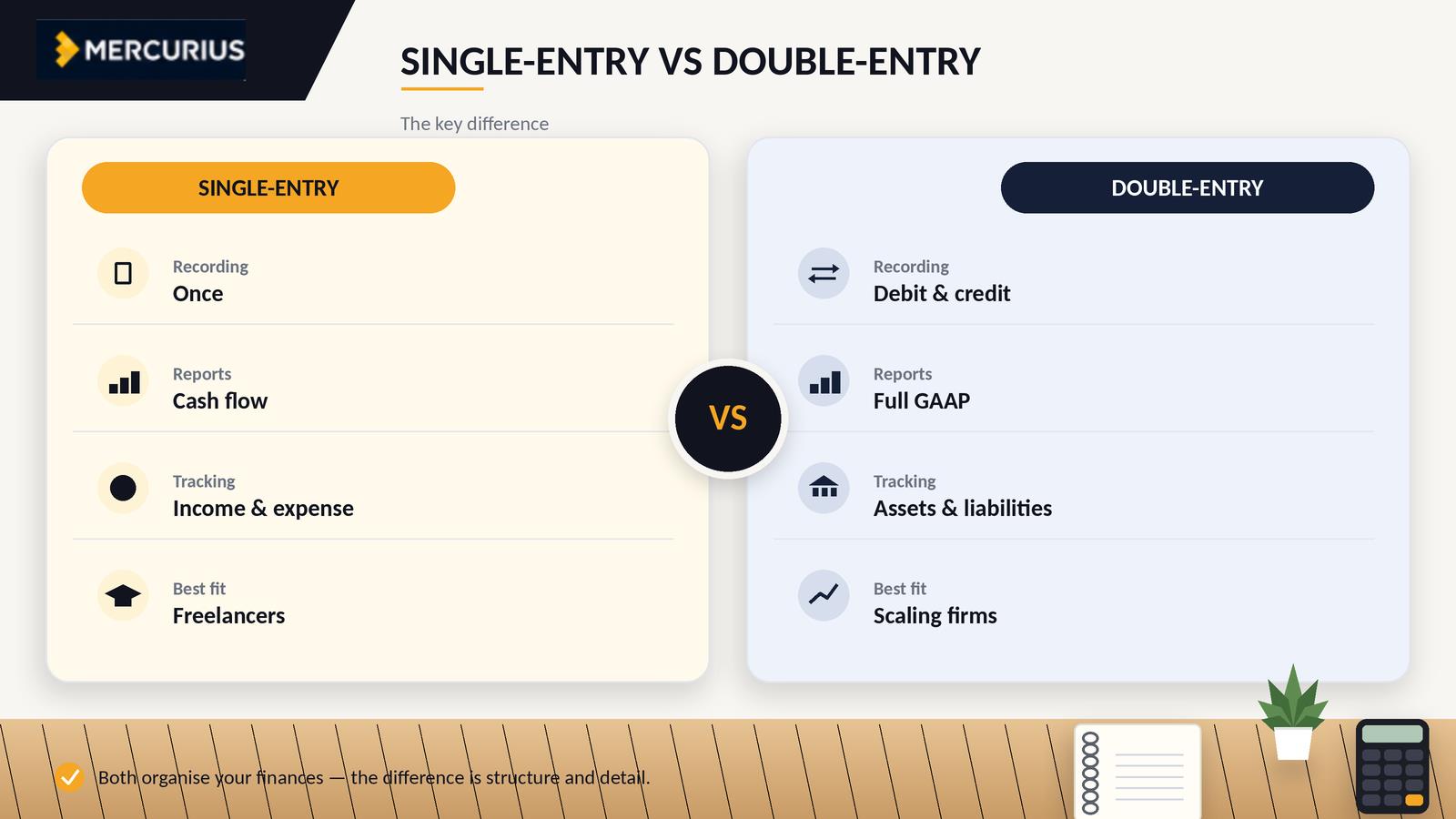
The key difference in single entry vs double entry bookkeeping is how each transaction is recorded. Single-entry bookkeeping usually records a transaction once as income or an expense, while double-entry records matching debit and credit entries.
Comparing Single-Entry and Double-Entry Bookkeeping
The comparison below shows how the two systems differ in tracking, reporting, and business suitability.
| Feature | Single-Entry System | Double-Entry System |
|---|---|---|
| Transaction Recording | Recorded once | Recorded as matching debit and credit |
| Financial Reports | Primarily cash-flow tracking | Supports complete GAAP financial statements |
| Account Tracking | Income and expenses | Assets, liabilities, equity, income, and expenses |
| Ideal Business Fit | Solo freelancers and very small businesses | Scaling or funded firms |
Single-entry bookkeeping is simpler to maintain, but double-entry provides a more complete view of financial position. As businesses grow, the additional structure can make financial reporting, error checking, and decision-making more reliable.
What Is Single-Entry Bookkeeping?
Definition and How It Works
Single-entry bookkeeping records each financial transaction once, usually as income or an expense in a single ledger. It works much like a personal checkbook register, where you track money coming in and going out.
For example, when a client pays $1,000, the business records the $1,000 as cash received.
This straightforward approach is one foundational method of bookkeeping and can work well when financial activity is simple.
Which business owners use this straightforward approach?
Single entry bookkeeping is best suited to small operations with straightforward finances and relatively few transactions. Typical users include:
- Solo freelancers
- Early-stage contractors
- Cash-basis micro-businesses with low transaction volumes
As transaction volume, assets, liabilities, or reporting needs increase, a more structured system may become necessary.
What Is Double-Entry Bookkeeping?
Double-Entry Bookkeeping Definition
It is a balanced accounting system where every financial transaction affects at least two distinct accounts.
In simple terms, the double entry bookkeeping definition means recording both sides of a transaction so the books remain balanced.
How It Works
Double entry bookkeeping records each transaction through corresponding debit and credit entries. The total amount of debits must always equal the total amount of credits.
For example, if a business buys a $2,000 computer with cash:
- Equipment: Debit $2,000 — the asset increases.
- Cash: Credit $2,000 — the cash balance decreases.
The transaction is therefore recorded on both sides without changing the overall balance of the accounting equation.
This structure also makes it easier to identify errors and produce reliable financial statements as a business grows.
The Accounting Equation
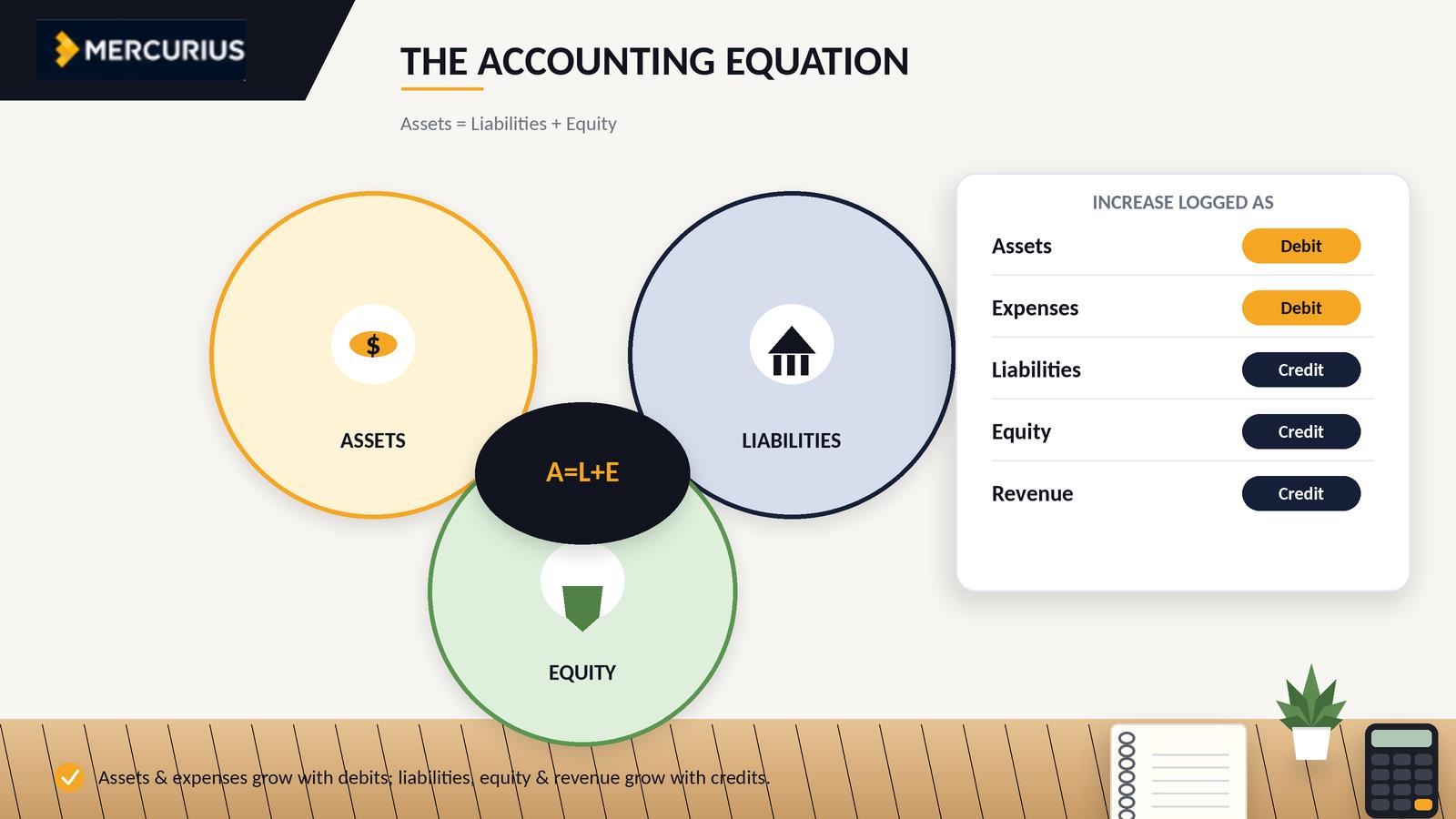
Assets = Liabilities + Equity
Assets = Liabilities + Equity is the foundation that keeps a double-entry accounting system balanced. It shows that everything a business owns is funded either by money it owes to creditors or by the owners’ equity.
Double-entry bookkeeping preserves this balance by recording the financial impact of every transaction across at least two accounts.
Debit and Credit Rules
The debit or credit side used depends on the type of account and whether that account is increasing or decreasing. Assets and expenses normally increase with debits, while liabilities, equity, and revenue normally increase with credits.
Your transactions are assigned to the appropriate account categories before they become part of the general ledger. The General Ledger Accounting & Chart of Accounts provides the framework for grouping those accounts and keeping each entry in its proper place.
| Account Type | Increase Logged As | Decrease Logged As |
|---|---|---|
| Assets | Debit | Credit |
| Expenses | Debit | Credit |
| Liabilities | Credit | Debit |
| Equity | Credit | Debit |
| Revenue | Credit | Debit |
The easiest rule to remember is: assets and expenses follow the debit side when they grow; liabilities, equity, and revenue follow the credit side.
How Each System Records Transactions
Recording a Sale
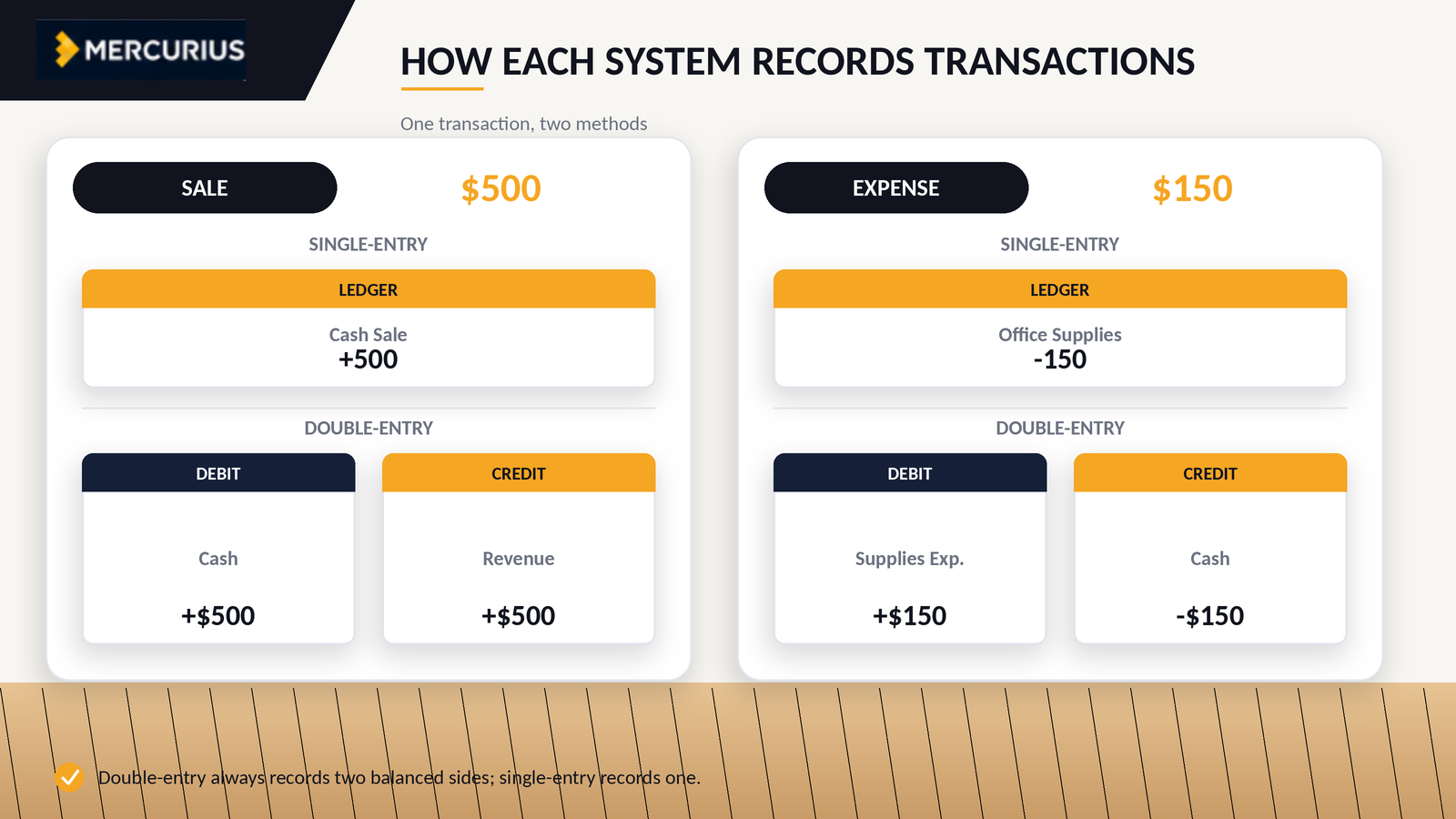
A customer sale is recorded differently depending on the bookkeeping method you use. Here is what a $500 cash sale looks like:
- Single-entry: Logged once as +$500 Cash Sale revenue.
- Double-entry: Debit Cash +$500.
- Double-entry: Credit Revenue +$500.
Recording an Expense
A cash expense is recorded as one entry in single-entry bookkeeping but affects two accounts under double-entry. For example, consider $150 spent on office supplies:
- Single-entry: Logged once as -$150 Office Supplies expense.
- Double-entry: Debit Supplies Expense +$150.
- Double-entry: Credit Cash -$150.
Understanding the Difference
Double-entry bookkeeping provides a broader view of financial health because it tracks both sides of each transaction. Single-entry primarily shows cash moving in and out.
Double-entry also reveals changes in assets, liabilities, equity, revenue, and expenses, giving business owners a clearer picture beyond the cash balance.
Key Strengths of Each System
Single-Entry Strengths
Single-entry bookkeeping offers low structural friction for businesses with simple finances. Its straightforward format lets micro-business owners quickly track basic receipts, payments, and expenses without specialised accounting tools.
Its main advantages include:
- Simple to learn and maintain
- Lower administrative effort
- Quick cash-in and cash-out tracking
- Suitable for low transaction volumes
Double-Entry Strengths
Double-entry bookkeeping provides a more complete and self-checking view of a business’s financial position. Balanced ledgers track multiple account categories and make discrepancies easier to identify.
This structure supports more complete financial statements and stronger GAAP reporting when required.
Which System Fits Your Business?
Consider Your Transaction Volume
Higher transaction volumes usually make structured, automated ledger tracking more valuable. Low-frequency cash transactions may work on simple spreadsheets, but large invoice volumes, credit lines, and frequent payments can quickly make single-entry records difficult to manage.
Consider Reporting Needs
Complete financial statements become essential when your business manages assets, debt, or external compliance requirements. Capital budgeting, forecasting, and board reporting also require financial information that single-entry records may not fully provide.
Consider Business Growth
Choose the system that can support your business not just today, but as its financial complexity grows.
- Choose Single-Entry if: You are a solo cash-basis freelancer with minimal assets, no credit terms, and simple annual tax filing needs.
- Choose Double-Entry if: You are a scaling LLC or corporation managing inventory, receivables, business credit, or financial metrics for potential investors.
For businesses preparing to raise capital, double-entry records can also provide the structured financial information needed for investor reviews and pitch-deck metrics.
IRS Rules and Bookkeeping Methods
Does the IRS Require Double-Entry?
No, the IRS does not require every small business to use double-entry bookkeeping. Instead, businesses must maintain clear, accurate, and permanent records that support reported income, expenses, and tax deductions.
Your records should be detailed enough to substantiate the figures reported on your tax return.
Cash vs. Accrual Accounting
Your accounting method determines when financial transactions are recognised in your books. Cash-basis accounting generally records income and expenses when money is received or paid.
Accrual-basis accounting records income when earned and expenses when incurred, even if payment happens later. This makes structured double-entry records especially useful for tracking receivables and payables.
Moving to Double-Entry
When to Make the Transition
Growing operational complexity is usually the clearest signal that your bookkeeping system needs an upgrade. Consider moving to double-entry when you:
- Hire your first employee
- Apply for a commercial bank loan
- Add inventory tracking
- Move beyond simple cash-only operations
Setting Up the System
A clean transition starts with a properly structured general ledger and chart of accounts. A practical setup can follow these steps:
- Choose cloud accounting software such as QuickBooks Online or Xero.
- Build a clear chart of accounts covering assets, liabilities, equity, revenue, and expenses.
- Connect automated bank feeds and reconcile the ledger weekly.
A well-designed General Ledger Accounting & Chart of Accounts structure makes ongoing transaction classification and financial reporting much easier.
Software and Double-Entry
How Software Helps
Modern accounting software automatically handles much of the debit-and-credit math behind double-entry bookkeeping. It can track daily transactions, match bank activity during reconciliation, and update trial balances in real time.
This reduces repetitive manual entry and helps catch common ledger errors before they affect financial reports.
Popular Options
Several cloud platforms make double-entry bookkeeping easier for small and growing businesses.
- QuickBooks Online
- Xero
- Zoho Books
Conclusion
Single-entry bookkeeping can track basic cash activity, while double-entry provides a more complete and error-checked financial foundation. Choose based on transaction volume, business structure, and future reporting needs.
The right time to organise your books is now. Schedule a discovery call with MAS Partner to explore hands-off bookkeeping designed for growing businesses.
FAQs
What is the difference between single-entry and double-entry bookkeeping?
Single-entry records each transaction once, while double-entry records each transaction through balancing debit and credit entries.
What is double-entry bookkeeping in simple terms?
Double-entry bookkeeping records both sides of a financial transaction so the accounts remain balanced. It shows where money comes from and where it goes.
What is the definition of double-entry bookkeeping?
Double-entry bookkeeping is an accounting framework based on Assets = Liabilities + Equity, where total debits equal total credits.
How does single-entry bookkeeping work?
Single-entry bookkeeping works like a checkbook register, recording cash inflows and outflows as individual entries.
How does double-entry bookkeeping work?
Double-entry bookkeeping records the financial impact of each transaction across two or more general ledger accounts. The corresponding debit and credit amounts must balance.
What are debits and credits in double-entry bookkeeping?
Debits generally increase asset and expense accounts, while credits generally increase liability, equity, and revenue accounts. The exact treatment depends on the account type.