US small businesses typically pay $30 to $90 per hour or $200 to $2,000+ per month for bookkeeping services. Final costs vary by business size, transaction volume, complexity, and service scope.
Common pricing models across North America include hourly rates, monthly flat fees, tiered packages, and custom pricing. Understanding these options, including bookkeeping rates per hour, can help businesses choose a cost-effective solution that fits their financial needs.
How Much Does Bookkeeping Cost?
Quick Answer
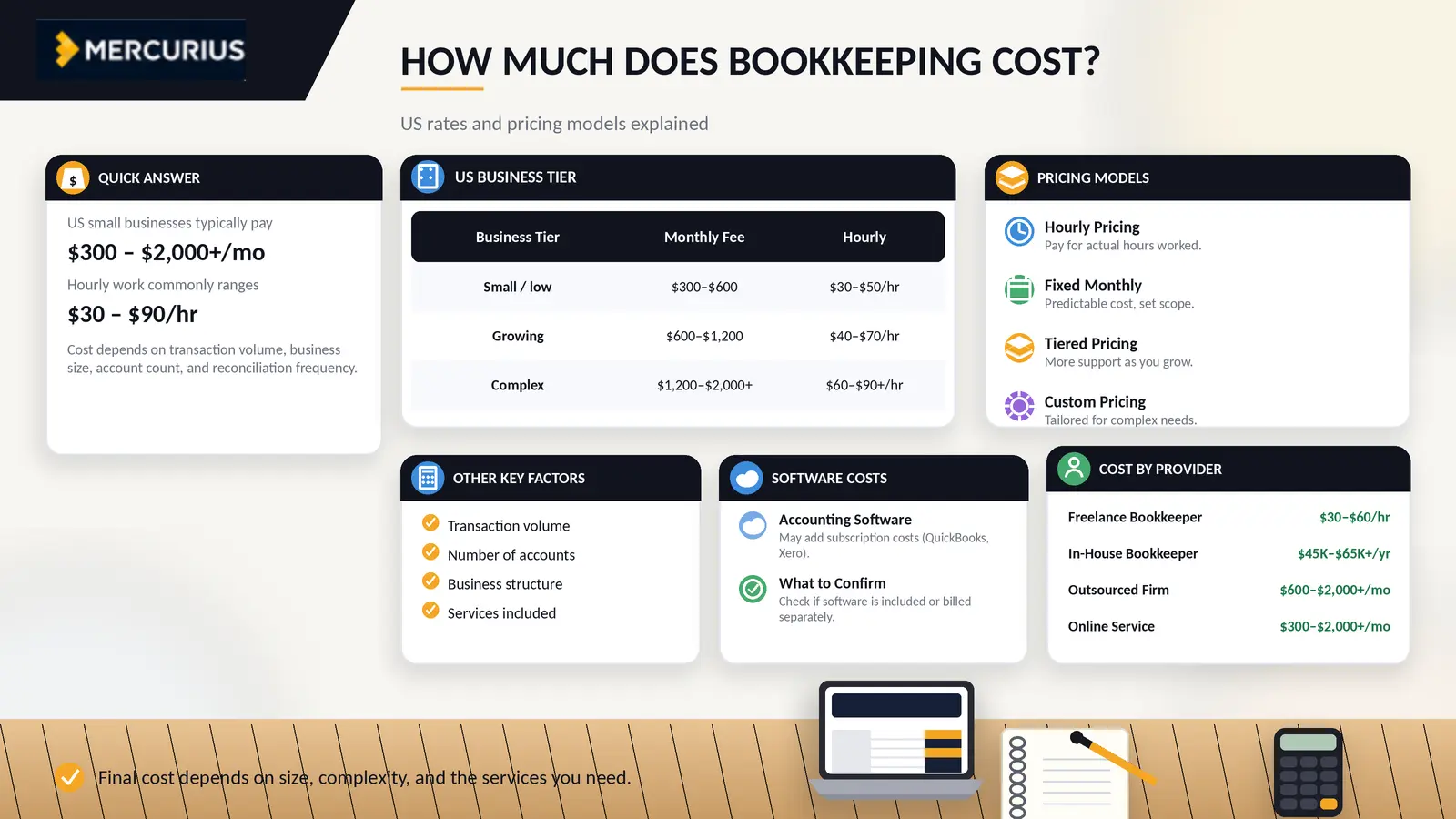
US small businesses typically pay $300–$2,000+ per month for bookkeeping services, while hourly work commonly ranges from $30–$90 per hour depending on complexity. The overall cost of bookkeeping services depends on transaction volume, business size, account count, and how frequently records need reconciliation.
| US business tier | Monthly flat fee | Hourly pricing |
|---|---|---|
| Small / low volume | $300–$600 | $30–$50/hr |
| Growing / moderate volume | $600–$1,200 | $40–$70/hr |
| Complex / high volume | $1,200–$2,000+ | $60–$90+/hr |
For US small businesses, higher transaction volumes generally require more bookkeeping time and increase costs. Weekly or daily reconciliation also costs more than monthly reconciliation.
The bookkeeping rates per hour can also vary by provider experience, location, software requirements, and additional services. Comparing the total monthly workload with the hourly bookkeeping rate gives a more realistic picture of value.
Bookkeeping Rates Per Hour
Average Hourly Rate
US small businesses typically pay freelance bookkeepers $30–$60 per hour, while professional firms or certified accountants often charge $60–$120+ per hour.
Freelancers can be economical for straightforward records, while professional firms may charge more for complex accounts, reporting, or specialised financial support.
When Hourly Pricing Works
Hourly pricing works best for US businesses with low transaction volumes, changing workloads, seasonal demands, or occasional cleanup needs.
It lets businesses pay for actual work performed rather than committing to a recurring monthly package. This can be useful for startups, seasonal companies, or businesses that occasionally need catch-up bookkeeping.
The trade-off is less predictable monthly spending, particularly when transaction volume suddenly increases or records require extensive cleanup.
Monthly Bookkeeping Costs
Basic vs. Full-Service Costs
Basic monthly bookkeeping in the US often costs $300–$600, while full-service packages can range from $600 to $2,000+ depending on scope.
Entry-level plans typically cover bank and credit-card reconciliations, transaction categorisation, and simple financial reports. They suit businesses with straightforward books and limited monthly activity.
Full-service bookkeeping covers a broader range of financial tasks, such as payroll, accounts payable, accounts receivable, and detailed management reporting. These packages cost more because they require greater expertise, time, and ongoing oversight.
Costs by Business Size
US bookkeeping costs generally increase as transaction volume, account complexity, and service requirements grow.
| Business size | Typical monthly cost | Common scope |
|---|---|---|
| Solopreneur | $200–$500 | Basic reconciliation and reports |
| Small Business | $500–$1,200 | Reconciliation, reporting, payroll |
| Higher-Volume Business | $1,200–$2,500+ | AP/AR, payroll, detailed reporting |
A business with multiple accounts, frequent transactions, or specialised reporting will usually sit toward the higher end of its tier.
Cost Estimator by Transaction Volume
Monthly Transaction Volume
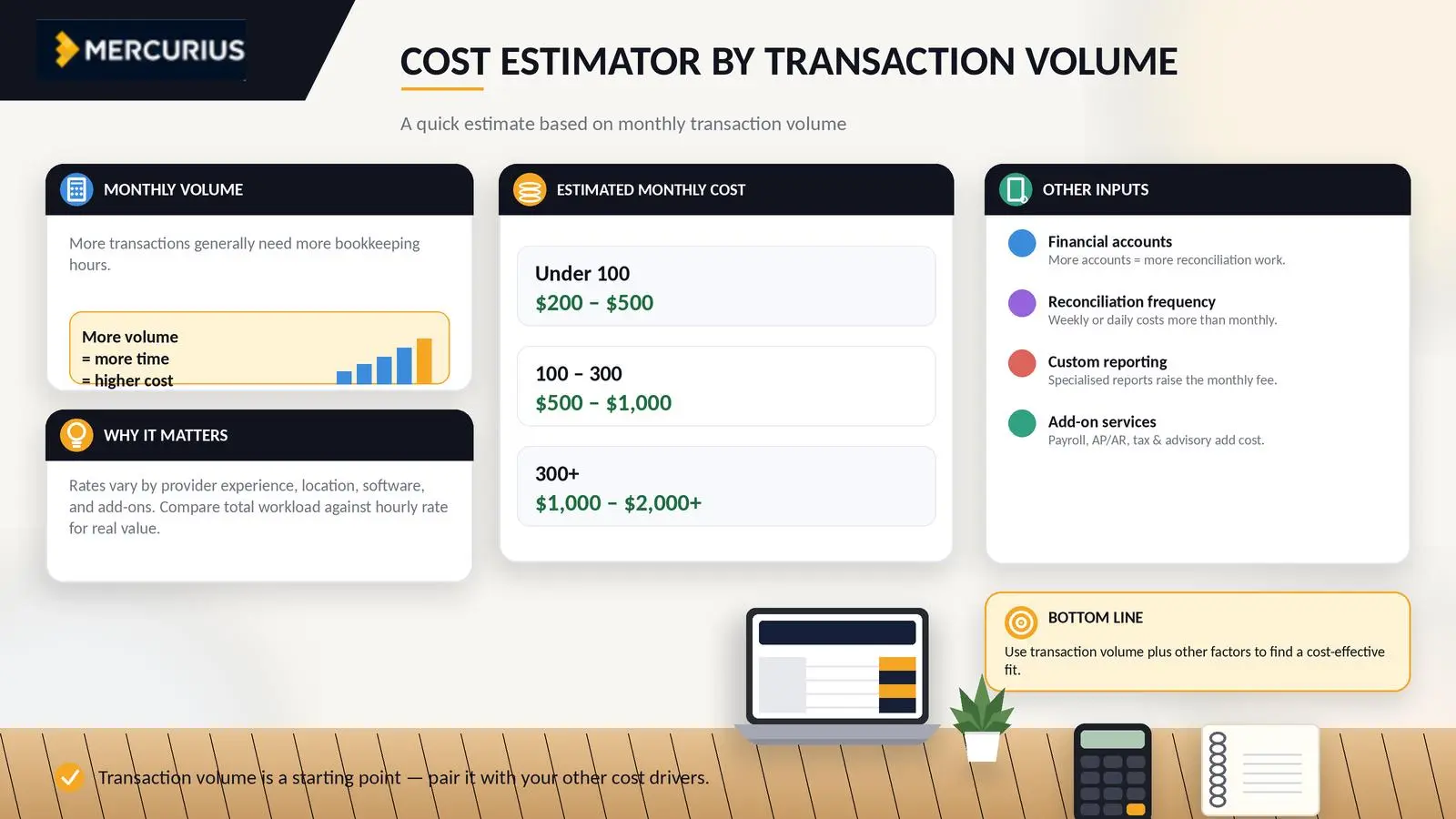
A practical Bookkeeping Cost Estimator starts with monthly transaction volume because more transactions generally require more bookkeeping hours.
| Monthly transactions | Estimated monthly cost |
|---|---|
| Under 100 | $200–$500 |
| 100–300 | $500–$1,000 |
| 300+ | $1,000–$2,000+ |
These US small-business estimates provide a starting point rather than a fixed quote, since transaction complexity can vary significantly.
Other Inputs to Consider
Transaction volume is only one part of estimating your bookkeeping costs.
- Financial accounts: More bank, credit-card, and payment accounts increase reconciliation work.
- Reconciliation frequency: Weekly or daily reconciliation generally costs more than monthly work.
- Custom reporting: Specialised financial reports can increase the monthly fee.
- Add-on services: Payroll, AP/AR, tax support, and advisory services can raise total costs.
Bookkeeping Pricing Models
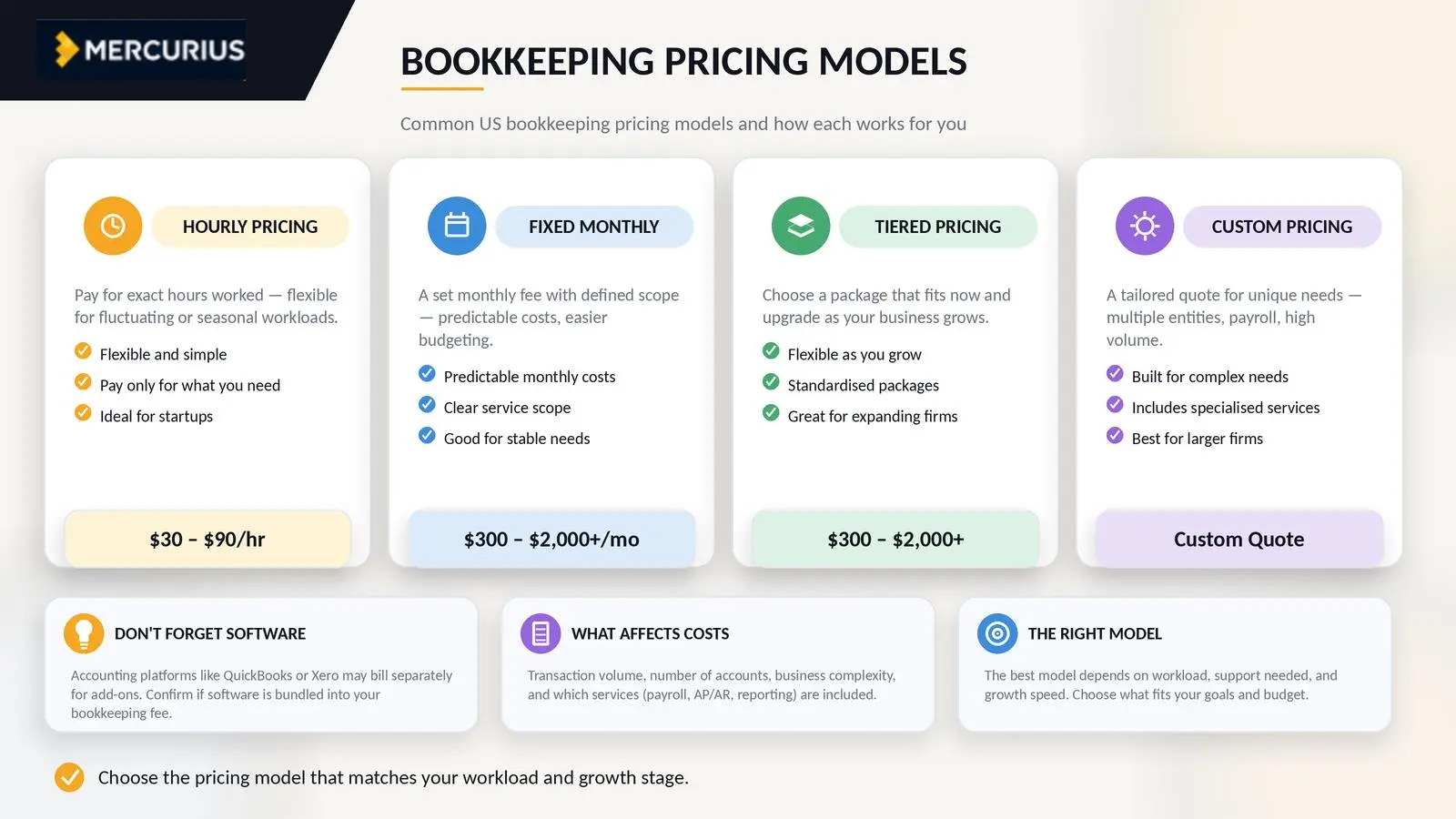
Hourly Pricing
- Hourly pricing fits businesses whose bookkeeping workload fluctuates throughout the year. You pay for the exact hours worked, making this model practical for seasonal businesses, startups, or companies needing occasional support.
Fixed Monthly Pricing
- Fixed monthly pricing suits businesses that want predictable overhead and a clearly defined service scope. A recurring fee makes budgeting easier while covering agreed bookkeeping tasks each month.
Tiered Pricing
- Tiered pricing works well for growing companies whose bookkeeping needs increase with transaction volume or service requirements. Standardised packages let businesses move to a higher service level as operations expand.
Custom Pricing
- Custom pricing is best for complex businesses with unique operational requirements. Providers create a tailored quote based on factors such as multiple entities, specialised reporting, payroll, or extensive transaction activity.
The right model depends on how predictable your workload is, how much support you need, and whether your business is growing rapidly.
Don’t Forget Software Costs
Accounting Software
- Accounting software can add to your total bookkeeping expenses through monthly subscriptions and specialised feature add-ons. Platforms such as QuickBooks and Xero may charge separately for features depending on your business requirements.
What to Confirm
- Always confirm whether software costs are included in your bookkeeping fee or paid separately by your business. Some providers bundle platform licences into their service, while others require you to purchase and manage subscriptions directly.
Ask about software costs before comparing quotes so you can evaluate the true monthly expense.
What Affects Bookkeeping Costs?
Transaction Volume
Higher monthly transaction counts increase bookkeeping costs because they require more manual entry, categorisation, checking, and review time. A business processing 500 transactions will typically need more support than one processing 50.
Number of Accounts
Multiple financial accounts increase complexity and reconciliation work. Bank accounts, credit cards, merchant processors, and payment platforms each create additional records to monitor and reconcile.
Business Structure and Industry
Complex legal structures and industry-specific requirements can significantly expand bookkeeping scope. Multiple entities, inventory tracking, or job costing may require specialised processes and reporting.
Services Included
Additional services increase total pricing because they require more ongoing work and expertise. Payroll support, AP/AR management, inventory tracking, and customised financial reporting can all raise the monthly bookkeeping fee.
The True Cost of DIY Bookkeeping
Time Investment
DIY bookkeeping costs more than software because business owners also spend valuable hours maintaining financial records. Those hours could otherwise support sales, operations, customer relationships, or growth.
Owner’s Hourly Value
An owner’s earning or billable rate reveals the opportunity cost of handling bookkeeping personally. If an owner can generate $100 per hour elsewhere, spending three hours on bookkeeping represents $300 in potential value.
A More Complete Cost View
The true cost of DIY bookkeeping combines software subscriptions with the management time lost to financial administration. A cheaper approach may therefore become more expensive when valuable owner time is included.
Cost by Provider Type
Freelance Bookkeeper
A freelance bookkeeper typically charges US businesses $30–$60 per hour or offers flexible monthly project agreements. This suits companies needing straightforward, variable support.
In-House Bookkeeper
An in-house bookkeeper can cost $45,000–$65,000+ annually before benefits and employment expenses. Health benefits, payroll taxes, equipment, recruiting, and onboarding increase the true cost.
Outsourced Bookkeeping Firm
An outsourced firm provides dedicated monthly or customised service tiers without adding full-time headcount. Team-based coverage can also provide broader expertise as bookkeeping needs grow.
Online Bookkeeping Service
Online bookkeeping combines software-driven automation with dedicated remote accountant support. This model can reduce manual data entry while maintaining professional oversight.
How Much Should a Small Business Budget?
Create a Monthly Budget
US small businesses can estimate bookkeeping expenses at roughly 1%–3% of monthly revenue or use a flat monthly retainer. Compare the resulting budget against the provider’s scope and expected workload.
Consider Business Growth
Bookkeeping budgets should increase as transaction volume, revenue streams, and reporting requirements become more complex. Review pricing whenever your business adds accounts, entities, or sales channels.
Build It Into the Operating Budget
Professional bookkeeping should be treated as a core operating expense rather than an optional administrative cost. Accurate financial records support compliance, cash-flow visibility, and better decisions.
How to Get an Accurate Quote
Information to Prepare
Providing complete business details helps US bookkeeping providers produce a more accurate quote.
- Entity type
- Monthly transaction counts
- Total connected bank and credit accounts
- Accounting software currently used
- Required bookkeeping scope
Confirm What Is Included
Always confirm exactly which services and costs are bundled into the quoted price. Ask whether tax preparation, monthly reconciliations, software fees, and financial reporting are included or billed separately.
Request a Custom Quote
A tailored quote can help you match bookkeeping costs to your actual financial workflow. Contact Maspartner to explore tailored Bookkeeping Services designed around your business’s specific requirements.
Frequently Asked Questions
How much does bookkeeping cost for a small business?
Small businesses typically pay $200–$2,000+ per month for bookkeeping, depending on workload, complexity, and services required.
What is the average bookkeeping rate per hour in the US?
The average US bookkeeping rates per hour are generally $30–$90 per hour, with specialised providers charging more.
What is the typical hourly bookkeeping rate?
A typical hourly bookkeeping rate is $30–$60 for freelancers and $60–$120+ for professional firms or accountants.
How much do monthly bookkeeping services cost?
Monthly bookkeeping services typically cost $300–$2,000+ per month for US small businesses, based on transaction volume and scope.
What factors affect the cost of bookkeeping services?
Costs commonly range from $200–$2,000+ monthly based on transactions, accounts, business structure, reconciliation frequency, and additional services.
Is bookkeeping usually charged hourly or monthly?
Bookkeeping is commonly charged $30–$90 per hour or $300–$2,000+ monthly, depending on whether hourly or fixed-fee pricing is used.
How much should a small business budget for bookkeeping?
A small business should generally budget $300–$1,200 per month for routine bookkeeping, increasing the budget as financial complexity grows.
What is included in a monthly bookkeeping package?
Monthly packages typically cost $300–$2,000+ and may include reconciliations, transaction categorisation, financial reports, and sometimes payroll or AP/AR.