Quick Answer: Filing an extension is not penalized. Failing to meet the October 15, 2026 deadline may lead to separate filing and payment penalties. A failure-to-file penalty of up to 5% of unpaid tax per month (maximum 25%) can apply, reduced by the 0.5% failure-to-pay penalty running since April 15. Interest, currently 7% a year, also accrues.
Missing the extended deadline makes the return late, and both failure-to-file and failure-to-pay penalties can apply. An extension gives more time to file, not more time to pay. The actual cost depends on the unpaid tax, how late the return is and the taxpayer’s circumstances.
Is There a Fee or Penalty for Requesting a Tax Extension?
No. Filing Form 4868 on time does not, by itself, incur a penalty. It gives taxpayers until October 15, 2026, to file their return, while any tax owed was still due by April 15, 2026.
Penalties come from two sources:
- Tax remains unpaid after April 15, 2026
- Return filed after the October 15, 2026 deadline
Form 4868 extends the filing deadline to October 15, but tax was still due on April 15. Under the Form 4868 rules, taxpayers can generally avoid the late-payment penalty if they paid at least 90% of their actual 2025 tax liability by April 15 and pay the remaining balance with a return filed by October 15. A return filed after October 15 loses this protection, so the late-payment penalty is charged from April 15 on any tax not paid by that date.
What Are the Consequences of Missing the October 15 Filing Deadline?
Once October 15 passes, an extended return becomes late as of October 16, and the failure-to-file penalty may begin accruing. The penalty is calculated on the tax that was unpaid on April 15, but the months counted for it start after the extended deadline.
Can I Request a Second Extension?
In most cases, taxpayers cannot request another filing extension for the same tax year.
What Happens When a Tax Extension Is Deemed Invalid?
Form 4868 requires a reasonable estimate of the tax owed. If the IRS finds the estimate was not reasonable, it can treat the extension as invalid, and the failure-to-file penalty is then calculated from April 15 instead of October 15.
What Is the Tax Extension Penalty? Failure to File vs. Failure to Pay
A missed extension deadline can bring two separate penalties plus interest. Both penalties are calculated on unpaid tax, while interest is charged on unpaid tax and on penalties.
| Failure to file | Failure to pay | Interest | |
|---|---|---|---|
| Trigger | Return submitted after the extended deadline | Tax not paid by April 15 | Unpaid tax and assessed penalties |
| Rate | 5% of unpaid tax for each month or partial month, reduced to 4.5% when both penalties apply | 0.5% per month or part month | 7% a year for the third and fourth quarters of 2026 (6% from April to June), compounded daily |
| Starts | October 16, 2026 | April 16, 2026 | April 15, 2026 |
| Maximum | 25% of unpaid tax | 25% of unpaid tax | No cap; the rate is set each quarter |
| Relief | AEP, First Time Abate or reasonable cause | AEP, First Time Abate or reasonable cause | Not removed by penalty relief, except interest on an abated penalty |
- Failure to file: 5% of unpaid tax for each month or part month, up to 25%.
- Failure to pay: 0.5% per month, up to 25%. The rate rises to 1% a month from the first month that begins more than 10 days after the IRS issues a notice of intent to levy.
- Combined: When both apply in the same month, the failure-to-file penalty is reduced by the failure-to-pay amount, so the charge is 5% a month, not 5.5%.
What Is the 60-Day Minimum Penalty?
A return filed more than 60 days after October 15, meaning after December 14, 2026, faces a minimum failure-to-file penalty. For returns due in 2026, it is $525 or 100% of the unpaid tax, whichever is less.
This affects small balances most. On $800 of unpaid tax filed December 20, the percentage penalty would be about $108, but the minimum is $525.
How Is Interest Charged on Unpaid Tax?
Interest runs from April 15, 2026 until the balance is paid, compounds daily, and can also accrue on assessed penalties. The individual underpayment rate is 7% for the fourth quarter of 2026. It was 6% from April to June and 7% from July to September, and the IRS sets it each quarter.
What Does a Late Return Actually Cost?
The table below assumes an individual owes $5,000, made no payments, filed a valid extension and receives no relief.
| Filing date | Months late | Failure to file | Failure to pay | Total penalties |
|---|---|---|---|---|
| October 15, 2026 | 0 | $0 | $150 | $150 |
| November 20, 2026 | 2 | $450 | $200 | $650 |
| December 20, 2026 | 3 | $675 | $225 | $900 |
| January 20, 2027 | 4 | $900 | $250 | $1,150 |
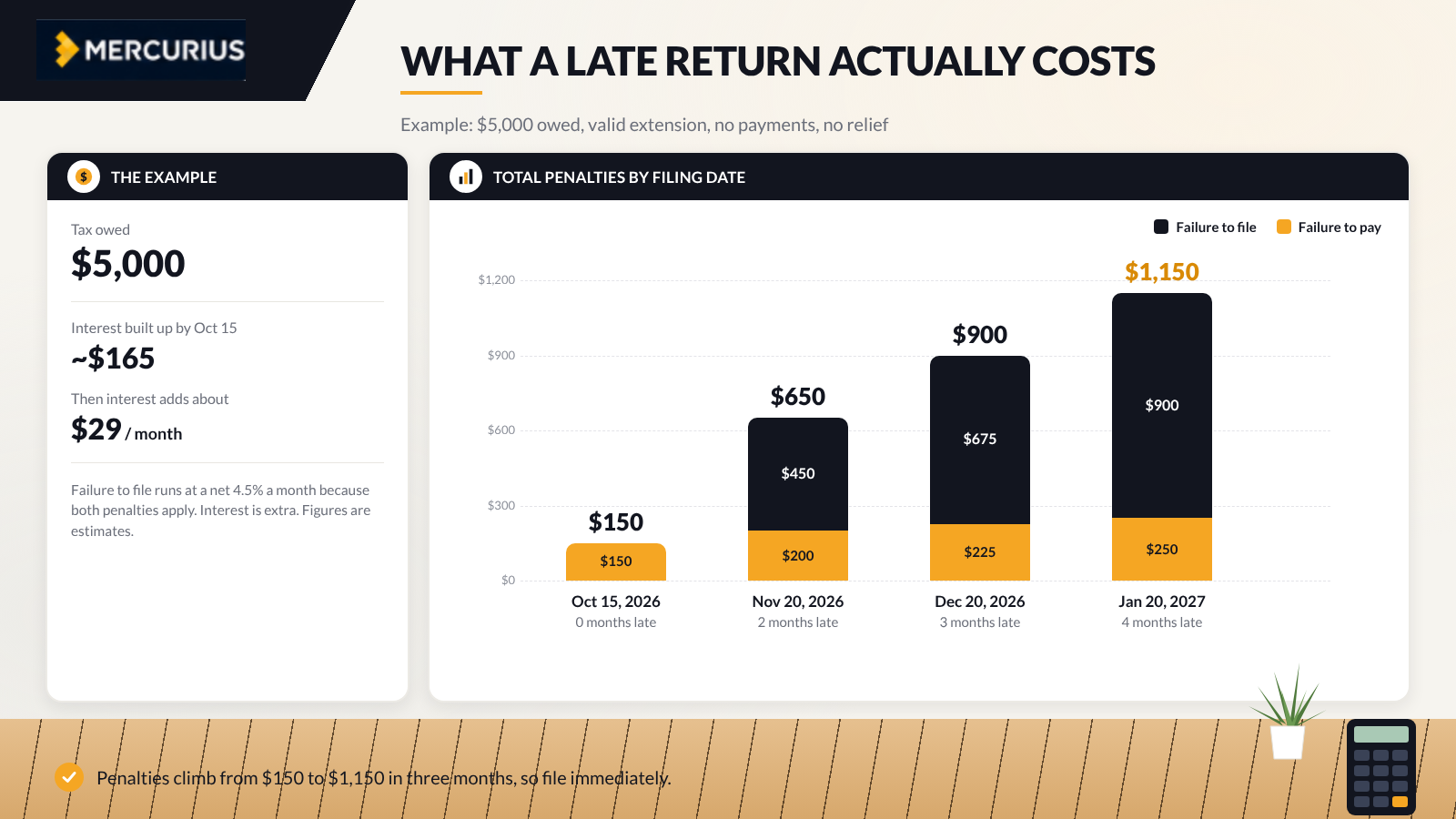
Because both penalties apply in the same months, the failure-to-file penalty is charged at a net 4.5% a month. The December and January amounts are already above the $525 minimum, so the minimum does not change them. Interest is additional: about $165 had built up by October 15, and it continues at roughly $29 a month on $5,000 at 7%. Figures are estimates.
Will a Late Filing Penalty Apply If I Am Due a Refund?
Generally, no. Both penalties are calculated on unpaid tax, so a return that shows a refund typically owes neither.
To receive a refund, the return generally must be filed within three years of its original due date. For 2025 returns, that means by April 15, 2029, and a valid extension can add up to six months to this window.
Can the IRS Waive a Penalty for Late Filing?
Yes, in qualifying cases, through automatic penalty relief (AEP or First Time Abate) or a reasonable cause request.
What Is Automatic Exemption from Penalty (AEP)?
AEP is the IRS’s automatic penalty relief, announced in July 2026. It applies without a request to eligible original returns beginning with tax year 2025. The main condition is a history of filing on time and paying any tax due in the three prior years. When AEP applies, the IRS does not charge the penalty and sends a notice confirming the relief.
AEP covers failure-to-file and failure-to-pay penalties, and failure-to-deposit penalties for businesses. It does not cover estimated tax penalties. See the guide on missing a Q3 estimated tax payment.
AEP is being phased in and fully replaces First Time Abate for returns originally due on or after January 1, 2027. Until then, some eligible taxpayers may still receive penalty notices for 2025 returns and can contact the IRS to request First Time Abate. The AEP penalty relief guide explains the change in full.
What Counts as Reasonable Cause?
The IRS may accept circumstances such as serious illness, a death in the immediate family, a disaster or the inability to obtain records. Relying on a tax preparer to file on time generally does not qualify. Lack of funds alone is not enough, although an inability to pay despite reasonable care may support relief from the late-payment penalty.
Taxpayers in federally declared disaster areas may have postponed deadlines, so confirm that status first.
How Do I Request Relief?
Relief is usually requested after the IRS has charged the penalty and sent a notice. Calling the number on the notice is often the quickest route, including for First Time Abate requests. A letter explaining the reasonable cause, or Form 843, can also be used to request relief from failure-to-file and failure-to-pay penalties. A waiver of the estimated tax penalty is generally requested on Form 2210, filed with the return.
What Should I Do After Missing the October 15 Deadline?
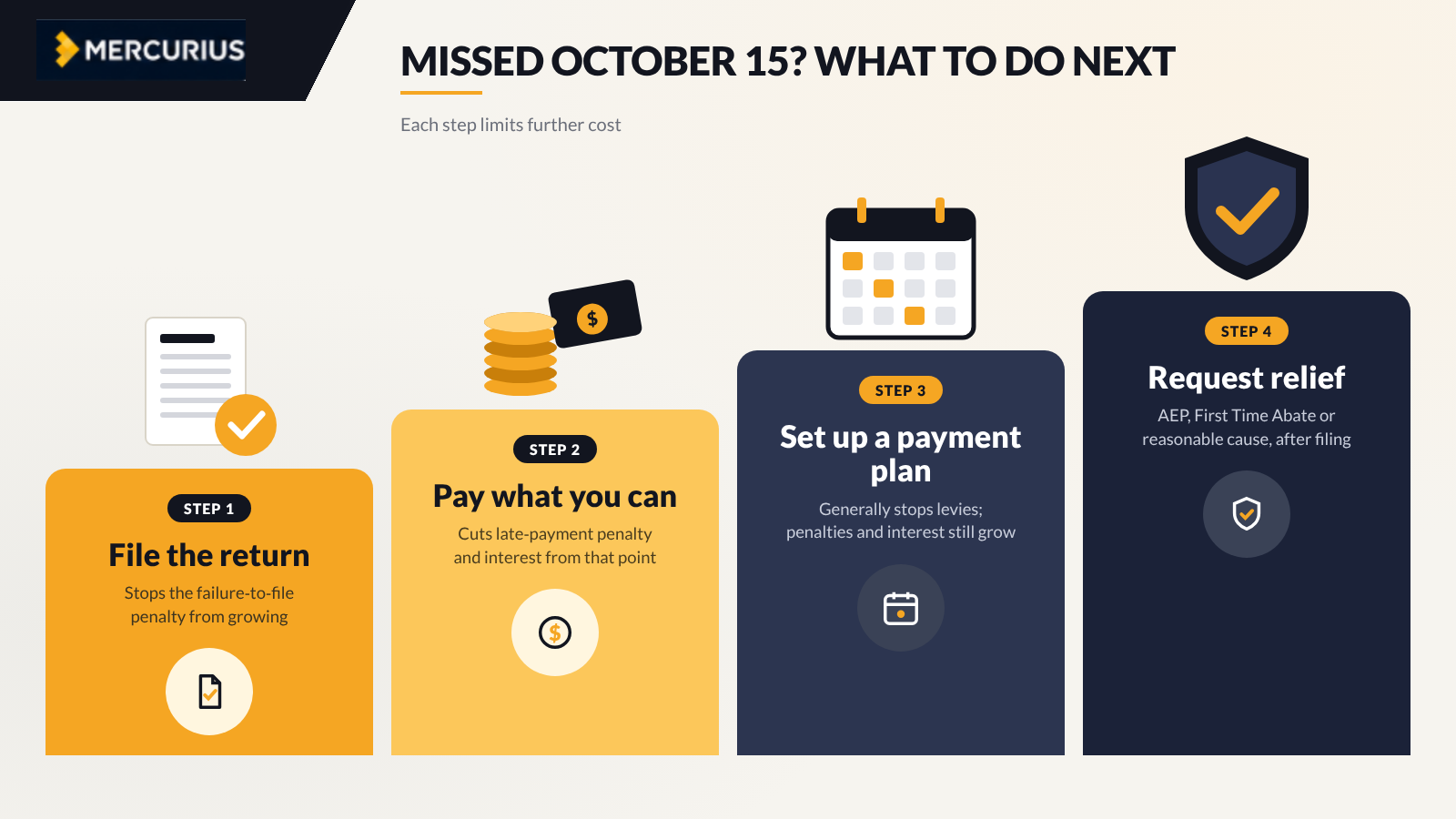
File the return immediately. Each step below limits further cost.
- File the return: Submitting the return stops the failure-to-file penalty from continuing to increase. Tax professionals can assist with preparing and submitting a late return.
- Pay what you can: Paying part of the balance now reduces the late-payment penalty and interest from that point. It does not reduce the failure-to-file penalty, which is based on the tax unpaid on April 15.
- Set up a payment arrangement: A plan generally stops the IRS from seizing wages or bank accounts (a levy) while it is in place, but penalties and interest keep growing, refunds can be applied to the balance and a tax lien may still be filed. The reduced 0.25% monthly late-payment rate applies only to returns filed on time, including extensions, so it does not apply after a missed October 15.
- Request relief if you qualify: A penalty abatement request is generally made after the tax return has been filed.
If an IRS notice has arrived, review it for the penalty charged and the date by which you must respond.
What Options Are Available If You Cannot Pay Your Taxes?
File anyway, then arrange payment. IRS options depend on the balance.
- Short-term payment plan: For balances that can be paid within 180 days.
- Installment agreement: Monthly payments for larger balances, with IRS balance limits and setup requirements.
- Other options: Currently not collectible status and an offer in compromise are last resorts with strict eligibility.
For help with IRS balances and notices, see Maspartner’s taxation services.
Do Business and State Returns Carry Separate Penalties?
Yes. Federal penalty provisions vary by taxpayer type, and state tax authorities apply separate penalty rules.
- Partnerships and S corporations: Extended calendar-year Form 1065 and Form 1120-S returns were due September 15, 2026. The late-filing penalty is $255 per partner or shareholder per month, up to 12 months, for returns due in 2026, and it applies even when no tax is owed.
- C corporations: An extended calendar-year Form 1120 shares the October 15 date.
- State returns: State late-filing and late-payment penalties are separate from federal ones, and some states have later extended dates. Check the state first.
See Tax Extension Deadline 2026 for state dates and Business Tax Extension Deadlines for entity-level deadlines.
Conclusion
Filing immediately is the most effective step after a missed deadline. What is often called the tax extension penalty is really the failure-to-file and failure-to-pay penalties plus interest. Relief may reduce or remove the penalties, but not the tax, and interest is removed only on penalties that are removed.
If you are unsure where to start, Maspartner assists US businesses and individuals with late returns and IRS balances. Book a free consultation today to review your filing position and the options available. This article is general information, not personalized tax advice.
FAQs
What Penalties Apply After the October 15 Tax Extension Deadline?
There is no single amount. A failure-to-file penalty, a failure-to-pay penalty and interest can apply, based on unpaid tax and how late the return is.
How much is the failure-to-file penalty?
Unpaid tax can incur a monthly penalty of 5%, including partial months, up to a maximum of 25%. It is reduced by the failure-to-pay penalty when both apply.
What Happens When You File After the Tax Extension Deadline?
The IRS still accepts late returns, and filing promptly stops the failure-to-file penalty from growing. Unpaid tax continues to accrue interest and applicable payment penalties until it is settled.
Does a Refund Eliminate the Risk of a Late-Filing Penalty?
Generally, yes. Both penalties depend on unpaid tax, so taxpayers due a refund usually do not face a failure-to-file penalty. The refund must still be claimed within the three-year time limit.
Can the IRS waive a late filing penalty?
Yes, in some cases. Some qualifying cases may receive automatic penalty relief, and taxpayers may also request relief based on reasonable cause. Interest on unpaid tax generally remains, and relief is usually requested after the IRS sends a penalty notice.
What Options Do You Have If You Cannot Pay Your Tax Balance?
File the return first, then pay what you can. A short-term plan or installment agreement spreads the remaining balance and generally stops levies while it is in place, although interest and penalties continue.
Do state late filing penalties apply as well?
Yes. State penalties are separate from federal ones, and state deadlines and rates differ. Check the state tax agency’s rules for the filing and payment dates.