Bookkeeping vs accounting comes down to recording versus understanding: bookkeeping tracks your day-to-day financial transactions, while accounting interprets that data to help you make informed business decisions.
Think of them as two parts of the same team. Bookkeeping shows what happened financially; accounting explains what it means for your taxes, compliance, cash flow, and future growth.
Bookkeeping vs Accounting: The Key Difference
The Difference in One View
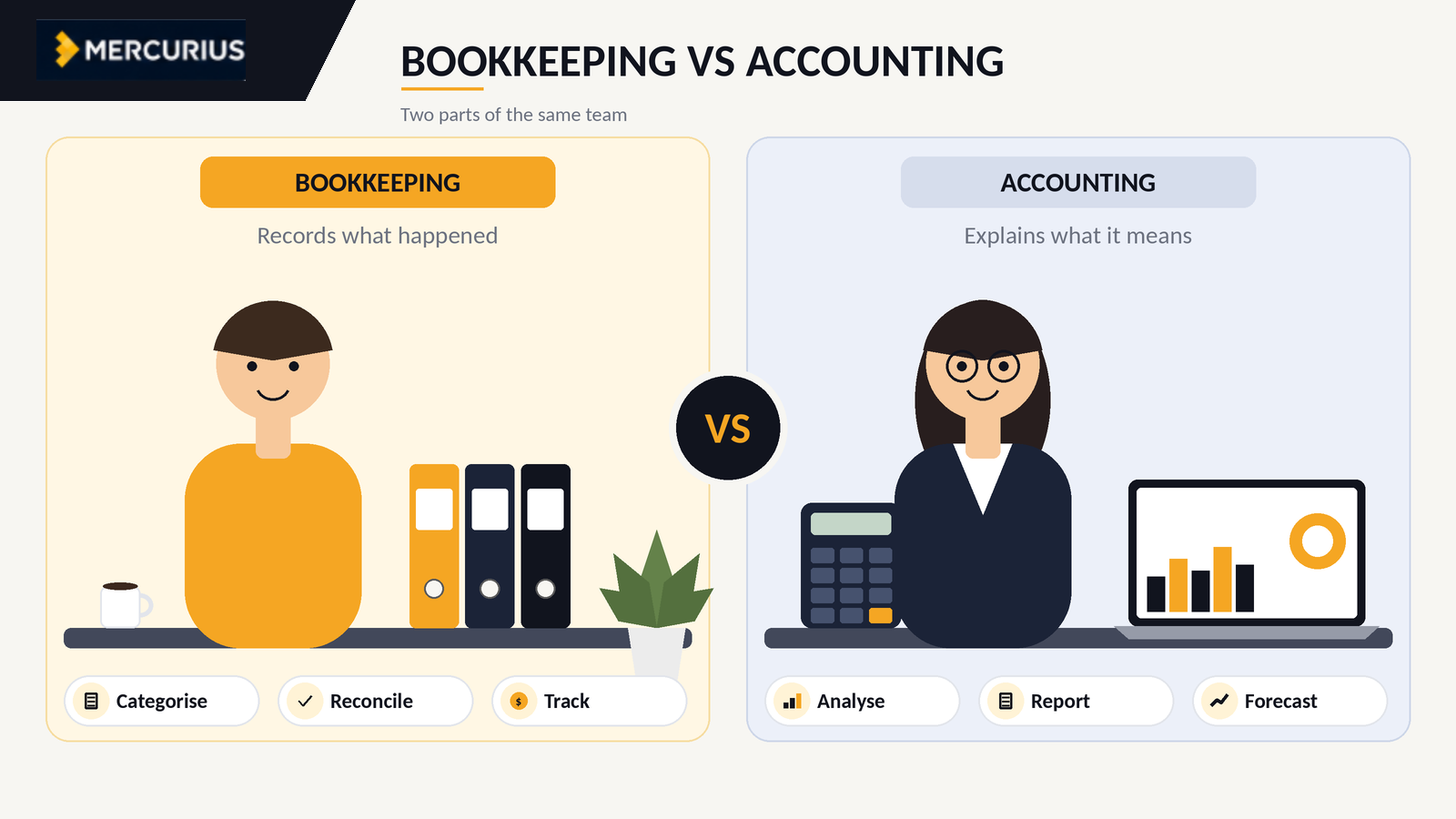
Bookkeeping records your business’s financial activity, while accounting interprets that information to explain what it means for your business. Bookkeeping captures what happened; accounting turns those records into insights for decisions, planning, and compliance.
Bookkeeping vs Accounting
| Bookkeeping | Accounting | |
|---|---|---|
| Main purpose | Record financial transactions | Interpret financial information |
| Key work | Categorising, reconciling, tracking | Analysing, reporting, forecasting |
| Typical output | Updated ledgers and reconciliations | Financial statements, analysis, tax insights |
| Business use | Keeps records accurate and organised | Supports strategy, cash flow, and compliance |
In simple terms, accounting vs bookkeeping is less about choosing one and more about understanding how they connect. Bookkeeping creates the reliable financial foundation; accounting uses it to guide business decisions, tax planning, and IRS compliance.
Bookkeeper vs Accountant
What does a bookkeeper do?
A bookkeeper keeps your financial records accurate, current, and organised. Their work focuses mainly on recording and maintaining the transactions that flow through your business.
Common responsibilities include:
- Recording daily financial transactions
- Categorising income and expenses
- Reconciling bank and credit card accounts
- Tracking accounts payable, including bills
- Managing accounts receivable, including invoices
- Maintaining organised financial records
For a deeper look at these tasks, see our What Is Bookkeeping? guide.
What Does an Accountant Do?
An accountant turns organised financial data into information you can use to run the business. They look beyond individual transactions to identify trends, risks, opportunities, and compliance requirements.
Their work may include:
- Preparing GAAP-based financial statements
- Analysing operational costs and profitability
- Supporting multi-state tax requirements
- Building business forecasts
- Reviewing financial reports and performance
- Supporting tax planning and compliance decisions
How their roles complement each other?
The bookkeeper vs accountant relationship works best as a team: one builds the reliable data foundation, while the other evaluates and applies it. The accountant can use clean books to assess financial performance, verify compliance, understand cash flow, and develop better tax and growth strategies.
So, when comparing accountant vs bookkeeper, the difference is primarily in focus: bookkeepers maintain the financial records, while accountants help explain and use those records to make smarter business decisions.
Salary, Education & Credentials Comparison
Education and Training
Bookkeepers generally have a lower formal education barrier, while accountants typically need a bachelor’s degree. Bookkeepers often enter the field with a high school diploma plus on-the-job training.
Accountants commonly hold a bachelor’s degree in accounting, finance, or a related field and may pursue additional professional training.
Certifications and Credentials
Accountants generally face higher certification requirements, especially when providing regulated services. Common credentials include:
- Certified Public Accountant (CPA): A state-licensed accounting credential with specific education, examination, and experience requirements.
- Enrolled Agent (EA): An IRS credential that allows qualified professionals to represent taxpayers before the IRS.
- Bookkeeping certifications: Optional credentials can demonstrate competency in areas such as ledgers, reconciliations, and accounting software.
There is no universal “CPA-equivalent” licence required to work as a bookkeeper.
Salary Comparison
Accountants generally earn more than bookkeepers because their roles typically require greater education, analysis, and professional credentials. The U.S. Bureau of Labor Statistics (BLS) reported median annual pay of $49,210 for bookkeeping, accounting, and auditing clerks and $81,250 for accountants and auditors in May 2024.
| Role | Average US Annual Salary |
|---|---|
| Bookkeeper | $49,210 |
| Accountant / CPA | $81,250 |
Note: BLS figures are median wages, not specifically “average” salaries, and CPA compensation can vary significantly by experience, location, and employer.
CPA vs Accountant vs Bookkeeper
Bookkeeper
A bookkeeper focuses on keeping your financial records accurate, organised, and up to date. Their work includes daily data entry, recording transactions, reconciling accounts, and maintaining balanced ledgers.
Accountant
An accountant turns financial records into useful information for running and planning your business. In the accountant vs bookkeeper comparison, accountants work beyond transaction recording.
They may handle financial reporting, operational cost analysis, corporate tax preparation, forecasting, and broader business consulting.
CPA
A Certified Public Accountant (CPA) is an accountant who has met rigorous, state-specific licensing requirements. A CPA may be especially valuable for:
- Corporate IRS audits
- Formal attest and assurance services
- Complex multi-state tax planning
- Financial matters requiring licensed CPA services
Not every business needs a CPA for routine bookkeeping or everyday accounting tasks.
How Bookkeeping and Accounting Work Together
From Transactions to Analysis
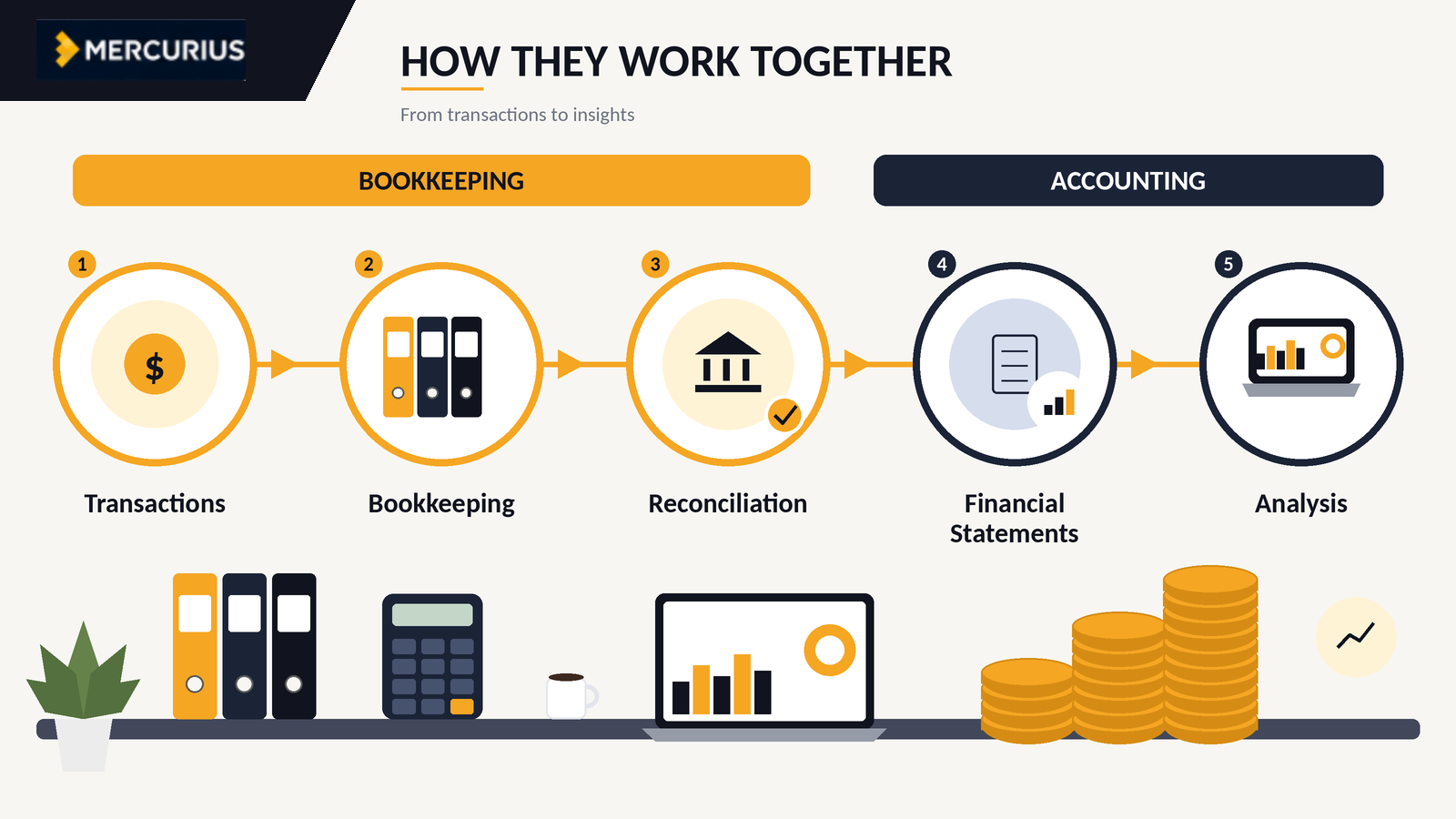
Financial data moves through a shared process that starts with transactions and ends with business insights.
Transactions → Bookkeeping → Reconciliation → Financial Statements → Accounting Analysis
Bookkeeping captures and organises the activity, while accounting uses the resulting reports to identify trends, risks, and opportunities.
Building Better Financial Visibility
Accurate, well-organised ledgers are the foundation of reliable financial reporting. Clean records give accountants dependable information without forcing them to spend time fixing basic data-entry errors.
A well-structured General Ledger Accounting & Chart of Accounts tie transactions to financial statements and keep reporting clear.
Supporting Business Decisions
Bookkeeping and accounting work together to turn daily financial tracking into better business decisions. Reliable records support cash-flow budgeting, forecasting, profitability analysis, and more accurate tax planning.
What Each Service Costs
Bookkeeping Costs
Bookkeeping is commonly priced by the hour or through a fixed monthly fee for software or professional services. The right structure depends on transaction volume and how much work is handled internally.
See How Much Does Bookkeeping Cost? for a detailed breakdown of typical US pricing models and rates.
Accounting Costs
Accounting costs depend largely on business complexity and the level of compliance support required. CPA fees can range from straightforward tax preparation to more involved GAAP reporting, audit support, or multi-state tax work.
Choosing Based on Services Needs
Choose financial services based on your business needs, not price alone. An early-stage business may only need automated cash-basis bookkeeping, while a growing company seeking funding may need a CPA-led accounting and reporting function.
Which Does Your Business Need?
When Bookkeeping is the Priority
Daily bookkeeping is the baseline need for early-stage businesses that need clean, organised financial records. Startups typically use it to track income and expenses, monitor cash activity, and maintain records for tax compliance.
When does Accounting add value
Accounting becomes essential when business decisions depend on deeper financial analysis and compliance. Growing companies may need support with:
- Fundraising and financial due diligence
- Multi-state corporate tax preparation
- Budgeting and operational financial planning
- Cash-flow and profitability analysis
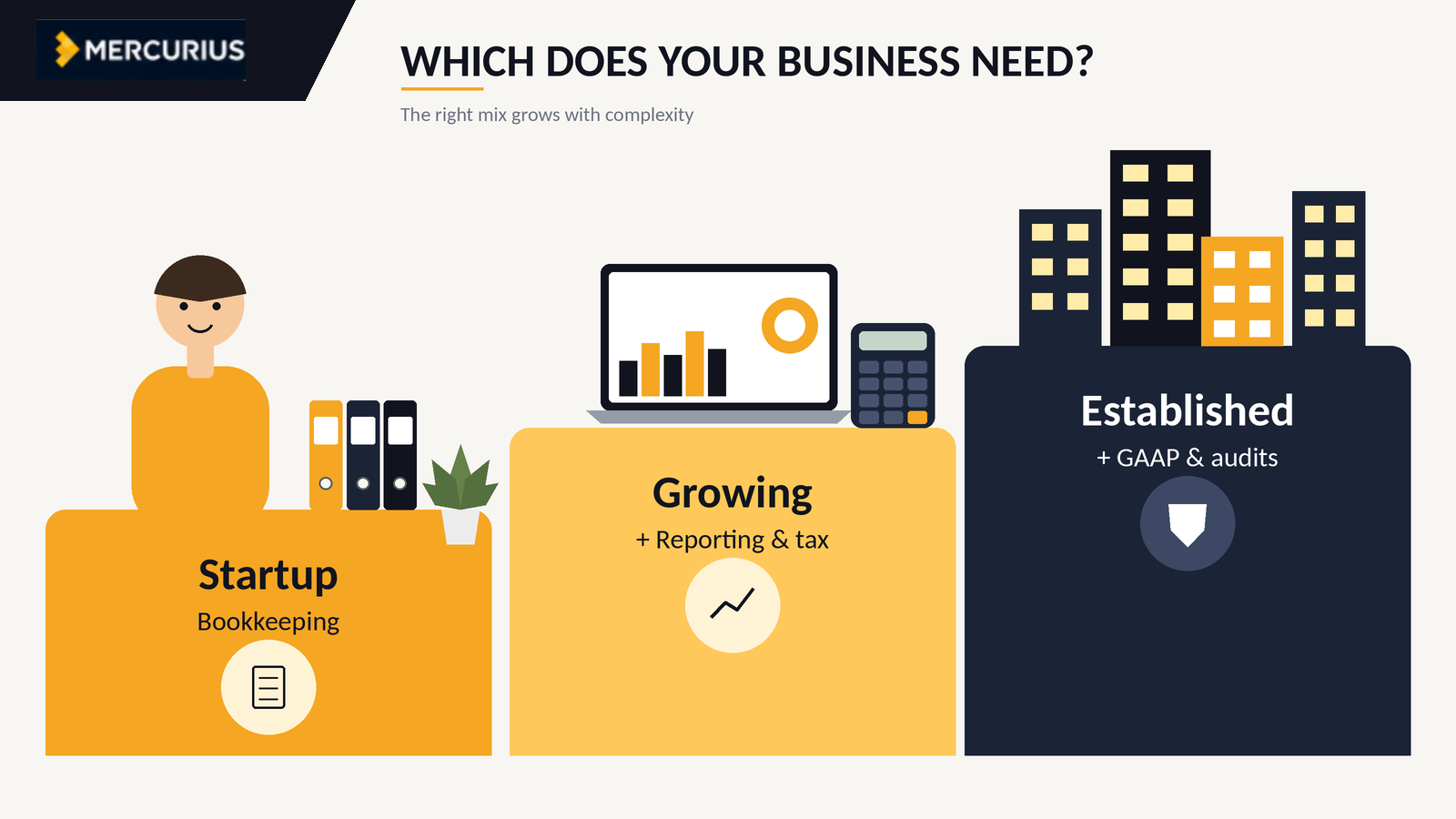
Why Growing Business Use Both
As a business scales, combining bookkeeping and accounting creates a stronger financial strategy.
- Startups: Need accurate transaction records.
- Growing firms: Require reporting and tax planning.
- Established firms: May require comprehensive GAAP financial reporting and audits.
The right mix changes as financial complexity increases.
Software for Each
Bookkeeping Software
Bookkeeping software focuses on automating routine financial tracking and record maintenance. Common features include automated bank feeds, receipt capture, invoice creation, and quick transaction reconciliation.
Accounting Software
Advanced accounting platforms extend beyond transaction entry into automated reporting, analytics, and financial management. They can support cash-to-accrual conversions, balance-sheet generation, and depreciation schedules.
Popular Platforms
Modern businesses can choose from platforms designed for different levels of financial complexity.
- QuickBooks Online — small-business accounting and bookkeeping
- Xero — cloud-based financial management
- Sage — accounting and business management
- NetSuite — ERP capabilities for complex, growing organisations
Conclusion + CTA
Bookkeeping and accounting are different but connected pillars of strong financial management. Bookkeepers keep transactions accurate and organised, while accountants turn that data into analysis for compliance, profitability, and growth.
Together, they give your business a clearer financial foundation and better decisions. For integrated bookkeeping and accounting support tailored to your needs, contact MAS Partner and explore a package built for your business.
FAQs
What is the difference between bookkeeping and accounting?
The difference is recording versus interpreting. Bookkeeping tracks daily ledger entries, while accounting analyses those results for compliance, planning, and strategy.
What is the difference between a bookkeeper and an accountant?
Bookkeepers focus on transaction categorisation and record maintenance, while accountants handle financial reporting, analysis, and more complex tax work.
Is bookkeeping part of accounting?
Yes, bookkeeping forms the administrative foundation of the accounting cycle. Accountants rely on accurate records to produce meaningful reports and strategic insights.
Can a bookkeeper do accounting ?
A bookkeeper can handle many routine accounting tasks, but complex GAAP requirements may require an accountant or CPA. The scope depends on the business and reporting requirements.
Do small businesses need both a bookkeeper and an accountant?
Growing businesses often benefit from both functions because clean records and strategic financial analysis serve different needs.
What does a bookkeeper do for a small business?
A bookkeeper manages financial recordkeeping tasks such as data entry, invoicing, expense tracking, and bank reconciliations.
What does an accountant do for a small business?
An accountant analyses financial information and supports tax planning, reporting, forecasting, compliance, and business decisions.
Is a CPA the same as an accountant?
No, a CPA is an accountant who has met specific state licensing requirements and passed the CPA examination. Licensing requirements vary by state.