Does a sole proprietor need an EIN? Not always. A sole proprietor or single-member LLC with no employees, no excise tax filings and (for a sole proprietor) no qualified retirement plan can generally use the owner’s Social Security Number (SSN) or Individual Taxpayer Identification Number (ITIN). LLCs taxed as partnerships or corporations are required to obtain an Employer Identification Number (EIN).
The IRS issues an Employer Identification Number (EIN), a unique nine-digit federal identifier used by businesses for tax returns and reporting purposes. Having one and being required to have one are different things, and the answer turns on structure, employees and tax classification. Details reflect IRS guidance as of November 2026.
Does a Sole Proprietor Need an EIN?
Quick Answer
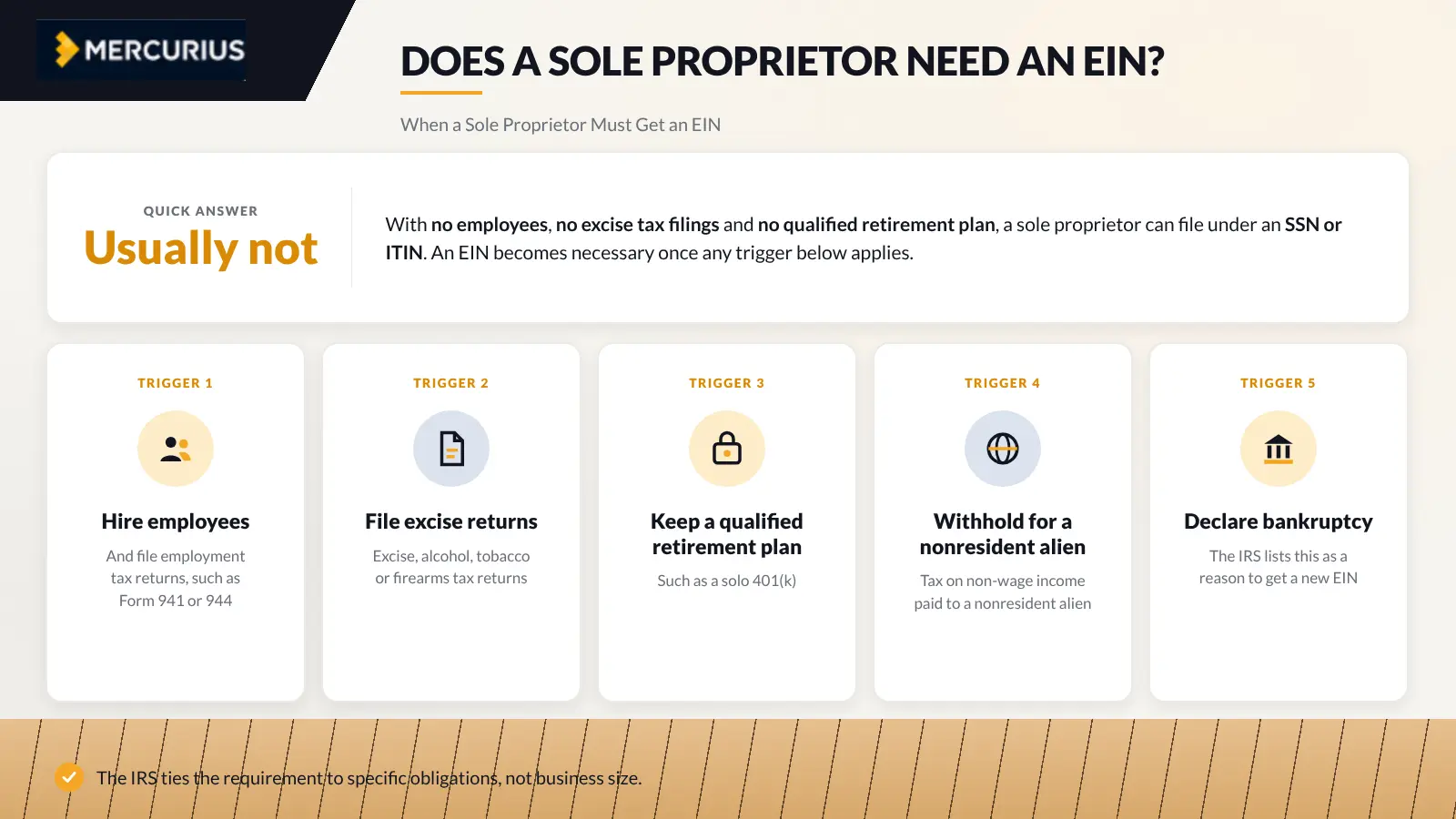
Usually not. A sole proprietor with no employees, no excise tax filings and no qualified retirement plan can file under an SSN or ITIN. An EIN becomes necessary once any of those applies, and in a few other cases listed below.
When a Sole Proprietor Must Get an EIN
The IRS ties the requirement to specific obligations, not business size. According to IRS EIN guidelines and Form SS-4 instructions, a sole proprietor is required to obtain an EIN if they:
- Hire employees and file employment tax returns (such as Form 941 or 944)
- File excise, alcohol, tobacco or firearms tax returns
- Maintain a qualified retirement plan, such as a solo 401(k)
- Withhold tax on non-wage income paid to a nonresident alien
- Declare bankruptcy (the IRS lists this as a reason for a sole proprietor to get a new EIN)
Does an LLC Need an EIN?
Quick Answer
The requirement is determined by the LLC’s membership structure and federal tax status, rather than its state registration. A partnership or
corporation-taxed LLC needs an EIN; a disregarded single-member LLC does not always need one.
How the IRS Classifies LLCs
A domestic LLC with one member is a disregarded entity by default, so its activity appears on the owner’s return. An LLC with multiple members is generally classified as a partnership for federal tax purposes by default. Either can file Form 8832 to elect corporate treatment.
Forming an LLC with the state and applying for an EIN are separate steps. An EIN application is not a tax classification election; an LLC changes its default classification by filing Form 8832 (or Form 2553 for S corporation status).
Single-Member LLC EIN Rules
When the Owner’s SSN or ITIN Works
Can an LLC operate without an EIN if it has no employees? Yes, but only if it is a disregarded single-member LLC with no excise tax liability. It uses the owner’s name and taxpayer identification number, and income goes on the owner’s return.
On Form W-9, it gives the owner’s SSN or EIN, not the LLC’s EIN.
EIN Requirements for Single-Member LLCs
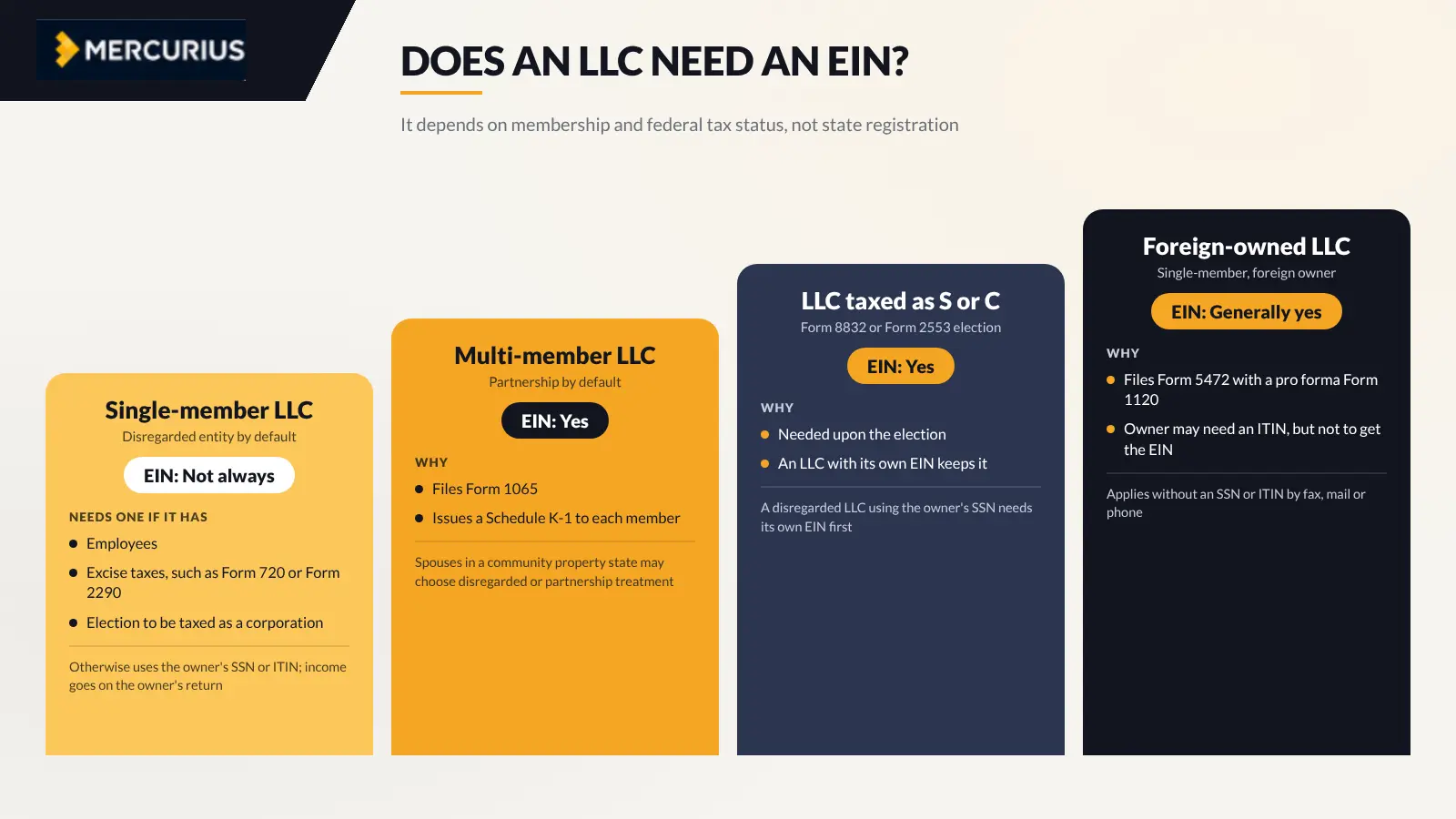
It needs one if it has employees, must file excise tax returns such as Form 720 or Form 2290, or elects to be taxed as a corporation. For employment tax and certain excise taxes, the IRS treats a single-member LLC as a separate entity even though it is disregarded for income tax purposes. The IRS notes that most new single-member LLCs classified as disregarded entities will need an EIN, and a bank may ask for one too.
State Requirements
Some states require a federal EIN for state tax or registration even when the IRS does not, and the IRS lets the LLC apply in that case.
Multi-Member LLC EIN Rules
An EIN Is Required
Yes. A domestic LLC with two or more members is a partnership by default, and the IRS lists partnerships among entities that need an EIN. It files Form 1065 and issues a Schedule K-1 to each member.
Spouses who wholly own an LLC as community property under state law may treat it as either a disregarded entity or a partnership under Rev. Proc. 2002-69. An LLC owned by spouses in a non-community property state is generally treated as a partnership.
LLCs Taxed as S Corporations or C Corporations
Corporate Elections Need an EIN
Yes. An LLC electing corporate treatment through Form 8832, or S corporation status through Form 2553, needs an EIN. An LLC that files Form 2553 does not also need Form 8832.
An LLC that already has its own EIN keeps it; the IRS says no new EIN is needed for the election. A disregarded single-member LLC that has been using its owner’s SSN or sole proprietor EIN needs its own EIN before it can make the election.
EIN Requirements at a Glance
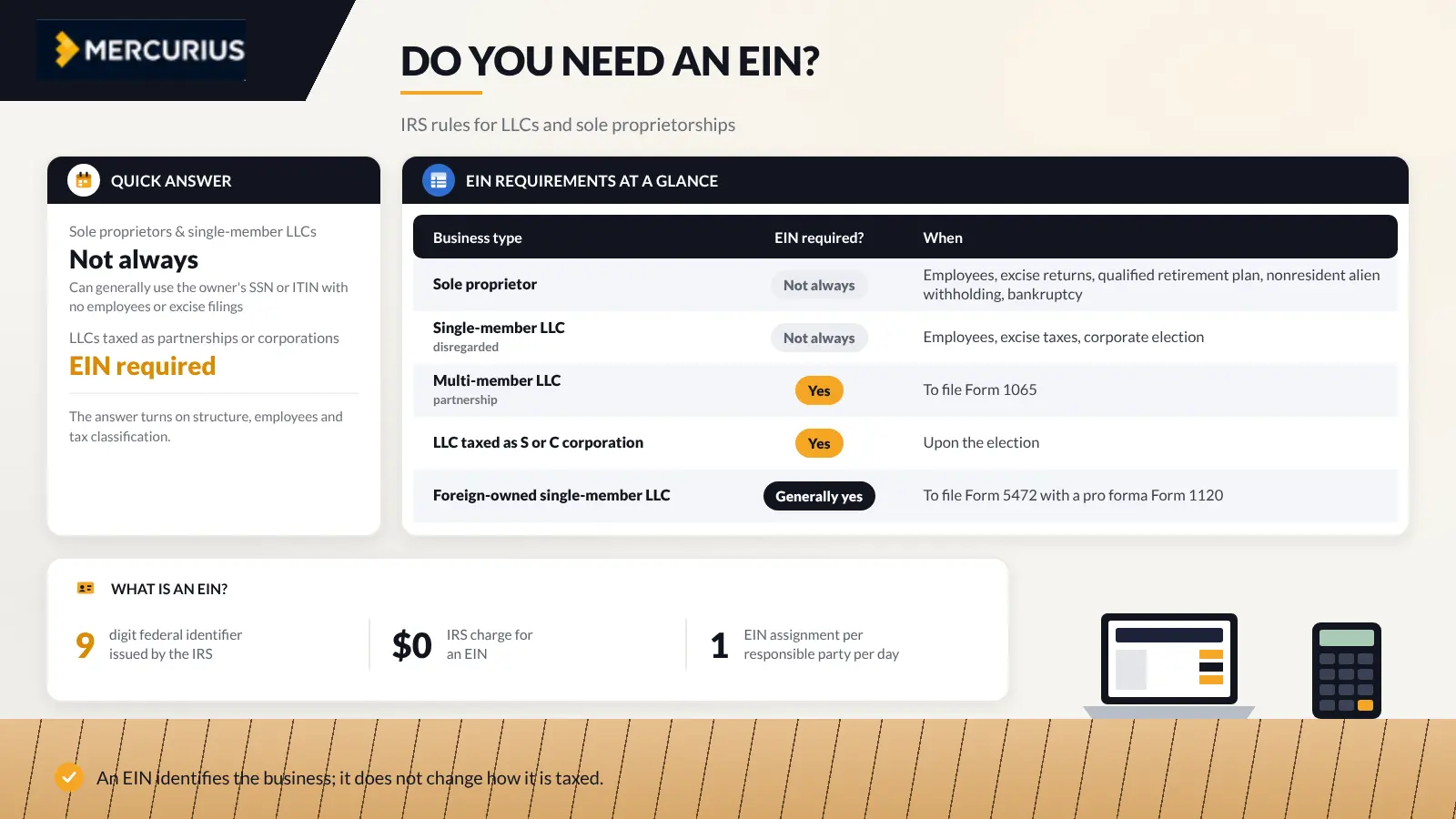
Quick Reference Table
Use this “Do I need an EIN?” guide as a starting point.
| Business type | EIN required? | When |
|---|---|---|
| Sole proprietor | Not always | Employees, excise returns, qualified retirement plan, nonresident alien withholding, bankruptcy |
| Single-member LLC (disregarded) | Not always | Employees, excise taxes, corporate election |
| Multi-member LLC (partnership) | Yes | To file Form 1065 |
| LLC taxed as S or C corporation | Yes | Upon the election |
| Foreign-owned single-member LLC | Generally yes | To file Form 5472 with a pro forma Form 1120 |
Foreign-Owned LLCs and EINs
Why an EIN Is Required
A U.S. LLC wholly owned by a foreign person generally needs an EIN, because it must file Form 5472 with a pro forma Form 1120 when it has reportable transactions with its owner or other related parties. Getting an EIN is separate from that reporting; duties vary by facts, so confirm them in the current Form 5472 instructions. When applying, the Form SS-4 instructions tell these LLCs to check “Other” on line 9a and write “Foreign-owned U.S. disregarded entity-Form 5472.”
The Owner’s Tax ID
A foreign owner may need an ITIN for personal U.S. tax filing, but not to get the LLC’s EIN (see ITIN vs. EIN). If the responsible party has no SSN or ITIN and is ineligible to obtain one, enter “foreign” or “N/A” on Form SS-4 line 7b.
The online application requires a responsible party with an SSN or ITIN, so applicants without one use fax or mail. An entity with no legal residence, principal place of business or principal office or agency in the U.S. or U.S. territories may also apply by phone at 267-941-1099 (international applicants only); see the Form SS-4 instructions for the fax numbers and mailing addresses that apply to international applicants.
Why Get an EIN Even If It Isn’t Required
Limit Use of Your SSN
A sole proprietor with an EIN may enter either number on Form W-9, though the form says the IRS encourages using the SSN. This reflects the Form W-9 currently posted by the IRS (Rev. March 2024); because the IRS has released drafts of a revised form that would require sole proprietors to use their SSN, check the revision date of the form you are using. A disregarded single-member LLC enters the owner’s SSN or EIN, not its own EIN. An EIN does not replace your SSN or ITIN.
Open a Business Bank Account
Many banks ask for an EIN, but that is bank policy, not an IRS rule. The IRS allows an EIN for banking purposes, and having one does not guarantee approval.
Build Business Credit
Some lenders and credit agencies use an EIN to identify a business apart from its owner. That is a business practice, not an IRS rule, and it guarantees nothing.
Prepare to Hire
The IRS says an entity that already has an EIN should not reapply just to hire employees. A disregarded single-member LLC that has been using its owner’s SSN or EIN, however, needs its own EIN once it has employees.
SSN vs. EIN for Business Taxes
Filing With Your SSN
A sole proprietor reports business income on Schedule C (Form 1040) under the owner’s SSN or ITIN and pays self-employment tax on net earnings, figured on Schedule SE (Form 1040).
What Changes With an EIN
Not the tax treatment. An EIN serves as the business’s identification number but does not change its federal tax classification. A single-member LLC that has an EIN still reports its income on the owner’s return; the LLC uses its own EIN for employment and excise tax purposes.
When You Need a New EIN
Changing Your Business Structure
A sole proprietor who incorporates or forms a partnership needs a new EIN. One who forms a single-member LLC can keep the sole proprietor EIN, unless the LLC chooses corporate or S corporation taxation, has employees or owes excise tax. USA Company Formation can help with either.
Ownership or Tax Classification Changes
An LLC that already has its own EIN keeps it when it elects corporation or S corporation treatment, and a partnership converting to an LLC taxed as a partnership needs no new EIN either. A disregarded single-member LLC that adds a member becomes a partnership by default and requests an EIN as a partnership.
Ending an LLC to form a new corporation or partnership requires a new EIN.
Cases Where a New EIN Isn’t Required
A name, address or responsible party change does not require one, but a responsible party change must be reported to the IRS on Form 8822-B within 60 days. A sole proprietor operating multiple businesses generally uses the same EIN across all of them.
How to Get an EIN
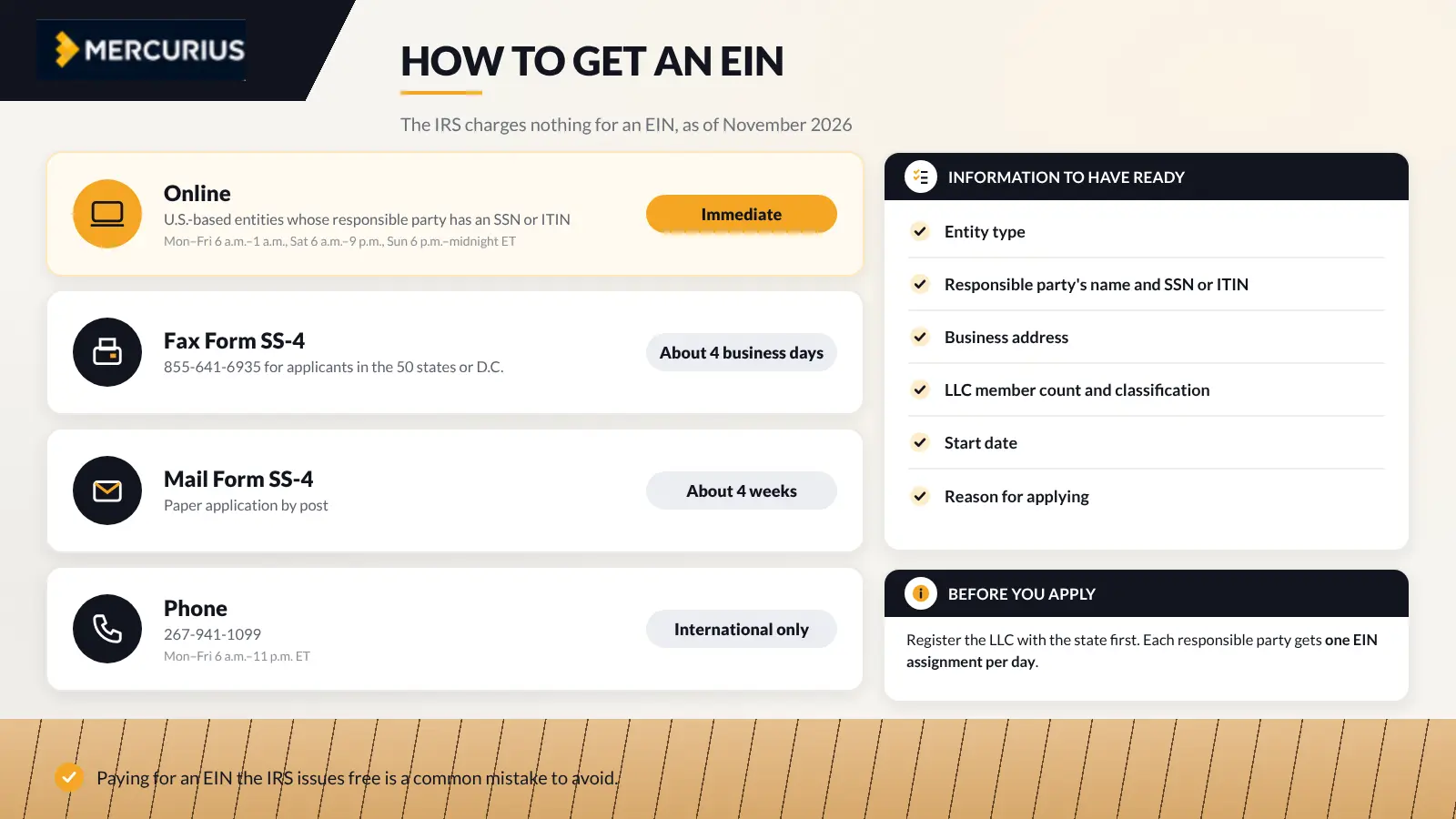
Application Options
The IRS charges nothing for an EIN, as of November 2026. Your options:
- Online: immediate issuance for U.S.-based entities whose responsible party has an SSN or ITIN. Available Mon–Fri 6 a.m.–1 a.m., Sat 6 a.m.–9 p.m., Sun 6 p.m.–midnight ET.
- Fax Form SS-4 to 855-641-6935 (applicants in the 50 states or D.C.): about 4 business days.
- Mail Form SS-4: about 4 weeks.
- Phone (international applicants only): 267-941-1099, Mon–Fri 6 a.m.–11 p.m. ET.
The IRS limits each responsible party to one EIN assignment per day, and the IRS says to register an LLC with the state before applying, because applying first may delay the application. For help preparing the application, see Maspartner’s EIN Application Services.
Information to Have Ready
Have the entity type, responsible party’s name and SSN or ITIN, business address, LLC member count and classification, start date and reason for applying ready. What Does an EIN Number Look Like? explains the number’s format.
Common EIN Mistakes to Avoid
Application and Reporting Errors
- Paying for an EIN the IRS issues free
- Putting a disregarded LLC’s own EIN on Form W-9 instead of the owner’s SSN or EIN
- Using the old EIN after a structure change that requires a new one
- Applying more than once for the same entity
- Assuming an EIN changes how the business is taxed
Conclusion
Is an EIN Required for Sole Proprietors? Only when employees, excise taxes, a qualified retirement plan or another IRS trigger applies; otherwise an SSN or ITIN is enough. LLC rules follow tax classification: multi-member and corporate-taxed LLCs need an EIN, while disregarded single-member LLCs do not always need one.
Voluntary EINs can still help with banking and hiring. Maspartner offers EIN application and company formation support if you want help.
FAQs
Does a sole proprietor need an EIN?
Not always. Employees, excise tax returns or a qualified retirement plan, among other triggers, require one; otherwise an SSN or ITIN works.
Does a single-member LLC need an EIN?
Not always. A disregarded single-member LLC with no employees and no excise tax liability does not need one. It needs one for employees, excise taxes or a corporate election.
Does a multi-member LLC need an EIN?
Yes. It is taxed as a partnership by default and needs an EIN to file Form 1065.
Can I use my SSN instead of an EIN for my LLC?
Only if it is a disregarded single-member LLC with no employees and no excise tax liability. Multi-member LLCs and LLCs taxed as corporations need their own EIN.
Is a new EIN necessary when converting a sole proprietorship into an LLC?
Not for a single-member LLC without employees, excise taxes or a corporate election. Multi-member LLCs and LLCs taxed as corporations need a new EIN.
Is an EIN necessary for opening a business bank account?
No, but many banks ask for one. That is bank policy and does not guarantee approval.
Does a foreign-owned LLC need an EIN?
Generally yes, to file Form 5472 with a pro forma Form 1120 when it has reportable transactions.
Is There a Cost Involved in Obtaining an EIN from the IRS?
No. The IRS issues EINs free, as of November 2026.