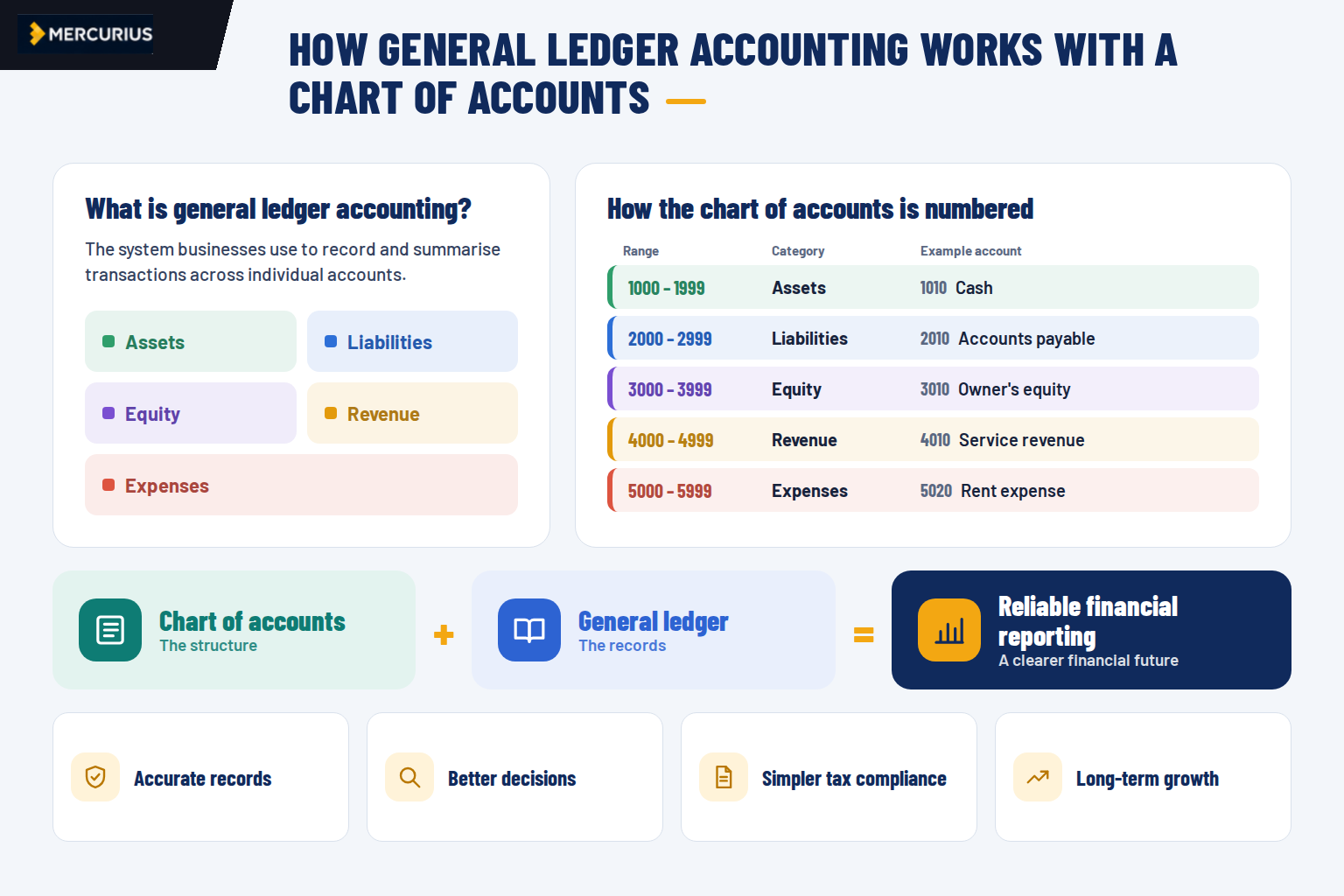
General Ledger Accounting is the system businesses use to record and summarise financial transactions across individual accounts.
The chart of accounts provides the structural index and categories, while the general ledger records actual transaction activity within those accounts. This guide explains core account categories, numerical coding, practical transaction flows, real-world examples, and setup templates.
What Is General Ledger Accounting?
General Ledger Definition
It is the process of maintaining a business’s master financial record, where every transaction is classified into specific asset, liability, equity, revenue, or expense accounts.
The general ledger provides a centralised view of financial activity, helping businesses track how transactions affect each account and maintain consistent records.
How the General Ledger Works
The general ledger works by posting individual journal entries to their corresponding accounts. Each entry records the financial impact of a transaction using debits and credits, creating an organised history of business activity.
Daily bookkeeping activities provide the transaction data needed to maintain these records. Learn more about What Is Bookkeeping? and how routine recording supports accurate ledger management.
Once transactions are posted and organised, account balances are aggregated into financial statements. This structured data supports the preparation of balance sheets, income statements, and reliable financial reports, giving business owners a clear view of financial performance and position.
What Is a Chart of Accounts?
Chart of Accounts Definition
A chart of accounts is the index or master list of every account used in a business’s financial system. This chart of accounts definition accounting concept provides a structured way to classify financial activity and answer what is a chart of accounts in accounting.
Five Main Account Categories
- Assets
- Liabilities
- Equity
- Revenue
- Expenses
These categories organise transactions consistently and support accurate financial reporting.
How the COA Structures the General Ledger
The COA provides the blueprint that organises all general ledger data into clearly defined accounts. Each transaction is assigned to the appropriate account, making the chart of accounts definition central to structured record-keeping.
General Ledger vs. Chart of Accounts
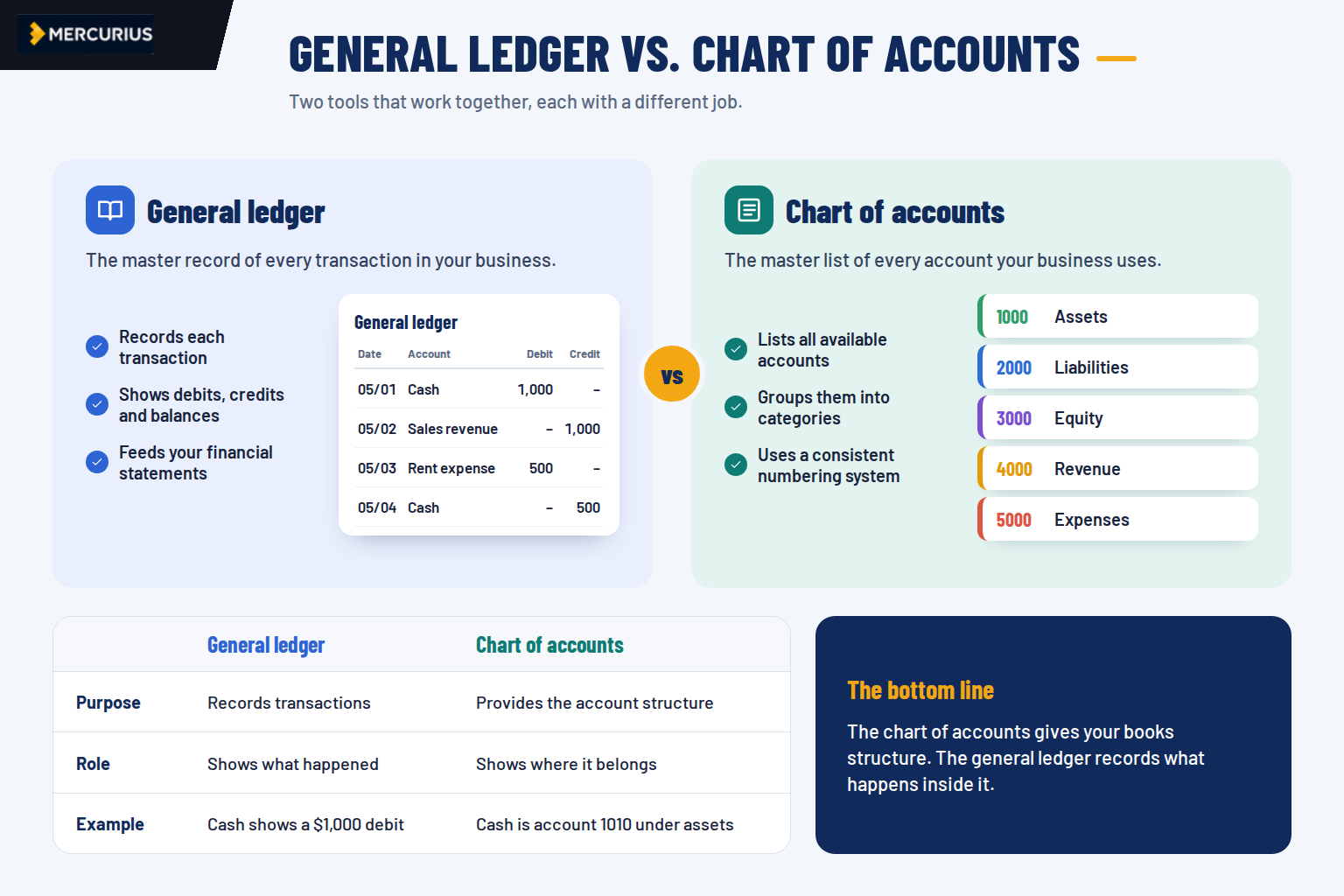
Chart of Accounts = Structure
The chart of accounts acts as a filing cabinet or structural map listing every available financial account. It tells businesses where each type of transaction belongs.
General Ledger = Transactions
The general ledger contains the detailed entries and financial activity recorded within those accounts. It tracks the debits, credits, and balances created by business transactions.
How They Work Together
The COA classifies transactions before the general ledger records and aggregates them into financial reports.
| Form | Entity | Tax year | Original deadline | Extended deadline |
|---|---|---|---|---|
| 1065 | Partnership | 2025 | March 16, 2026 | September 15, 2026 |
| 1120-S | S corporation | 2025 | March 16, 2026 | September 15, 2026 |
| 1120 | C corporation | 2025 | April 15, 2026 | October 15, 2026 |
| 1065 / 1120-S | Partnership / S corporation | 2026 | March 15, 2027 | September 15, 2027 |
| 1120 | C corporation | 2026 | April 15, 2027 | October 15, 2027 |
Flow: COA → Transaction Classification → General Ledger → Financial Statements
How the Chart of Accounts Organizes the Ledger
Asset and Liability Accounts
The COA categorizes assets and liabilities by whether they are short-term or long-term. It can separate resources such as cash and accounts receivable from obligations such as accounts payable and business loans.
Equity and Revenue Accounts
Equity and revenue accounts track ownership value and incoming business income. Owner’s equity and retained earnings show overall net worth, while separate income streams make revenue easier to monitor.
Expense Accounts
Expense accounts organize the operating costs required to run a business. Common categories include payroll, rent, software subscriptions, utilities, and marketing expenses.
Subaccounts for More Detail
Subaccounts break broad categories into more specific areas for granular financial tracking. For example, Marketing can include Social Media Ads as a subaccount, providing useful detail without cluttering the primary general ledger structure.
Chart of Accounts Numbering
Why Account Numbers Are Used
Four-digit account numbers simplify transaction posting, sorting, and financial reporting by giving each account a consistent numerical identifier. This makes accounts easier to locate and organise as the ledger grows.
Sample Numbering Structure
A standard four-digit numbering system assigns number ranges to major account categories.
| Account Range | Category |
|---|---|
| 1000–1999 | Assets |
| 2000–2999 | Liabilities |
| 3000–3999 | Equity |
| 4000–4999 | Revenue |
| 5000–5999 | Expenses |
This structure can serve as a practical chart of accounts numbering template for many small and growing businesses.
Building a Flexible Numbering System
A flexible numbering system leaves room for future accounts while maintaining consistent category logic. For example, moving from 1010 to 1020 leaves space for additional asset accounts.
Businesses should customise the numbering structure around their reporting needs, industry, and account complexity rather than adding unnecessary codes.
Sample Chart of Accounts
Sample Asset, Liability, and Equity Accounts
A sample chart of accounts uses numbered accounts to organise a business’s financial records. Common examples include Cash, Accounts Receivable, Equipment, Accounts Payable, and Owner’s Equity.
| Account Number | Account Name | Account Type |
|---|---|---|
| 1010 | Cash | Asset |
| 1020 | Accounts Receivable | Asset |
| 1500 | Equipment | Asset |
| 2010 | Accounts Payable | Liability |
| 3010 | Owner’s Equity | Equity |
Sample Revenue and Expense Accounts
Revenue and expense accounts track income earned and costs incurred during operations. Typical chart of accounts examples include Service Revenue, Product Sales, Payroll Expense, Rent Expense, and Software Expense.
| Account Number | Account Name | Account Type |
|---|---|---|
| 4010 | Service Revenue | Revenue |
| 4020 | Product Sales | Revenue |
| 5010 | Payroll Expense | Expense |
| 5020 | Rent Expense | Expense |
| 5030 | Software Expense | Expense |
How to Customize the Sample
Businesses should customise account names and numbers to reflect their exact operations and reporting needs. Add relevant accounts, remove unused ones, and preserve a logical numbering structure as the business grows.
Industry-Specific Chart of Accounts Examples
Service Business
Service businesses often need accounts that distinguish billable activity from operating costs. Professional firms may track Billable Hours, Professional Fees, Client Revenue, and subcontractor costs to understand project profitability.
Retail Business
Retail businesses require accounts that clearly track inventory and sales-related costs. Essential accounts include Inventory, Cost of Goods Sold (COGS), Sales Returns, and POS Merchant Fees.
SaaS Business
SaaS businesses benefit from accounts that reflect recurring revenue and technology costs. Monthly Recurring Revenue (MRR), Deferred Revenue, and Hosting/Cloud Infrastructure Expenses can provide clearer insight into subscription performance.
Adapting the chart of accounts to the industry helps businesses capture relevant financial insights directly within the general ledger, supporting more useful reporting and decision-making.
How Transactions Flow Through the Ledger
Recording a Customer Payment
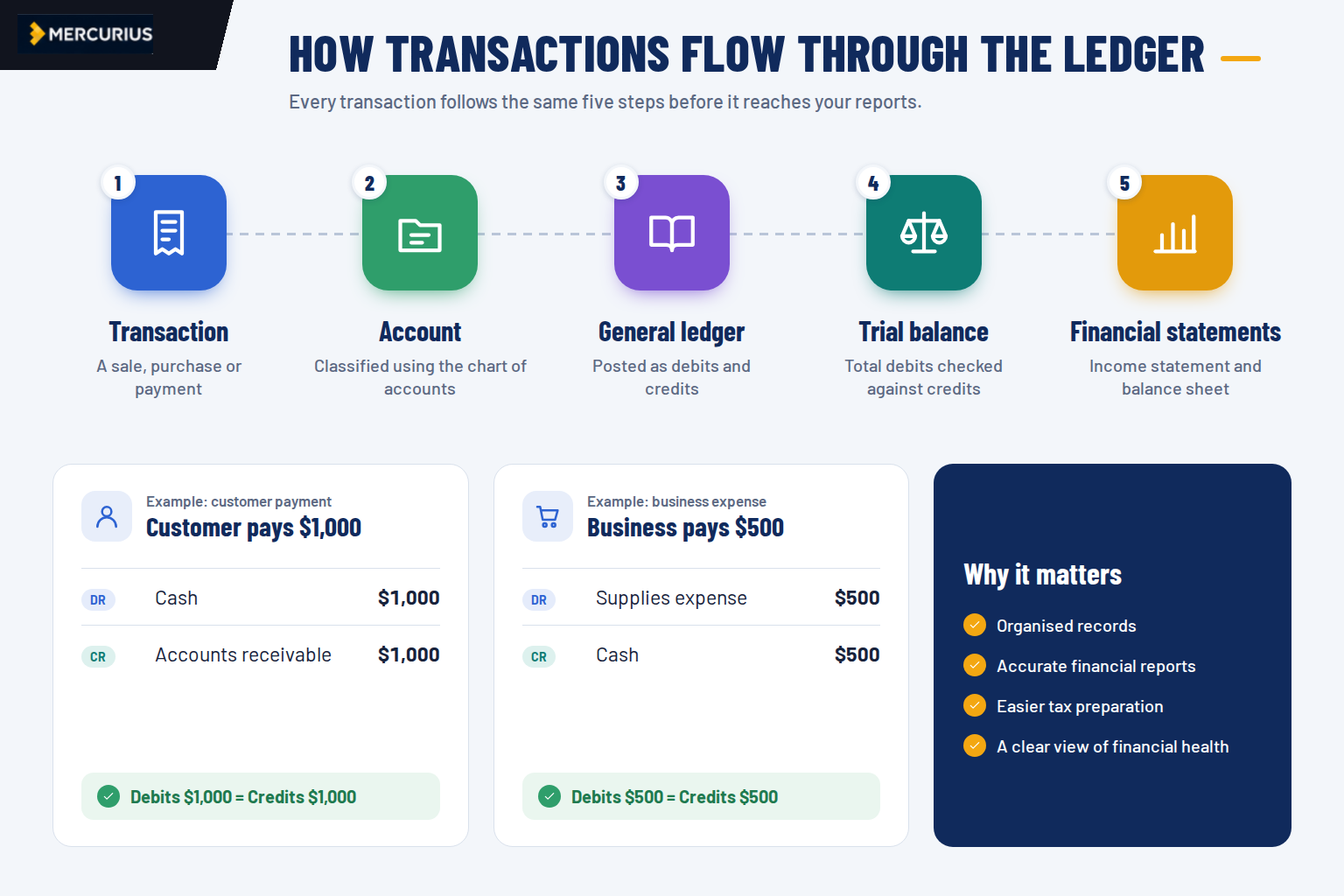
A customer payment is recorded by debiting Cash and crediting Accounts Receivable when settling an existing invoice, or Revenue when the sale is recorded at payment. This entry updates the appropriate general ledger accounts.
Recording a Business Expense
A business purchase or bill is recorded by debiting the relevant Expense account and crediting Cash when paid or Accounts Payable when payment is due later. This ensures the cost and related liability or cash movement are captured accurately.
From Transactions to Financial Statements
Every financial transaction follows a consistent accounting sequence before reaching financial statements.
Transaction → Account → General Ledger → Trial Balance → Financial Statements
The transaction is classified into the appropriate account, posted to the general ledger, summarised in the trial balance, and then used to prepare financial statements.
From Ledger to Trial Balance to Financial Statements
General Ledger to Trial Balance
Ending balances from every general ledger account are consolidated into a trial balance to verify that total debits equal total credits. This check helps identify posting and calculation errors before financial statements are prepared.
Trial Balance to Financial Statements
Verified trial balance figures feed directly into core financial reports, including the income statement and balance sheet. Revenue and expense balances support the income statement, while assets, liabilities, and equity form the basis of the balance sheet.
Why This Flow Matters
Each stage validates and builds upon the previous step to produce organised, audit-ready financial reporting. The process creates a reliable chain from recorded transactions to verified balances and accurate financial statements.
Free General Ledger and Chart of Accounts Template
General Ledger Template
A general ledger bookkeeping template provides a simple spreadsheet for tracking individual financial transactions. Core columns include Account Name/Number, Date, Description, Debit, Credit, and Running Balance, making it a practical accounting general ledger template.
Chart of Accounts Template
A chart of accounts template provides a structured index for organising every account used by a business. Include Account Number, Account Name, Account Category, and Description, using a logical chart of accounts numbering template.
How to Use the Templates
Small businesses should customise these templates to match their account structure and daily bookkeeping workflow. Add relevant accounts, remove unnecessary fields, assign consistent numbers, and update the templates as transaction volume and reporting needs grow.
Conclusion
A chart of accounts provides the organisational framework, while the general ledger records daily financial transactions within that structure. Together, structured accounts and accurate transaction entries create the foundation for reliable, audit-ready financial reporting.
Business owners should maintain a disciplined accounting process as their finances grow. To streamline financial management, explore tailored Maspartner Accounting Services.
Frequently Asked Questions
What is general ledger accounting?
General ledger accounting is the process of recording and organising a business’s financial transactions in its master financial record. It supports accurate account balances and financial reporting.
What is a chart of accounts in accounting?
A chart of accounts in accounting is the master list of accounts used to classify a business’s financial transactions. It typically includes assets, liabilities, equity, revenue, and expenses.
What is the difference between a general ledger and a chart of accounts?
A chart of accounts defines the account structure, while the general ledger records transactions within those accounts. The COA provides the framework; the ledger contains the activity.
What are the five main types of accounts in a chart of accounts?
The five main account types are assets, liabilities, equity, revenue, and expenses. These categories form the foundation of most accounting systems.
How does a chart of accounts work with a general ledger?
The chart of accounts classifies transactions into specific accounts that are then recorded in the general ledger. This creates organised data for financial reporting.
What is a sample chart of accounts?
A sample chart of accounts is a practical list of common accounts with account numbers and categories. Businesses can customise it based on their operations and reporting needs.
How are chart of accounts numbers assigned?
Chart of accounts numbers are assigned using logical numerical ranges for different account categories. For example, 1000-series numbers commonly represent assets.
What is a general ledger bookkeeping template?
A general ledger bookkeeping template is a structured spreadsheet for recording transactions, including dates, descriptions, debits, credits, and balances. It provides a consistent format for maintaining financial records.