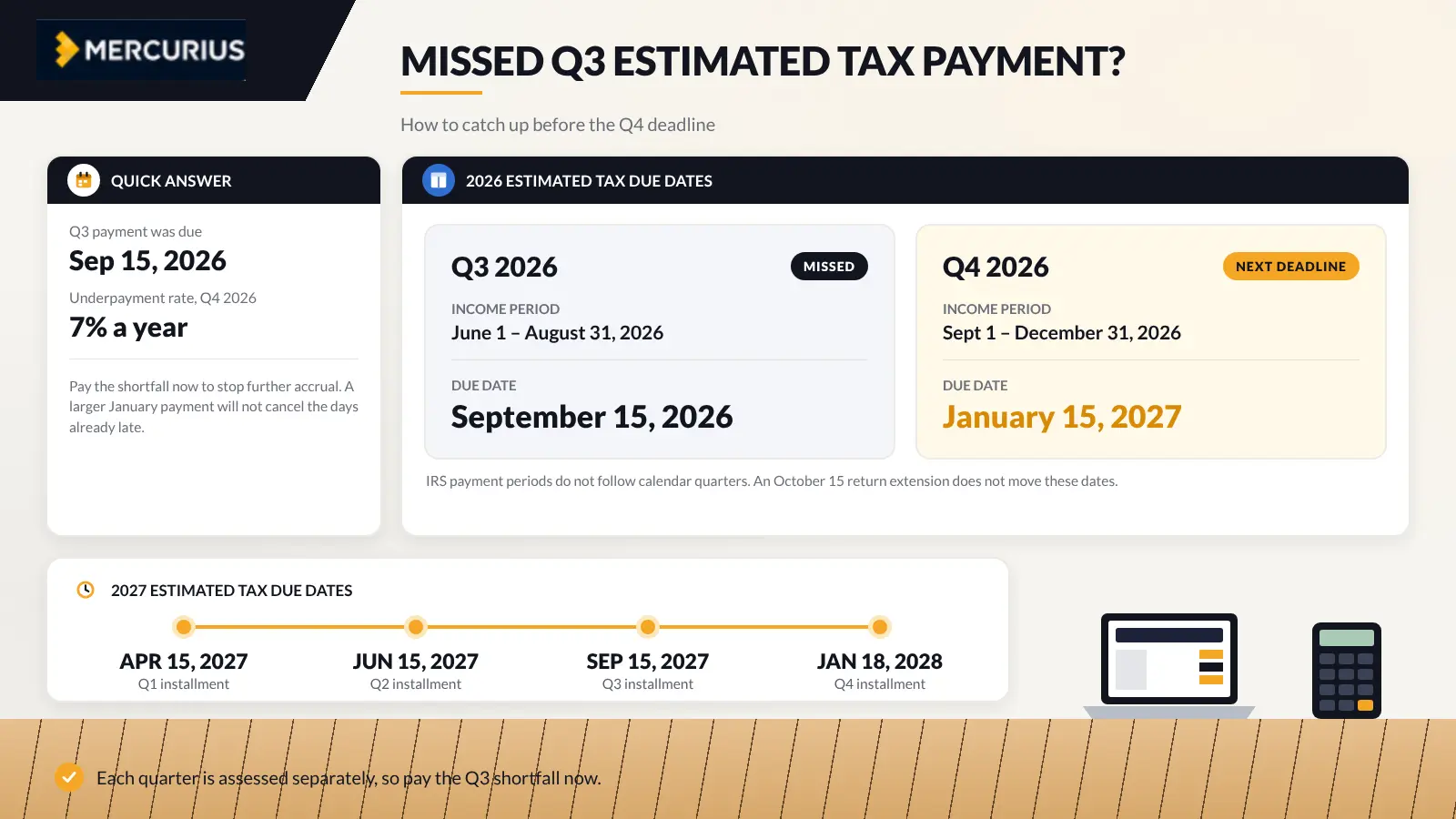
Quick Answer: If you missed the September 15, 2026 Q3 estimated tax payment, pay the shortfall as soon as possible. The IRS charges an underpayment penalty on the unpaid amount, calculated like interest at 7% a year for the fourth quarter of 2026. Paying now stops further accrual. A larger January payment will not cancel the days already late.
A missed estimated tax payment can trigger an underpayment penalty on that quarter’s shortfall, and the charge grows daily until the amount is paid. Each quarter is assessed independently, meaning an increased Q4 payment does not automatically compensate for an underpayment or delay in Q3. This guide shows how to check your exposure, catch up, and plan 2027. Some readers will find they owe no penalty at all.
When Were Quarterly Estimated Tax Payments Due in 2026?
The deadline for the third-quarter payment fell on September 15, 2026, while the fourth-quarter payment must be made by January 15, 2027.
| Installment | Income period | Due date |
|---|---|---|
| Q3 2026 | June 1 – August 31, 2026 | September 15, 2026 |
| Q4 2026 | September 1 – December 31, 2026 | January 15, 2027 |
IRS payment periods do not follow calendar quarters, so Q2 covers two months and Q4 covers four.
For all quarterly due dates, refer to our detailed Q4 estimated tax payment guide.
A return extension to October 15 does not move these dates. See Tax Extension Deadline 2026, or Missed the October 15 Tax Extension Deadline if that date has also passed.
C corporations follow a different schedule, covered in Corporate Estimated Tax Payments.
Can Missing an Estimated Tax Payment Trigger an IRS Penalty?
Not every missed estimated tax installment automatically results in a penalty. Review the IRS rules that apply to your situation before making an additional payment.
- The $1,000 threshold: You generally won’t face an underpayment penalty if your remaining tax liability for 2026, after accounting for withholding and refundable credits, is less than $1,000.
- The safe harbor rule: You may avoid a penalty if your tax withholding and estimated payments meet the required amounts. Generally, these are based on paying at least 90% of your 2026 tax liability or 100% of your 2025 tax liability, subject to applicable IRS rules. The prior-year figure becomes 110% if your 2025 adjusted gross income exceeded $150,000 ($75,000 if married filing separately).
Treat the safe harbor as a check, not a plan. Withholding counts toward it, so include it.
Calculate first, then pay. Guessing risks overpaying. Both tests are set out in the Form 2210 instructions.
How Does the IRS Determine Penalties for Estimated Tax Underpayments?
The penalty is interest-based, not a flat late fee.
What Rate Applies?
The IRS sets the underpayment rate quarterly. The annual underpayment interest rate for both Q3 and Q4 of 2026 is 7%, as stated in IRS news release IR-2026-98.
What Is the Basic Formula?
The shortfall is multiplied by the applicable rate for each day it stays unpaid: shortfall × rate × days late ÷ 365.
When Do You Find Out?
The charge appears when you file the annual return, as a balance due or a smaller refund.
Form 2210 allows you to work out the applicable penalty and include the calculation with your annual tax return. Alternatively, the IRS may determine the amount and notify you of the balance due.
Why a Bigger Q4 Payment Does Not Erase the Q3 Penalty
The IRS tests every installment separately, so a late Q3 payment keeps its own penalty.
Each Quarter Stands Alone
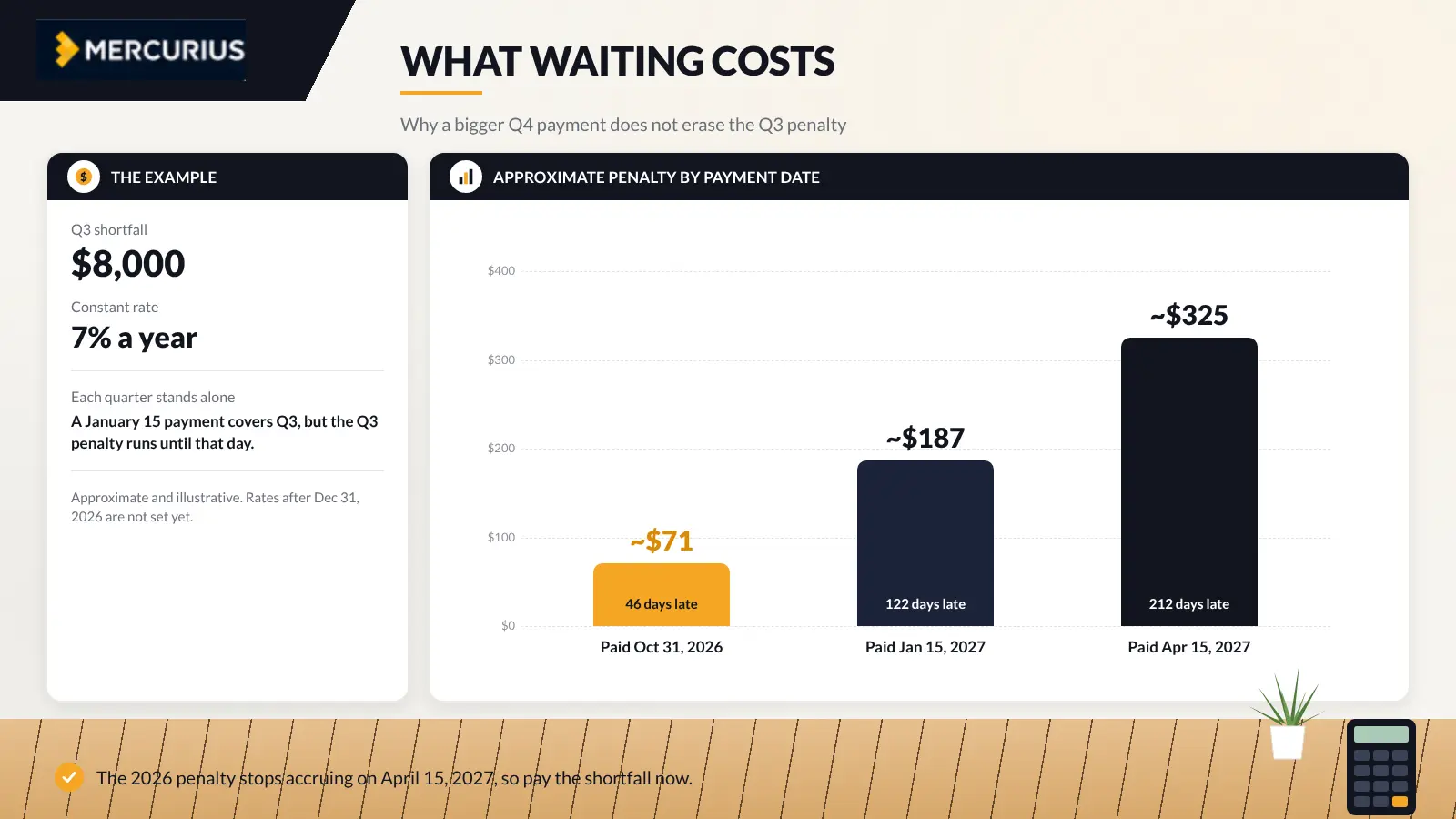
Per the Form 2210 instructions, a payment applies to the earliest unpaid installment first. A January 15 payment therefore covers Q3, but the Q3 penalty runs until that day.
What Does Waiting Cost?
The example below assumes an $8,000 Q3 shortfall and a constant 7% rate. Amounts are approximate and illustrative.
| Shortfall paid on | Days late | Approximate penalty |
|---|---|---|
| October 31, 2026 | 46 | $71 |
| January 15, 2027 | 122 | $187 |
| April 15, 2027 | 212 | $325 |
Rates after December 31, 2026 have not been set, so the January and April figures may change. The penalty for 2026 stops accruing on April 15, 2027, but any balance still unpaid after that date is charged interest and a failure-to-pay penalty instead.
How Can You Catch Up Before the Q4 Deadline?
Pay the missed amount now, recalculate Q4, then schedule 2027. Follow these steps in order.
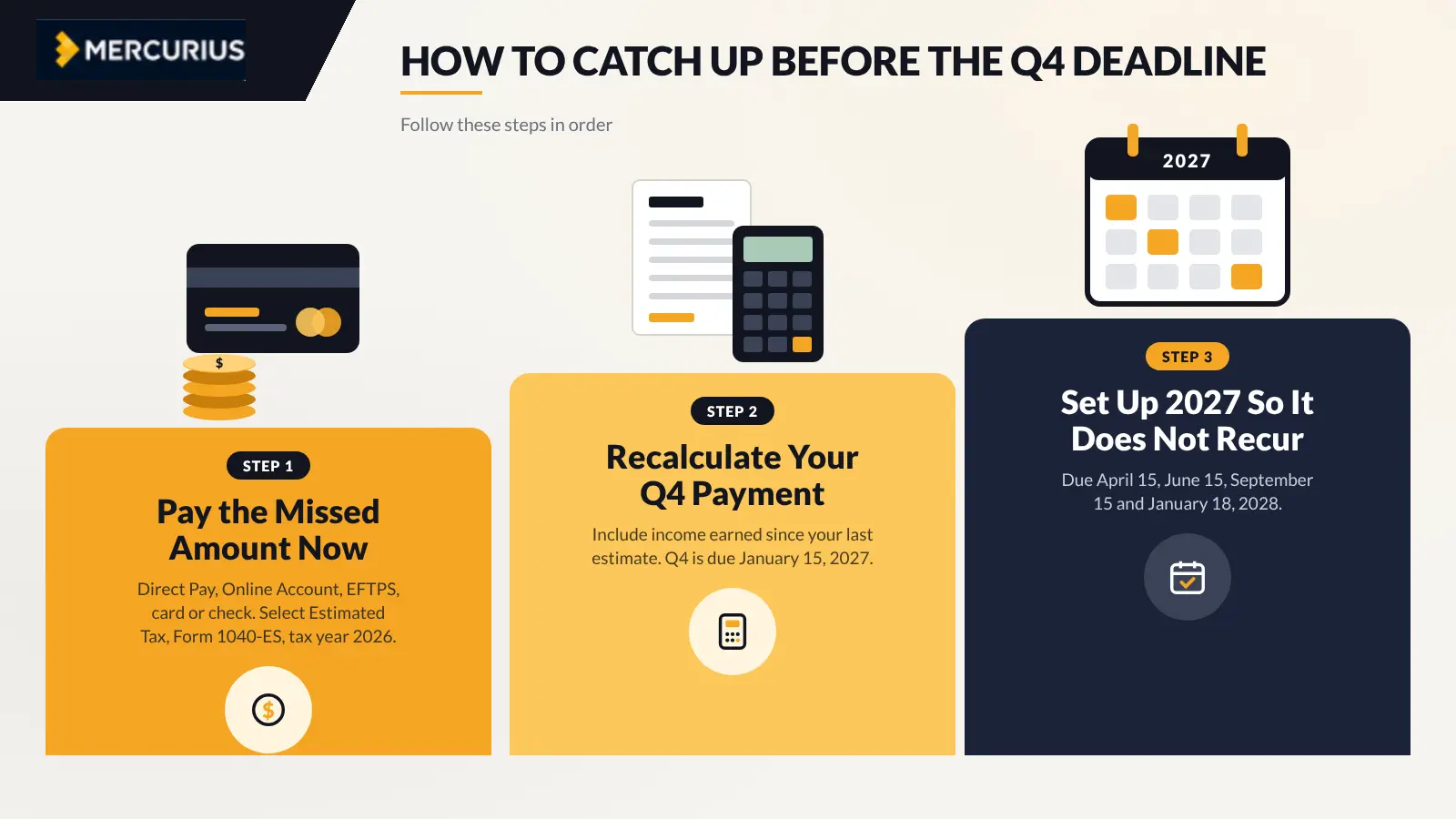
Step 1: Pay the Missed Amount Now
The charge on that quarter stops growing once the IRS receives payment.
You can make your payment through IRS Direct Pay, your IRS Online Account, the Electronic Federal Tax Payment System (EFTPS), a debit card, credit card or digital wallet (processor fees apply), or by mailing a check or money order with the Form 1040-ES payment voucher. Select “Estimated Tax,” Form 1040-ES, and tax year 2026 when submitting the payment.
Step 2: Recalculate Your Q4 Payment
Include income earned since your last estimate when you work out the January figure.
Some filers can skip the January payment by filing their 2026 return by February 1, 2027 and paying the entire balance due with it. The rule is in our Q4 estimated tax payments guide.
Step 3: Set Up 2027 So It Does Not Recur
For 2027, the estimated tax payment deadlines fall on April 15, June 15, and September 15, followed by January 18, 2028, for the final installment.
Set up your estimated tax payments through IRS Direct Pay or your online IRS account. Our Tax Planning page covers building next year’s estimates.
The Withholding Catch-Up Method
Higher withholding late in the year can offset an earlier shortfall.
Why Does Withholding Help?
Tax withheld is generally treated as paid evenly across the year, whenever it was actually withheld.
How Do You Use It?
Adjust your paycheck withholding or arrange tax withholding from retirement distributions before the end of the year. Use the IRS Tax Withholding Estimator to determine the appropriate adjustment to your withholding.
Who Does It Suit?
This method is useful for taxpayers who earn income from employment alongside self-employment or business activities. The result depends on your figures, and no method guarantees a penalty-free outcome.
The Annualized Income Method
This method can reduce the penalty when income arrives unevenly.
When Is Income Uneven?
Seasonal or project-based earnings make equal installments the wrong yardstick.
How Does It Help?
Annualizing can reduce or remove the penalty for quarters with little income. You use Schedule AI of Form 2210, where the Q3 period covers income from January 1 through August 31. You must check box C in Part II and attach Form 2210 to your return.
It requires income and deduction records by period, and it is not available for every situation.
Can the IRS Waive the Estimated Tax Penalty?
The IRS can waive it, but only in limited situations.
When May the IRS Waive It?
Two situations qualify: a casualty, disaster or other unusual circumstance, or retiring after age 62 or becoming disabled in 2025 or 2026. For the first, the IRS must find that imposing the penalty would be inequitable. For the second, the underpayment must be due to reasonable cause and not willful neglect.
First Time Abate and the new Automatic Exemption from Penalty (AEP) apply only to failure-to-file, failure-to-pay and failure-to-deposit penalties, so they do not cover this penalty, per IRS penalty relief guidance.
How Do You Request It?
Check box A in Part II of Form 2210, complete page 1, and attach it to your annual tax return with a statement explaining the circumstances. Include supporting documents, such as proof of your retirement date or insurance or police reports for a casualty.
Do Not Forget State Estimated Payments
Estimated tax obligations at the state level must be handled independently of federal tax payments.
Most income-tax states set their own due dates and penalties, which may differ from the IRS schedule. Check your state agency. For multi-state support, see our Taxation Services page.
Conclusion
Making up a missed estimated tax payment sooner can help reduce potential penalties compared with delaying action until you file your tax return. Pay the shortfall, recalculate Q4, and schedule 2027 payments.
Maspartner handles estimated tax planning and US tax filing. Our Tax Filing Services team can review your figures and next steps. Book your free consultation today.
FAQs
What Are the Consequences of Missing a Quarterly Estimated Tax Deadline?
The IRS may assess an underpayment penalty on the amount paid late or left unpaid. The penalty is generally calculated for the period between the payment deadline and the date the balance is settled, with the final amount usually assessed when you submit your annual return.
Is It Possible to Make Up a Missed Estimated Tax Payment?
Yes, you can pay the missed amount through IRS Direct Pay, your IRS Online Account or by card. Further penalty accrual on that amount stops once payment is received.
Does paying extra in Q4 remove the penalty for a missed quarter?
No. Payments apply to the earliest unpaid installment first, but the Q3 penalty runs until that payment date, so a January payment stops further charges without erasing earlier ones.
How Does the IRS Determine the Penalty for Underpaid Estimated Taxes?
The penalty is the shortfall times the IRS underpayment rate, for each day it stays unpaid.
The annual underpayment rate for Q3 and Q4 of 2026 is 7%, with the IRS reviewing and setting the rate each quarter.
What Is the Deadline for the Fourth-Quarter Estimated Tax Payment?
The Q4 2026 estimated tax payment is due January 15, 2027, covering income from September 1 through December 31, 2026. Certain taxpayers may not need to make the payment if they file their 2026 return by February 1, 2027 and pay the entire balance due with it.
Does First Time Abate or the new automatic penalty relief cover estimated tax penalties?
No. IRS guidance states estimated tax penalties are not eligible for First Time Abate or the new Automatic Exemption from Penalty, though a separate waiver may apply in limited circumstances.
Can the IRS waive an underpayment penalty?
Yes, but only in limited cases: a casualty, disaster or other unusual circumstance, or retirement after age 62 or disability in 2025 or 2026 where the underpayment was due to reasonable cause.