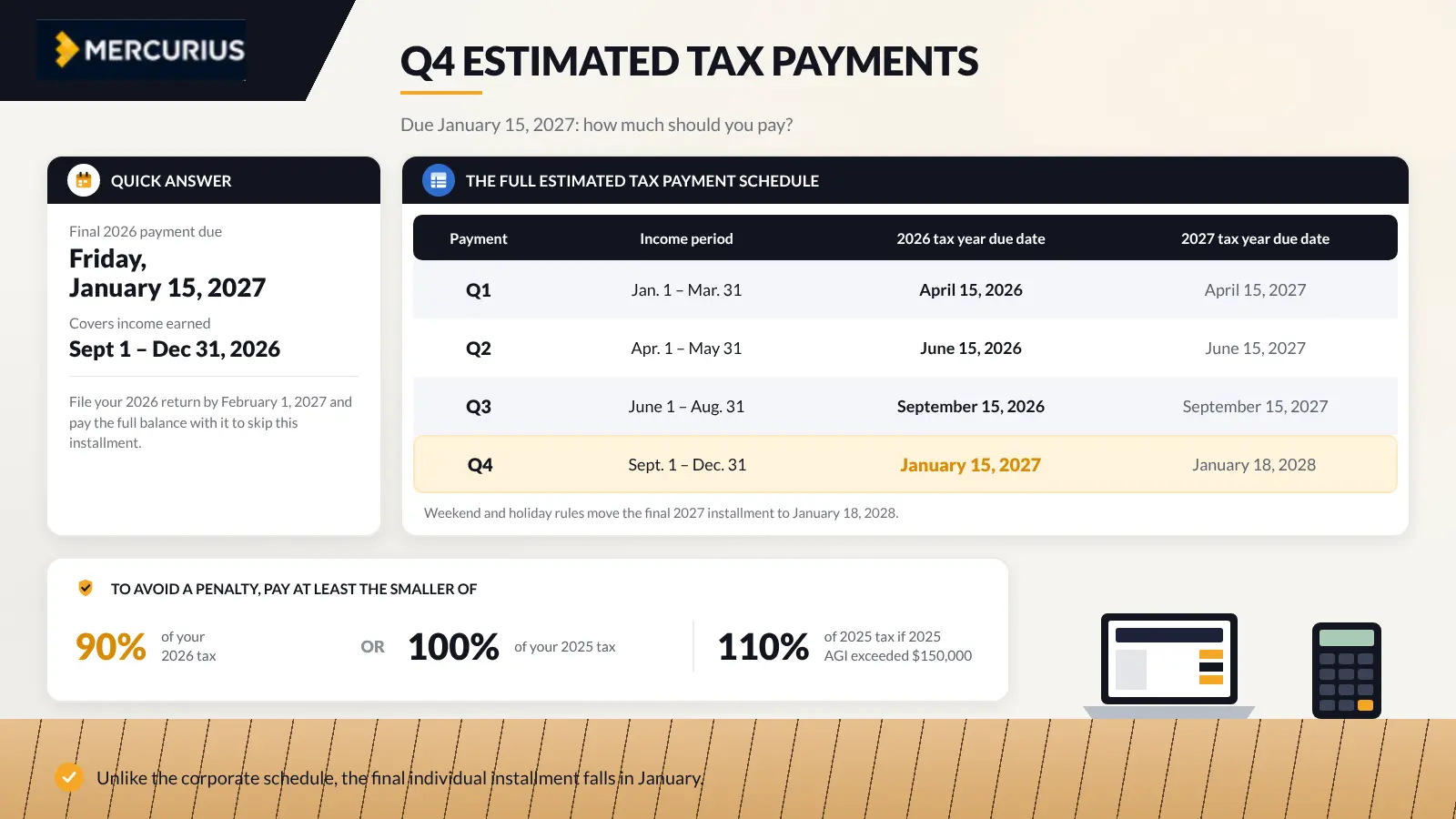
Quick answer: The final 2026 estimated tax payment is due Friday, January 15, 2027, and covers income from September 1 through December 31. To avoid an underpayment penalty, withholding plus installments generally must total at least the smaller of 90% of 2026 tax or 100% of 2025 tax (110% if 2025 AGI exceeded
$150,000). Filing your 2026 return by February 1, 2027 and paying the entire balance due with it lets you skip this installment.
The final installment of estimated tax payments for the 2026 tax year must be paid by January 15, 2027 (Friday). It covers income earned from September through December. This guide explains how to calculate the amount, which safe harbor applies, and when the payment can be skipped.
The rules below are federal and apply to individuals. Corporations and states follow separate schedules.
When Are Estimated Tax Payments Due for 2026 and 2027?
The Full Estimated Tax Payment Schedule
Federal estimated tax payments for 2026 are due April 15, June 15, and September 15, 2026, and January 15, 2027. The 2027 tax year dates follow the same calendar
pattern, since the IRS has not yet released a 2027 Form 1040-ES; confirm them against that form once it is published.
| Payment | Income period | 2026 tax year due date | 2027 tax year due date |
|---|---|---|---|
| Q1 | Jan. 1 – Mar. 31 | April 15, 2026 | April 15, 2027 |
| Q2 | Apr. 1 – May 31 | June 15, 2026 | June 15, 2027 |
| Q3 | June 1 – Aug. 31 | September 15, 2026 | September 15, 2027 |
| Q4 | Sept. 1 – Dec. 31 | January 15, 2027 | January 18, 2028 |
The periods are uneven by design: the second covers two months, the fourth covers four, and the first and third cover three each. When a due date falls on a Saturday, Sunday, or legal holiday, a payment is on time if made on the next business day, which is why the final 2027 installment is due January 18, 2028.
Why the Final Installment Is Not Due December 31
The fourth individual installment falls on the following January 15, unlike the corporate schedule, which closes in December. This timing is set out in the 2026 Form 1040-ES and IRS Publication 505.
Who Needs to Make a Q4 Payment?
The Basic Test
Most taxpayers must make estimated payments if they expect to owe at least $1,000 for 2026 after withholding and refundable credits. Withholding and refundable credits must also be expected to fall below the smaller of 90% of the tax shown on the 2026 return or 100% of the tax shown on the 2025 return (110% if 2025 AGI exceeded $150,000). The 2025 return must cover all 12 months. You do not have to pay estimated tax for 2026 if you were a U.S. citizen or resident alien for all of 2025 and had no tax liability for the full 12-month 2025 tax year.
Who It Typically Applies To
This most often affects self-employed individuals, independent contractors, sole proprietors, landlords, investors, and anyone with large year-end income that has no withholding. Online sellers can find a tailored estimate in our guide to Quarterly Taxes for Amazon Sellers.
Business owners who want help projecting liability can review Maspartner’s Taxation Services.
How Much Should You Pay for the Fourth Quarter?
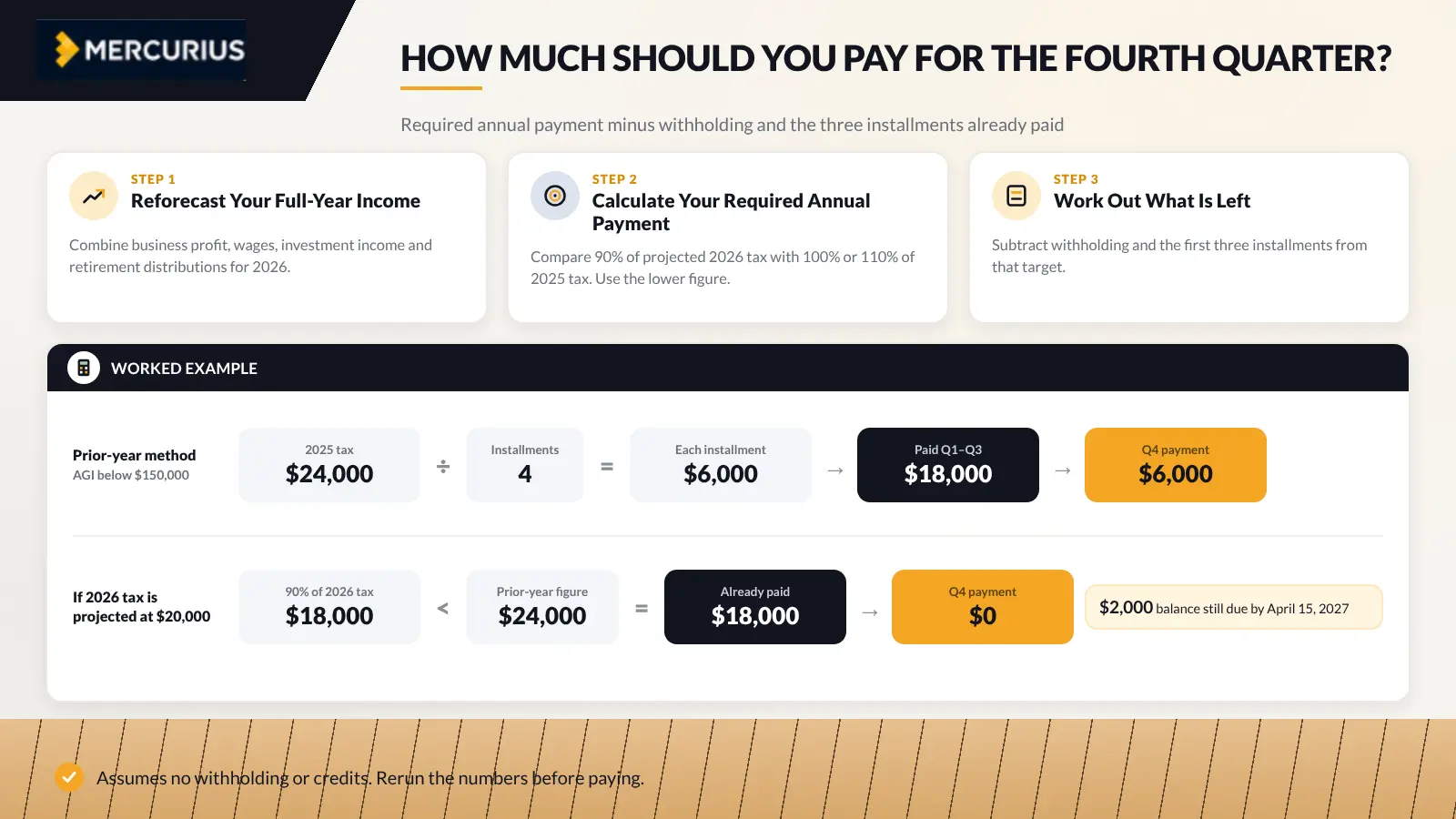
The Q4 amount is your required annual payment minus withholding and the three installments already paid.
Step 1: Reforecast Your Full-Year Income
Combine business profit, wages, investment income, and retirement distributions for 2026, then estimate the resulting tax.
Step 2: Calculate Your Required Annual Payment
Compare 90% of your projected 2026 tax with your prior-year figure (100% or 110% of 2025 tax). Use the lower of the two figures as the target.
Step 3: Work Out What Is Left
Subtract withholding and the first three installments from that target. The IRS generally treats withholding as paid in equal installments throughout the year, regardless of when it was actually withheld, unless you establish the actual dates.
Worked example. If your 2025 tax liability was $24,000 and your AGI was below $150,000, your required estimated payments under the prior-year method would total
$24,000, divided into four equal installments of $6,000 each. You paid $18,000 in Q1 through Q3, which leaves $6,000 for Q4.
Now assume 2026 tax is projected at $20,000. Ninety percent is $18,000, which is lower than the $24,000 prior-year figure and equals what you have already paid, so no Q4 payment is needed to avoid the penalty. Any remaining $2,000 tax liability must be paid no later than April 15, 2027. This assumes no withholding or credits.
Year-End Income That Changes the Number
December bonuses, K-1 distributions, capital gains, retirement distributions, and one-off contract income can all move the figure. An April projection rarely reflects what happened by December, so rerun the numbers before paying.
Which Safe Harbor Should You Use?
Two safe harbors protect most taxpayers from the underpayment penalty, and the better one depends on whether income rose or fell.
The Prior-Year Safe Harbor
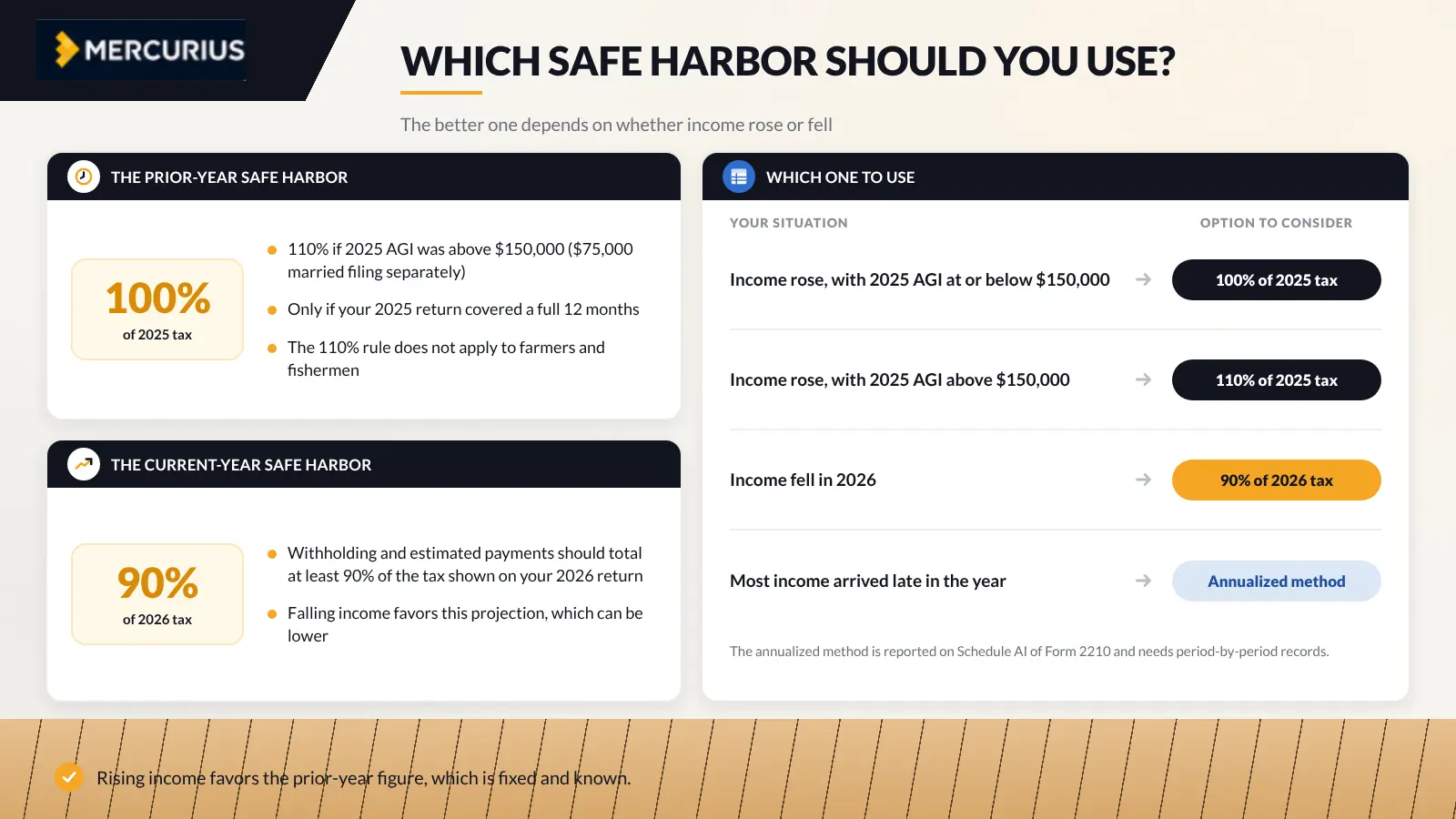
Your withholding and estimated payments should total at least 100% of the tax shown on your 2025 return, or 110% if your 2025 AGI was above $150,000 ($75,000 for married individuals filing separately). This rule applies only if your 2025 tax return covered a complete 12-month period. The 110% rule does not apply to farmers and fishermen.
The Current-Year Safe Harbor
Withholding and estimated payments should total at least 90% of the tax shown on your 2026 return.
Which One to Use
Rising income favors the prior-year figure, which is fixed and known. Falling income favors the current-year projection, which can be lower.
If Your Income Was Uneven: Annualize
Installments are not always four equal amounts. The annualized income installment method matches tax to the period in which income was earned, which helps with seasonal or late-year income.
It requires period-by-period records and is reported on Schedule AI of Form 2210 with the return.
| Your situation | Option to consider |
|---|---|
| Income rose, with 2025 AGI at or below $150,000 | 100% of 2025 tax |
| Income rose, with 2025 AGI above $150,000 | 110% of 2025 tax |
| Income fell in 2026 | 90% of 2026 tax |
| Most income arrived late in the year | Annualized method |
Can You Skip the January 15 Payment?
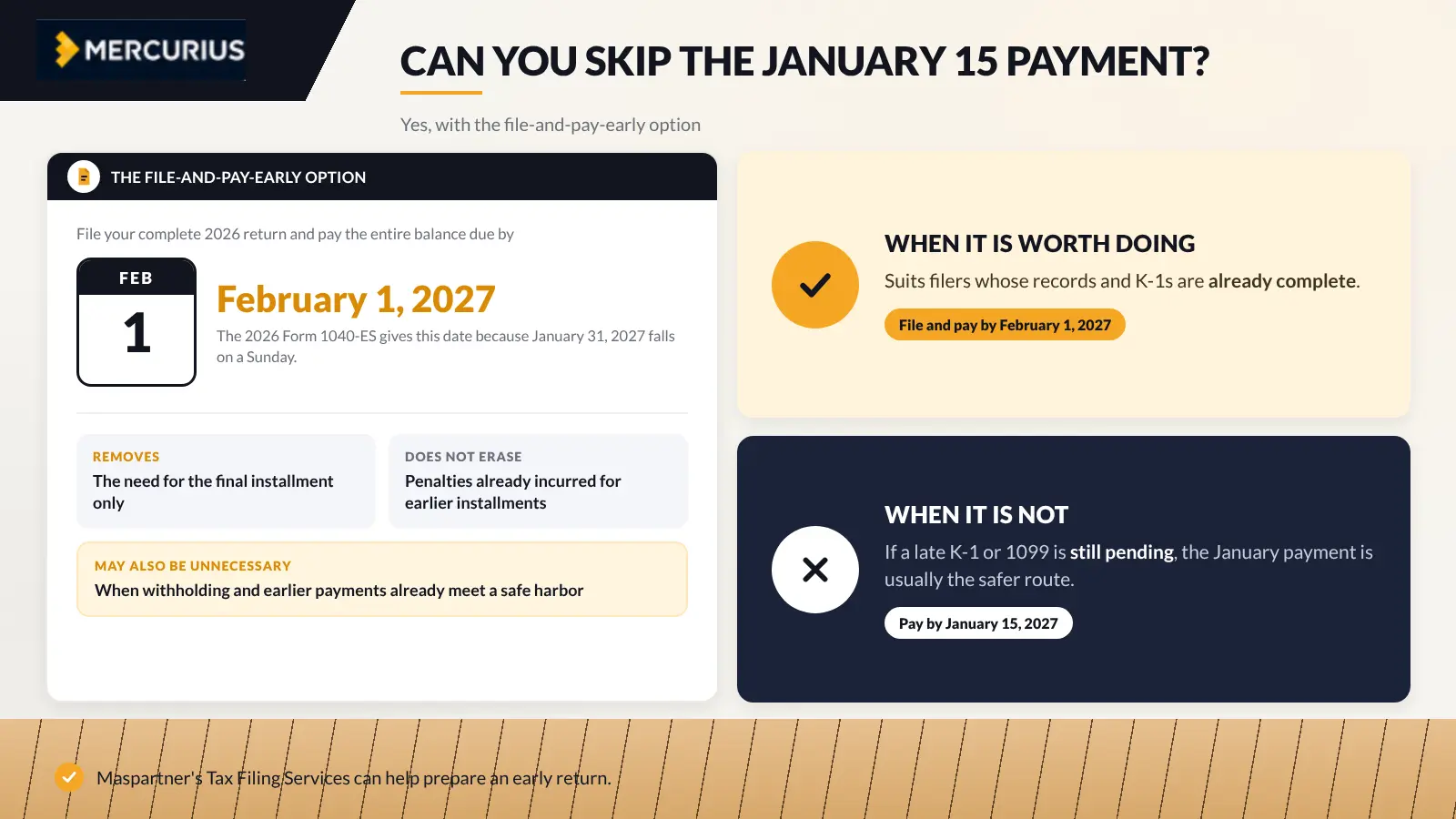
Yes, if you file your complete 2026 return and pay the entire balance due with it by February 1, 2027. The 2026 Form 1040-ES gives February 1 because January 31, 2027 falls on a Sunday.
The File-and-Pay-Early Option
This removes the need for the final installment only. It does not erase any underpayment penalty already incurred for earlier installments.
When It Is Worth Doing
It suits filers whose records and K-1s are already complete. Maspartner’s Tax Filing Services can help prepare an early return.
When It Is Not
If a late K-1 or 1099 is still pending, the January payment is usually the safer route.
How to Make Estimated Tax Payments
Individuals can pay online through IRS Direct Pay, an IRS Online Account, or by debit or credit card (a processing fee applies), or mail a check with a Form 1040-ES voucher.
Payment Methods
EFTPS stopped accepting new individual enrollments on October 17, 2025, and the IRS has said all individuals will be required to move to IRS Direct Pay or an IRS Online Account. If you still use EFTPS, confirm that you can log in, or switch to one of those options before paying.
Paper checks remain available, but the IRS encourages electronic payment. Under USPS rules effective December 24, 2025, a postmark may reflect the date mail is first processed rather than the date it was dropped off, which can be later than the date you mailed it. Mail early, or pay online close to January 15.
Tag the Payment Correctly
Choose estimated tax (Form 1040-ES) as the payment type and specify 2026 as the applicable tax year. A payment applied to the wrong year or type is a common error and slow to correct.
Keep the Confirmation
File each confirmation with the year’s tax records. You can also check posted payments in your IRS Online Account.
What Happens If You Pay Late?
A late or short installment triggers an underpayment penalty, which works like interest on the shortfall.
The Underpayment Charge
The penalty begins accruing on the payment due date and continues until the tax is paid or the return deadline arrives (April 15, 2027), whichever occurs earlier. The rate is the IRS underpayment rate, compounded daily, which is 7% a year for October through December 2026. The IRS resets it quarterly, so a shortfall that starts on January 15, 2027 is charged at the rate in effect for each 2027 quarter.
A Short Clock
A Q4 shortfall accrues for only a few months, so paying late costs far less than not paying. For catch-up options on an earlier quarter, see Missed Your Q3 Estimated Tax Payment.
Special Rules: Farmers, Fishermen, and Corporations
Farmers and Fishermen
Taxpayers who earn at least two-thirds of gross income from farming or fishing in 2025 or 2026 can make a single payment by January 15, 2027. They may instead file their 2026 return and pay the total tax due by March 1, 2027. For these taxpayers, 66 2/3% replaces 90% in the current-year test.
Corporations
C corporations follow a separate schedule, and a calendar-year corporation’s final installment is due December 15, 2026. For further information, refer to the section on Corporate Estimated Tax Payments.
State Estimated Tax Payments
Separate Schedules
Most income-tax states run their own estimated schedules, and a few use different due dates. A federal payment does not satisfy a state requirement, so check your state revenue department.
Your January 15 Checklist
Before You Pay
- Reforecast income using accurate year-to-date figures from your Bookkeeping Services records.
- Test both safe harbors.
- Subtract withholding and prior installments.
- Confirm the amount.
After You Pay
Save the confirmation, update the books, and carry the total into your return. Business owners also face W-2 and 1099-NEC filing dates on February 1, 2027, covered in W-2 and 1099 Deadline 2027.
Conclusion: Planning Your Final 2026 Installment
January 15, 2027, marks the deadline for the final estimated tax payment for the 2026 tax year. Reforecast income, compare the two safe harbor targets, subtract what you have paid, and decide whether to pay or file early.
Maspartner supports clients with estimated tax planning and U.S. tax filing.
FAQs
When is the fourth-quarter estimated tax payment due?
The federal Q4 estimated tax payment for 2026 is due Friday, January 15, 2027. It covers income earned from September 1 through December 31, 2026.
How much should you pay for the Q4 estimated tax payment?
Calculate the remaining annual tax amount by subtracting withholding and the first three installments from the required annual payment. This total is the lower of 90% of your 2026 tax or 100% of your 2025 tax (110% if your 2025 AGI exceeded $150,000).
When must estimated tax payments be made in 2027?
Payments due in 2027 fall on January 15 (the final installment for 2026), April 15, June 15, and September 15 (the first three installments for 2027). The final installment for the 2027 tax year is due January 18, 2028.
Is it possible to avoid making the fourth-quarter estimated tax payment?
Yes, by filing your 2026 return by February 1, 2027 and paying the full balance due with it. It may also be unnecessary when withholding and earlier payments already meet a safe harbor.
How does the estimated tax payment safe harbor rule work?
A safe harbor is a payment level that avoids the underpayment penalty: 90% of 2026 tax or 100% of 2025 tax, rising to 110% when 2025 AGI exceeded $150,000.
What happens if you pay the Q4 installment late?
An underpayment penalty accrues on the shortfall from January 15 until you pay or the return is due.
The IRS underpayment rate is reset each quarter and is 7%, compounded daily, for October through December 2026.
Do corporations follow the same January 15 deadline?
No. Calendar-year C corporations make their final 2026 installment by December 15, 2026, under separate corporate rules rather than the individual Form 1040-ES schedule used for the January 15 payment.