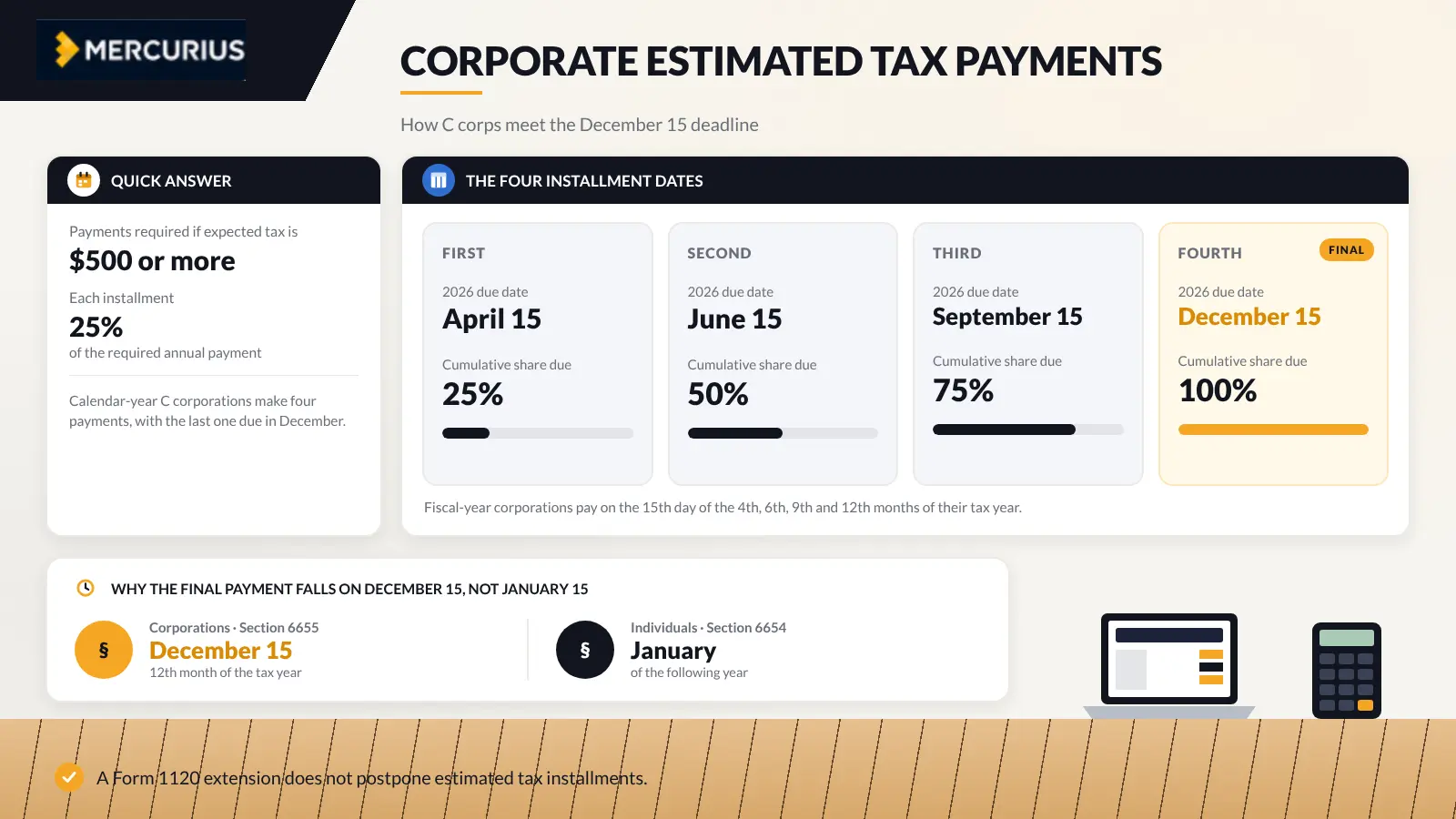
Quick Answer: C corporations expecting to owe $500 or more in federal income tax (after credits) generally make four estimated tax payments during the year. For calendar-year corporations, the 2026 deadlines are April 15, June 15, September 15, and December 15. Each installment is generally 25% of the required annual payment, subject to applicable calculation methods and exceptions.
Missing a corporate estimated tax payment deadline can result in IRS underpayment penalties, even when the annual tax return is filed on time. Unlike individuals, whose final estimated tax installment is generally due in January, calendar-year corporations must complete their fourth payment in December.
This guide explains payment eligibility, installment calculations, safe harbor rules, electronic payment methods, and how businesses can manage potential underpayment penalties.
When Are Corporate Estimated Tax Payments Due?
Corporate estimated tax payments follow a quarterly installment schedule determined by the corporation’s tax year. For calendar-year C corporations, the following table outlines the 2026 payment deadlines and cumulative payment requirements.
The Four Installment Dates
| Installment | 2026 due date | Cumulative share due |
|---|---|---|
| First | April 15 | 25% |
| Second | June 15 | 50% |
| Third | September 15 | 75% |
| Fourth | December 15 | 100% |
Fiscal-Year Corporations
Corporations using a fiscal year calculate their installment deadlines from the beginning of their tax year. Payments generally fall on the 15th day of the fourth, sixth, ninth, and twelfth months.
As a result, December 15 may not be the final payment deadline for every corporation. For example, a corporation whose tax year ends June 30 pays on October 15, December 15, March 15, and June 15. If a due date falls on a Saturday, Sunday, or legal holiday, the installment is due on the next business day. None of the 2026 calendar-year due dates falls on a weekend. Businesses should also check applicable state estimated tax requirements, which may differ from federal rules.
Importantly, an extension of time to file Form 1120 does not postpone estimated tax installments or extend the time to pay the tax. See our Business Tax Extension Deadlines guide for additional information about return filing dates.
Why the Final Payment Falls on December 15, Not January 15
Corporations and Individuals Follow Different Rules
Corporate and individual estimated tax payments follow different schedules under the Internal Revenue Code.
Section 6655 establishes corporate installment deadlines based on the fourth, sixth, ninth, and twelfth months of the tax year. By comparison, Section 6654 generally places the final individual estimated tax installment in January of the following year.
This distinction matters for business owners who manage both personal and corporate tax obligations. Applying the individual January deadline to a calendar-year corporation could result in a late fourth installment and potential underpayment penalties.
Which Corporations Must Make Estimated Tax Payments?
C corporations generally must make estimated tax payments when they expect their federal income tax liability, after applicable credits, to reach $500 or more.
This requirement also applies to LLCs that have elected to be taxed as C corporations.
S corporations follow different rules because their income generally passes through to shareholders. However, an S corporation may have estimated tax payment obligations when the total of its built-in gains tax, excess net passive income tax, and investment credit recapture tax is $500 or more.
Understanding these distinctions helps businesses determine whether quarterly payments are required before calculating their installment amounts.
Form 1120-W Is Retired: Use the Publication 542 Worksheet
Form 1120-W and its instructions are now classified by the IRS as historical, and the 2022 revisions were the last ones issued. Corporations can instead use the Estimated Tax Worksheet provided in IRS Publication 542 as a guide to figure each required estimated tax installment.
Using current IRS guidance helps businesses apply the appropriate calculation methods and avoid relying on outdated forms.
How Do C Corporations Calculate Each Installment?
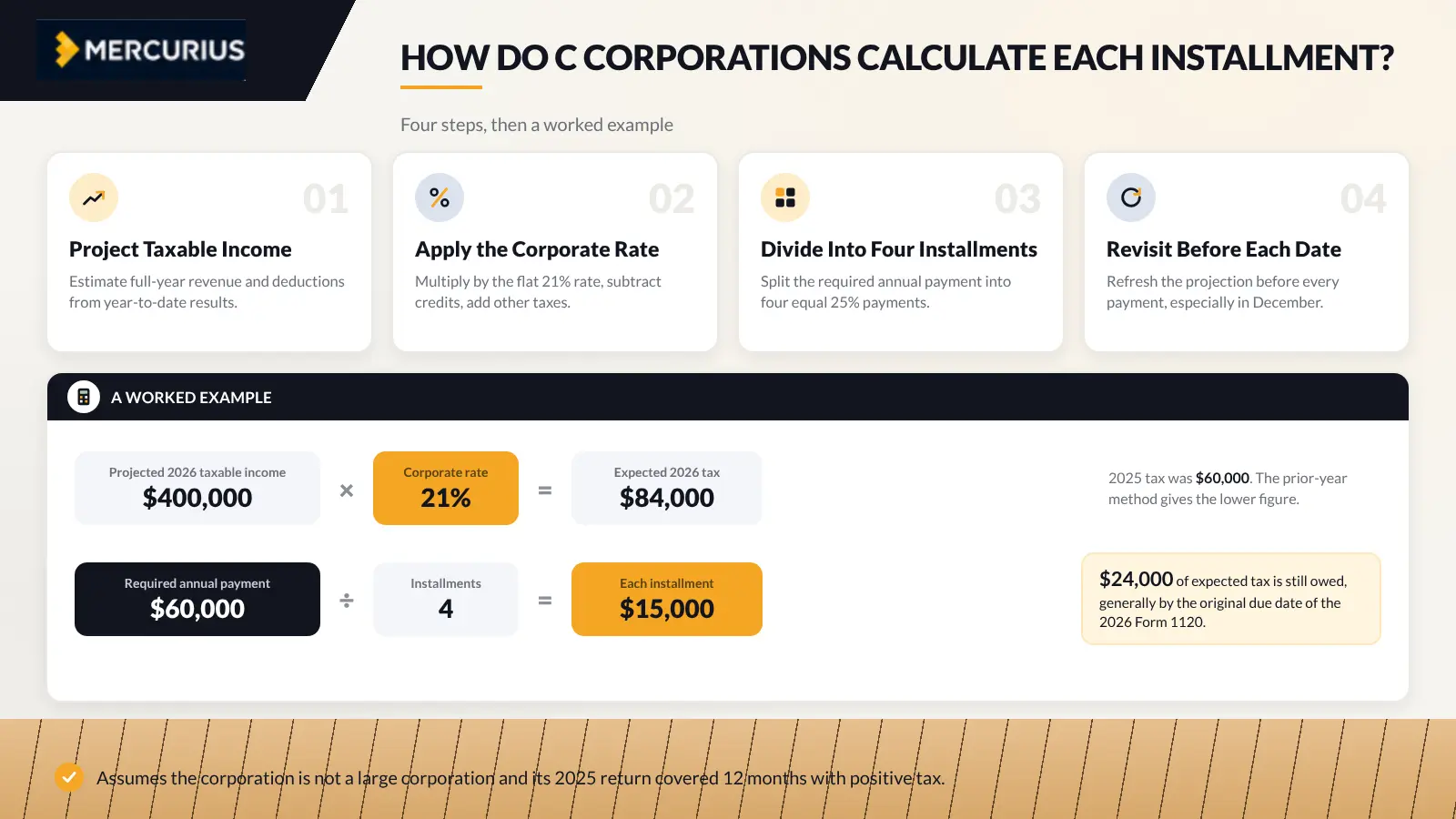
Project Taxable Income
Estimate full-year revenue and deductions, using year-to-date results and expected activity, to reach projected taxable income.
Apply the Corporate Rate
Multiply taxable income by the flat 21% federal rate, subtract expected credits, and add any other taxes the corporation expects to owe to find expected annual tax.
Divide Into Four Installments
The required annual payment is generally divided into four equal installments of 25% each. The required annual payment itself is generally the smaller of the current-year figure and, if the corporation is eligible, the prior-year figure, as explained in the safe harbor section below.
A Worked Example
Assume projected 2026 taxable income of $400,000. At 21%, expected tax is $84,000. The 2025 tax was $60,000.
Assuming the corporation is not a large corporation and its 2025 return covered a full 12 months and showed a positive tax liability, it qualifies for the prior-year method described below. The required annual payment is then the lower figure, $60,000, and each installment is $15,000. Paying these installments on time generally avoids the underpayment penalty, but the remaining $24,000 of expected tax is still owed and is generally due by the original due date of the 2026 Form 1120, not including extensions.
Revisit Before Each Date
Refresh the projection before every payment date, especially in December, when the year’s results are nearly known. If an earlier installment turns out to be too low, an immediate catch-up payment can reduce the underpayment penalty.
What Are the Safe Harbor Rules for Corporate Estimated Taxes?
Corporate estimated tax safe harbor rules provide methods for determining installment amounts that generally protect businesses from underpayment penalties when the applicable requirements are met. Publication 542 describes these rules as Method 1 (current year) and Method 2 (prior year).
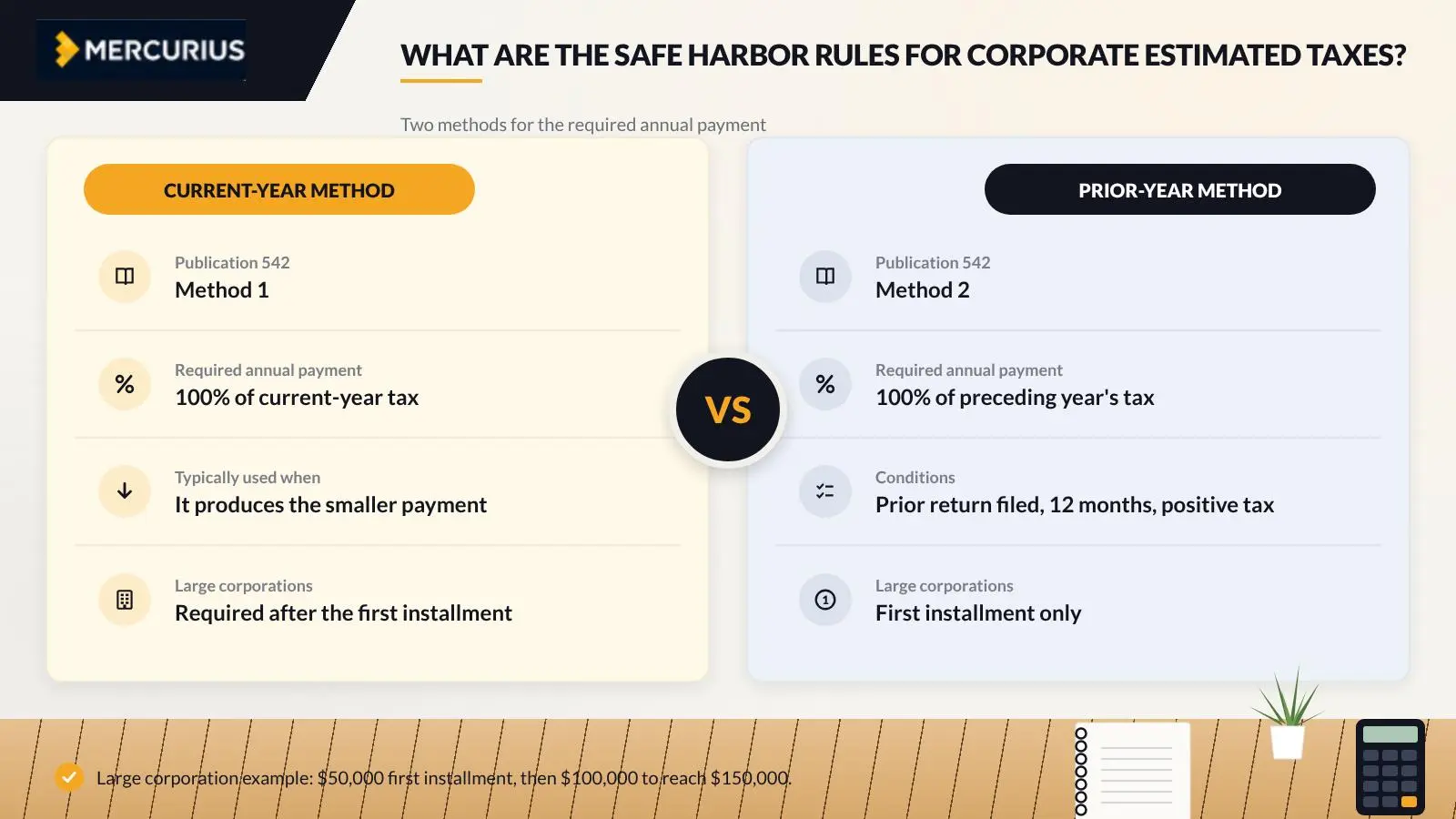
Corporations may generally calculate their required annual payment using either method below, and typically use whichever produces the smaller payment:
- Current-year method: 100% of the corporation’s current-year tax liability.
- Prior-year method: 100% of the preceding year’s tax, provided the corporation filed a return for the previous year, that year covered 12 months, and the return reported a positive tax liability.
How Does the Large Corporation Exception Work?
A corporation (other than an S corporation) generally qualifies as a large corporation when it had taxable income of $1 million or more in any of the three immediately preceding tax years (or in fewer years, if it has existed for less time). For this test, taxable income is figured without net operating loss and capital loss carrybacks or carryovers, and members of a controlled group share a single $1 million threshold.
Large corporations may generally use the prior-year amount for their first installment only, with subsequent payments adjusted using current-year tax requirements. Any reduction in the first installment is made up in the second installment.
For example, suppose a large corporation expects $300,000 in current-year tax and had $200,000 of tax for the preceding year.
Its first installment may be $50,000 based on the prior-year figure. However, its second installment would need to increase to $100,000 to bring cumulative payments to $150,000, assuming neither the annualized income installment method nor the adjusted seasonal installment method is used.
How to Pay: Electronic Deposits Are Required
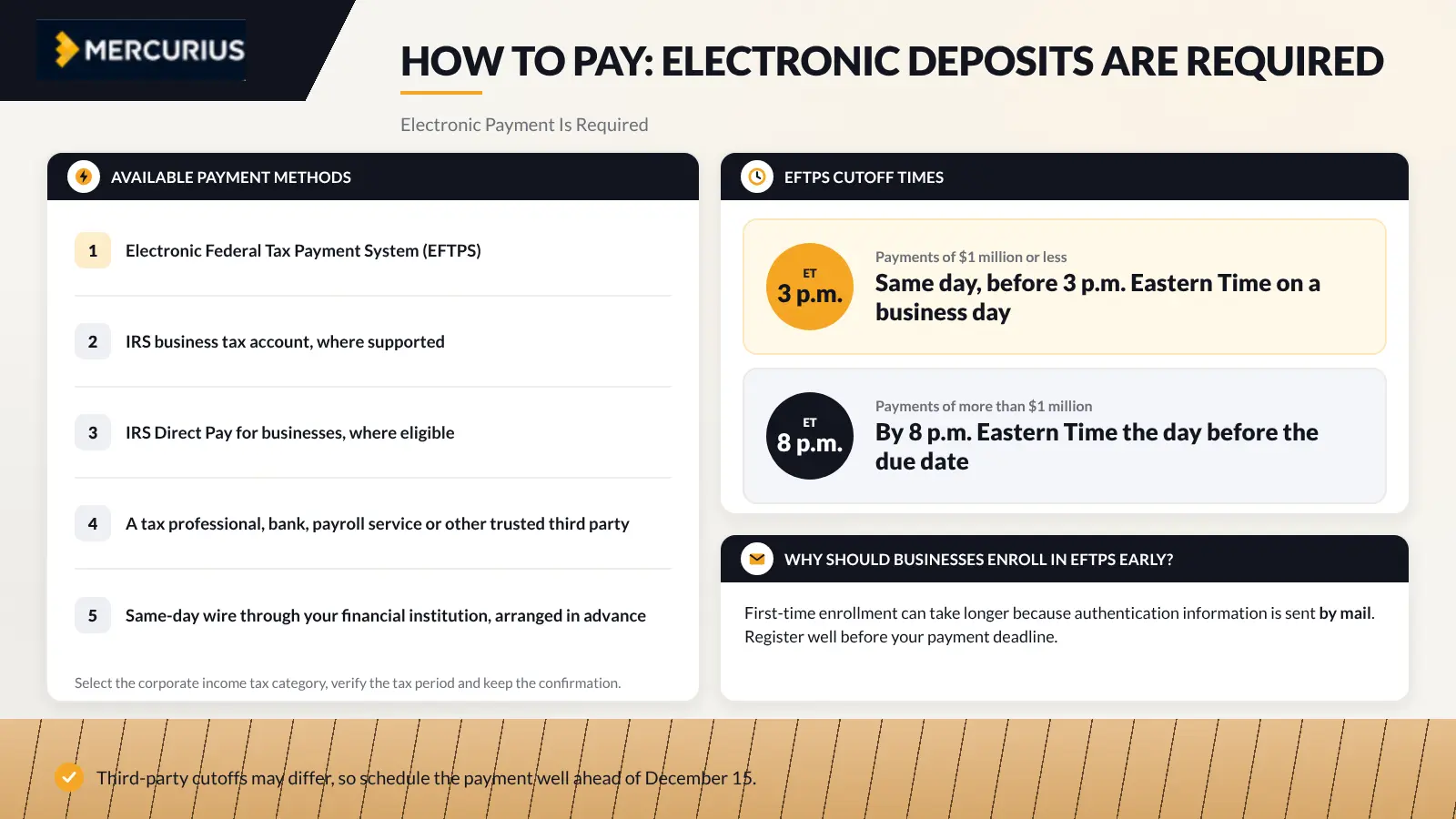
Electronic Payment Is Required
Corporations generally must make federal estimated tax payments electronically. Available methods include:
- Electronic Federal Tax Payment System (EFTPS)
- IRS business tax account, where supported
- IRS Direct Pay for businesses, where eligible
- A tax professional, financial institution, payroll service, or other trusted third party acting on the corporation’s behalf
- Same-day wire through the corporation’s financial institution, arranged in advance
When submitting a payment, businesses should select the appropriate corporate income tax category, verify the tax period, and retain the payment confirmation for accounting records.
EFTPS accepts same-day payments of $1 million or less if they are submitted before 3 p.m. Eastern Time on a business day. A payment of more than $1 million must be submitted by 8 p.m. Eastern Time the day before the due date. Cutoff times may differ when a third party makes the payment, so scheduling the payment well ahead of December 15 is the safest approach.
Why Should Businesses Enroll in EFTPS Early?
First-time enrollment may require additional processing time because authentication information is sent by mail. Businesses intending to use EFTPS should complete registration well before their payment deadline to avoid last-minute difficulties.
Underpayment Penalties and Form 2220
Corporations may incur an underpayment penalty when an estimated tax installment is insufficient or paid after its deadline. The charge, which the Internal Revenue Code treats as an addition to tax, depends on the amount of the underpayment, the period it remains unpaid, and the underpayment interest rate the IRS publishes quarterly. No penalty applies if the tax shown on the corporation’s return is less than $500.
For the fourth quarter of 2026, the federal underpayment interest rate is 7% annually, compounded daily (IRS Revenue Ruling 2026-15). Because the IRS adjusts interest rates quarterly, the applicable rate may change during an underpayment period.
How Is Form 2220 Used?
Form 2220 helps corporations calculate estimated tax underpayment penalties. A corporation generally does not have to file it, because the IRS can figure any penalty and bill the corporation. However, even when no penalty is owed, the corporation must attach Form 2220 to Form 1120 in situations such as using the annualized income installment method, using the adjusted seasonal installment method, or being a large corporation that figures its first installment on the prior year’s tax.
The penalty is figured separately for each installment, so a corporation can owe a penalty for an earlier due date even if later payments make up the shortfall. Each payment is applied to the earliest unpaid installment first, and the penalty period generally runs from the installment’s due date until the shortfall is paid or the return’s original due date arrives, whichever is earlier.
For guidance on individual estimated tax requirements, see our Missed Your Q3 Estimated Tax Payment article.
Annualized and Adjusted Seasonal Methods
For Uneven or Seasonal Income
Corporations whose income varies during the year, such as a seasonal business, may be able to lower one or more installments by using the annualized income installment method or the adjusted seasonal installment method.
Why It Matters
These methods can reduce or eliminate a penalty that equal installments would create. The calculation is made on Schedule A (Form 2220). If Schedule A is used for any installment due date, it must be used for all due dates, and for each installment Schedule A selects the smallest of the annualized, seasonal (if applicable), and regular installment amounts. The adjusted seasonal installment method is available only if the corporation’s base period percentage (generally, the share of taxable income earned in its busiest six consecutive months, averaged over the three preceding years) is 70% or more.
If You Overpaid: The Quick Refund Option
Applying for an Early Refund
A corporation that substantially overpays estimated tax can apply for a quick refund on Form 4466.
- The overpayment must be at least 10% of the corporation’s expected tax liability and at least $500.
- File after the tax year ends, before filing the return, and no later than the original due date of the return (not including extensions); an extension of time to file does not extend this deadline.
- The IRS acts on the application within 45 days from the date it is filed.
- A copy of Form 4466 must also be attached to the corporation’s income tax return.
Your December 15 Checklist
Before the Payment Date
- Keep year-to-date figures current with our Bookkeeping Services so the projection is reliable.
- Update the full-year projection.
- Confirm which safe harbor method applies.
- Schedule the payment.
After the Payment
Record the payment, reconcile it against the books and carry it forward to the Form 1120 filing. Maspartner’s Accounting Services can support that reconciliation.
Conclusion
Managing corporate estimated tax payments requires accurate financial records, regular tax projections, and timely installment planning. Understanding the applicable calculation methods and payment requirements can help C corporations reduce compliance risks and avoid unnecessary penalties.
At Maspartner, we support US businesses with corporate tax compliance, accounting, and bookkeeping services. Explore our Taxation Services or book your free consultation today to discuss your estimated tax obligations and upcoming deadlines.
FAQs
When are corporate estimated tax payments due?
Calendar-year C corporations pay on April 15, June 15, September 15 and December 15. Fiscal-year corporations pay on the 15th day of the 4th, 6th, 9th and 12th months.
Why is the C corp fourth installment due December 15?
Corporate installments follow the Internal Revenue Code’s corporate schedule, which sets the fourth installment in the 12th month of the tax year. Individual deadlines follow separate rules.
Which corporations must make estimated tax payments?
C corporations expecting to owe $500 or more must pay. S corporations pay only when built-in gains, excess net passive income and investment credit recapture taxes total $500 or more.
Is Form 1120-W still used?
No. The IRS classifies Form 1120-W as historical, with the 2022 version as the last revision. Corporations can use the Estimated Tax Worksheet in Publication 542 as a guide.
How do you calculate corporate estimated tax payments?
Project taxable income, apply the 21% rate, subtract credits, and pay the required annual amount in four equal installments, using the current-year or an eligible prior-year safe harbor.
How do corporations pay estimated tax?
Corporations pay electronically through EFTPS, an IRS business tax account or IRS Direct Pay for businesses. First-time EFTPS users should enroll early because the PIN arrives by mail.
What is the penalty for underpaying corporate estimated tax?
The penalty is an addition to tax charged at the IRS underpayment rate (7% for Q4 2026) on each underpaid installment until the shortfall is paid or the return’s original due date arrives, whichever is earlier. Form 2220 is used to figure the penalty.