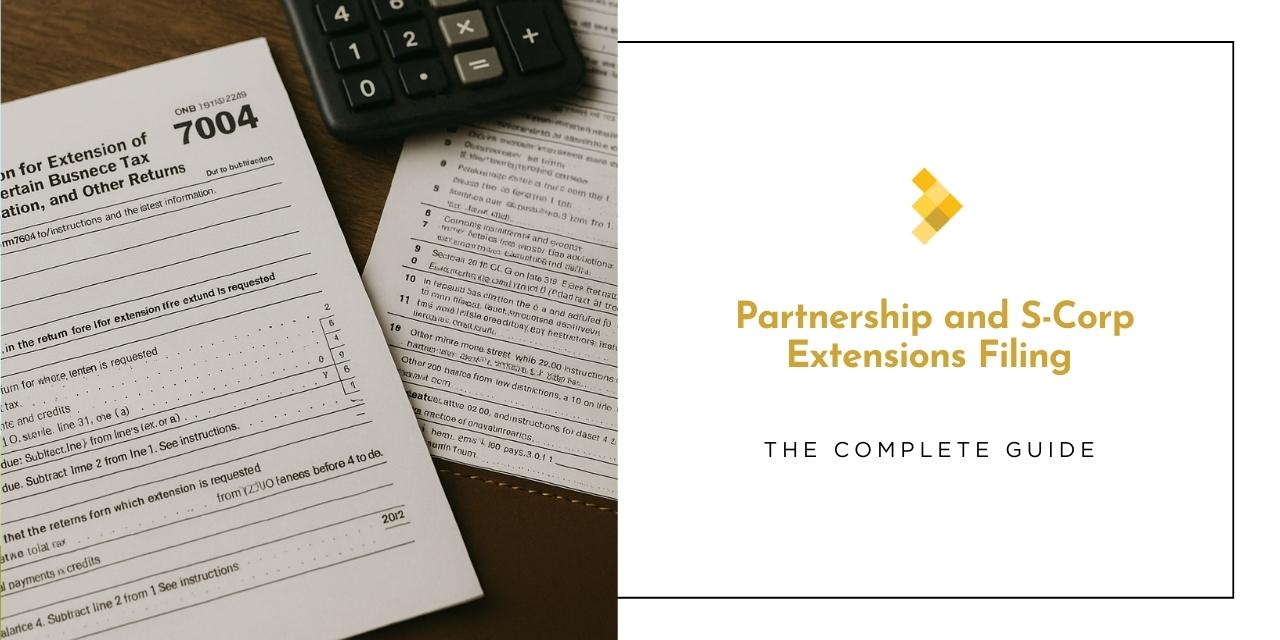
Deadlines are everywhere: projects, bills, even renewing your license. Sometimes you just need extra time. The IRS understands this, which is why it offers S Corporations and partnerships the option to file a 7004 form extension, a simple way to buy up to six more months during tax season.
Filing an extension doesn’t mean you’re avoiding your tax responsibilities, it simply gives you breathing room to get everything right.
In this guide, we’ll cover how S Corp extension work, what they cover, and the steps you need to take to stay compliant at both the federal and state levels.
Why Businesses File Extensions
Extensions are more than a backup; they’re a smart strategy. Many businesses use them to:
• Avoid penalties for late filing
• Ensure accuracy in financial reporting
• Distribute Schedule K-1s to shareholders or partners without rushing
• Allow accountants and bookkeepers more time to reconcile accounts
For an S Corp, accuracy matters. Filing under pressure can lead to errors that are far more expensive to fix than simply requesting more time. S Corp extensions are often the most practical step to ensure compliance.
Filing Deadlines for S Corps and Partnerships
• S Corporations (Form 1120-S) – Due on the 15th day of the third month after the end of the tax year. For calendar-year filers, this usually means March 15 (or the next business day if it falls on a weekend or holiday)
• Partnerships (Form 1065) – Share the same deadline as S Corps, and many businesses choose to file Form 1065 extension to avoid last-minute errors
Filing a 7004 form extension gives you up to six additional months to submit your return. For calendar-year businesses, that moves the deadline to mid-September. These extended dates are one of the main benefits of S Corp extensions.
S Corp Extension Deadline
S Corporations that follow a calendar year must file their taxes by March 15.
By filing IRS Form 7004 on or before your original tax deadline (March 15 for calendar-year S Corps and partnerships), you can automatically extend your filing deadline by six months, moving it to September 15. The S Corp filing deadline moves to September 15 with this extension.
Remember: It extends your filing deadline, but any taxes due must still be paid on time. Any estimated tax due must still be paid by March 15, to avoid penalties.
How to Request a S Corp Extension
To request an extension file IRS Form 7004. The process is easy, but attention to detail is essential. This is the core S Corp form for extensions.
Steps to File Form 7004
1. Determine your return type
• Form 1120-S – For S Corporations
• Form 1065 – For Partnerships
Verify that you’ve marked the correct entity type when completing Form 7004
2. Provide business information
Include accurate details such as your business name, address, and EIN when filing.
3. Estimate your tax liability
The IRS requires you to make a good-faith estimate of your tax due, even when filing an extension. This ensures you remain compliant and avoid underpayment penalties.
4. Choose your filing method
• E-file – Recommended. Filing electronically through the IRS Modernized e-File system gives you instant confirmation
• Paper filing – Still allowed, but slower and riskier close to deadlines
5. Submit payment if necessary
An extension delays filing, not payment. Any taxes due must be paid by your original deadline. Use the Electronic Federal Tax Payment System (EFTPS), IRS Direct Pay, or mail a check along with your form.
6. File before the original due date
Late submissions of Form 7004 will not be granted an extension.
You can review the full IRS Form 7004 instructions on the official IRS website. Choosing the right process ensures smooth handling of S Corp extensions.
What an Extension Covers
Submitting 7004 Form accurately provides an automatic extension of up to six months:
• Form 1120-S – S Corporation return
• Form 1065 – Partnership return
• Schedule K-1s – For shareholders or partners
But it’s equally important to know what it does not cover:
• Tax payments – Any taxes owed must still be paid by the original due date. An extension only delays paperwork, not payments.
• Schedule K-1 obligations – Even though technically extended, partners and shareholders often need their K-1s early to complete personal returns. Don’t delay unnecessarily.
• State taxes – Federal extensions don’t automatically apply to state returns. Rules vary, and many states require a separate filing.
• Accuracy penalties – If your estimates are far below what you actually owe, you may still face underpayment penalties.
Understanding S Corp requirements here is crucial; extensions only help with filing deadlines, not payments.
State-Level Extensions: What You Need to Know
While the federal 7004 form extension applies to S Corps and partnerships nationwide, states handle extensions differently.
• Automatic recognition states – Some states, like California, accept the federal extension if you’ve filed Form 7004.
• Separate filing states – Others, such as New York, require you to submit a state-specific extension form.
• No income tax states – In states like Texas and Florida, there’s no corporate or partnership income tax, so no state extension is necessary.
Since requirements vary, it’s always best to confirm what applies to your state. You can also connect with us to clarify your state’s extension rules and ensure you stay compliant.
S Corp Extensions for Multi-State Businesses
• Check your state’s Department of Revenue website for specific requirements.
• Remember that even if a state grants an extension, payments are usually still due on the original deadline.
• If your business operates in multiple states, confirm rules for each to avoid penalties.
For multi-state filers, S Corp extensions must always be coordinated with state-level requirements.
Best Practices & Pitfalls
Filing for S Corp extensions is simple, but mistakes can lead to penalties.
Best Practices
• File early to reduce the risk of errors.
• Use e-filing for faster processing and confirmation.
• Pay estimated taxes along with your extension filing.
• Keep shareholders and partners informed about when they’ll receive their K-1s.
Pitfalls to Avoid
• Assuming an extension covers payment obligations, it doesn’t.
• Mailing paper forms too close to the deadline.
• Forgetting about state-level requirements.
• Filing the wrong extension form (Form 4868 is for individuals, not businesses).
Avoiding these errors ensures S Corp extensions deliver the benefits they’re meant to provide.
Why Extensions Are a Smart Strategy
Some business owners hesitate to file extensions, fearing it looks disorganized. In reality, extensions are often a sign of smart planning. They allow you to:
• Avoid penalties for late filing.
• Gain more time for accurate reporting.
• Strategically plan taxes, applying deductions or credits carefully.
• Give accountants breathing space during the busiest season.
Extensions provide flexibility while keeping your business compliant; a win-win when used correctly. Filing a timely S Corp filing with an extension ensures you avoid penalties while staying in control.
Final Thoughts
For S Corporations and partnerships, the 7004 form extension is one of the simplest tools to reduce stress during tax season. It grants up to six additional months to file and helps protect your business from penalties.
Just remember: it extends the filing, not the payment. And always check your state’s requirements, since federal approval doesn’t guarantee state approval. When done right, S Corp extensions are a valuable tool for compliance and peace of mind.
Want to file your S Corp extension the right way? We can help you estimate taxes, prepare Form 7004, and handle both federal and state filings, so you never miss a deadline.
Book your free consultation today and stay compliant this tax season.