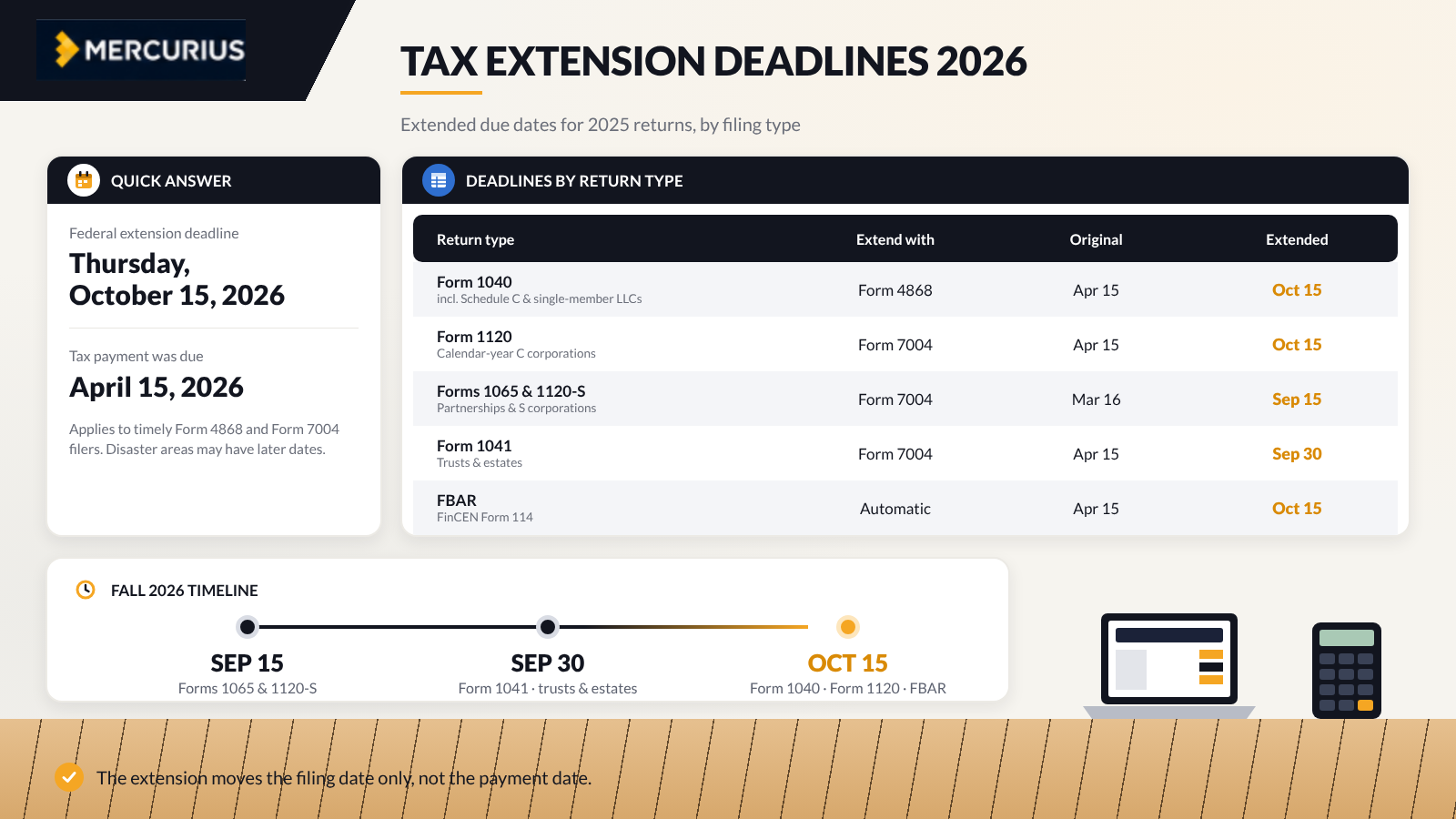
The tax extension deadline is Thursday, October 15, 2026, for 2025 federal returns. It applies to taxpayers who filed Form 4868 or Form 7004 on time, although federally declared disaster areas may have later deadlines. This guide covers what is due, what the extension does not cover, and who gets more time.
Quick answer: The federal tax extension deadline for 2025 individual returns is Thursday, October 15, 2026. The deadline covers taxpayers who timely submitted Form 4868, as well as calendar-year C corporations that requested an extension using Form 7004. The extension covers filing only. Tax owed was due April 15, 2026, and interest has accrued since then.
Tax Extension Deadline 2026 at a Glance
What Are the Tax Extension Deadlines by Filing Type?
The extended deadline depends on the return type, so the fall calendar contains three dates: September 15, September 30, and October 15, 2026.
| Return type | Form used to extend | Original deadline | Extended deadline |
|---|---|---|---|
| Form 1040, including Schedule C filers and single-member LLCs | Form 4868 | April 15 | October 15 |
| Form 1120, calendar-year C corporations | Form 7004 | April 15 | October 15 |
| Forms 1065 and 1120-S | Form 7004 | March 16 | September 15 |
| Form 1041, trusts and estates | Form 7004 | April 15 | September 30 |
| FBAR (FinCEN Form 114) | Automatic | April 15 | October 15 |
Source: IRS tax calendar; Form 4868 and Form 7004 instructions.
Who Has an October 15 Deadline?
Individuals who filed Form 4868, including Schedule C filers and single-member LLC owners, share the October 15 date with calendar-year C corporations that filed Form 7004. For the entity types that file Form 7004 instead of Form 4868, see the IRS instructions for Form 7004.
What Do You Need to File Before October 15?
Extended filers must submit the complete return, including required schedules and supporting forms, by October 15, 2026.
Your Federal Return
Individuals file Form 1040 and calendar-year C corporations file Form 1120, each with every schedule attached.
Schedules K-1 You Are Still Waiting On
K-1s from extended partnerships and S corporations were due in September. If you have not received your K-1 yet, follow up with the entity promptly, as a delayed K-1 does not change the October 15 filing deadline.
FBAR and Foreign Reporting
FinCEN Form 114 carries an automatic extension to October 15 and is filed separately through the BSA E-Filing System, not with the tax return. Form 8938 and Form 3520 are tied to the return where they apply.
What Does a Tax Extension Not Cover?
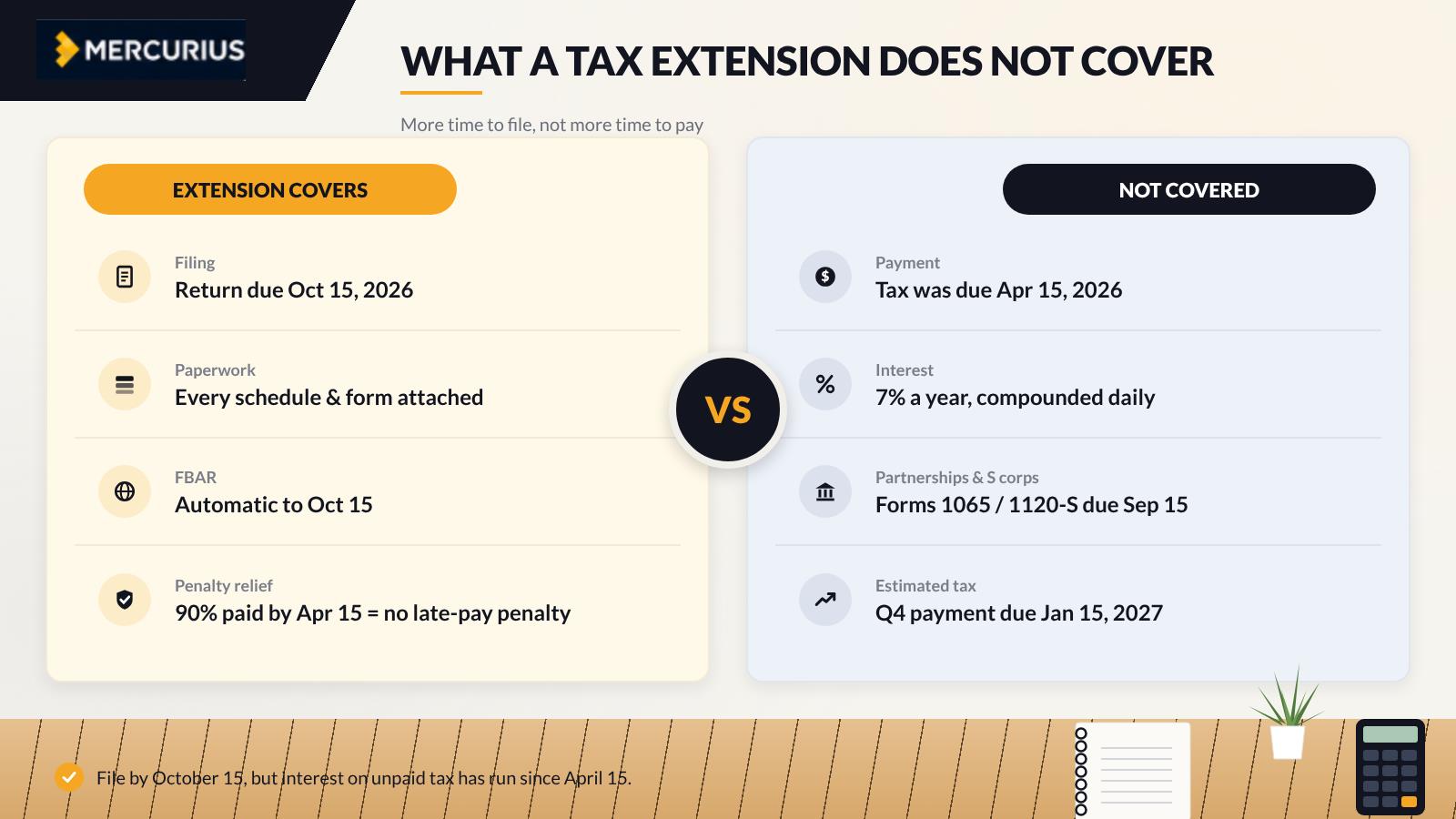
The extension gives you additional time to submit the return, but the tax payment deadline remains unchanged.
Myth-buster: An extension does not extend payment, stop interest, or move partnership, S corporation, or estimated tax deadlines.
Does the Original Tax Payment Deadline Still Apply?
Yes. Tax for 2025 was due April 15, 2026, and interest has accrued since then. For the quarter beginning October 1, 2026, the IRS underpayment rate is 7% annually, compounded daily. Unpaid tax may incur a monthly penalty of 0.5%, with the total penalty limited to 25%.
The Form 4868 instructions provide relief: no late payment penalty applies if at least 90% of the actual 2025 tax was paid by April 15 and the balance is paid with the return by October 15.
Does It Cover Partnership and S Corporation Returns?
No. Extended Form 1065 and Form 1120-S returns were due September 15, 2026.
Does It Move Estimated Tax Deadlines?
No. Estimated tax payments follow a separate quarterly payment schedule. The third-quarter payment was due September 15, 2026, and the fourth-quarter payment is due January 15, 2027. Taxpayers who missed the third-quarter date can review the IRS guidance on estimated tax payments.
Can an Extension Be Voided?
Yes. Form 4868 requires a reasonable estimate of the tax owed. If the IRS finds the estimate was not made in good faith, it may treat the extension as invalid, and late filing penalties then run from April 15.
Who Gets More Time Than October 15?
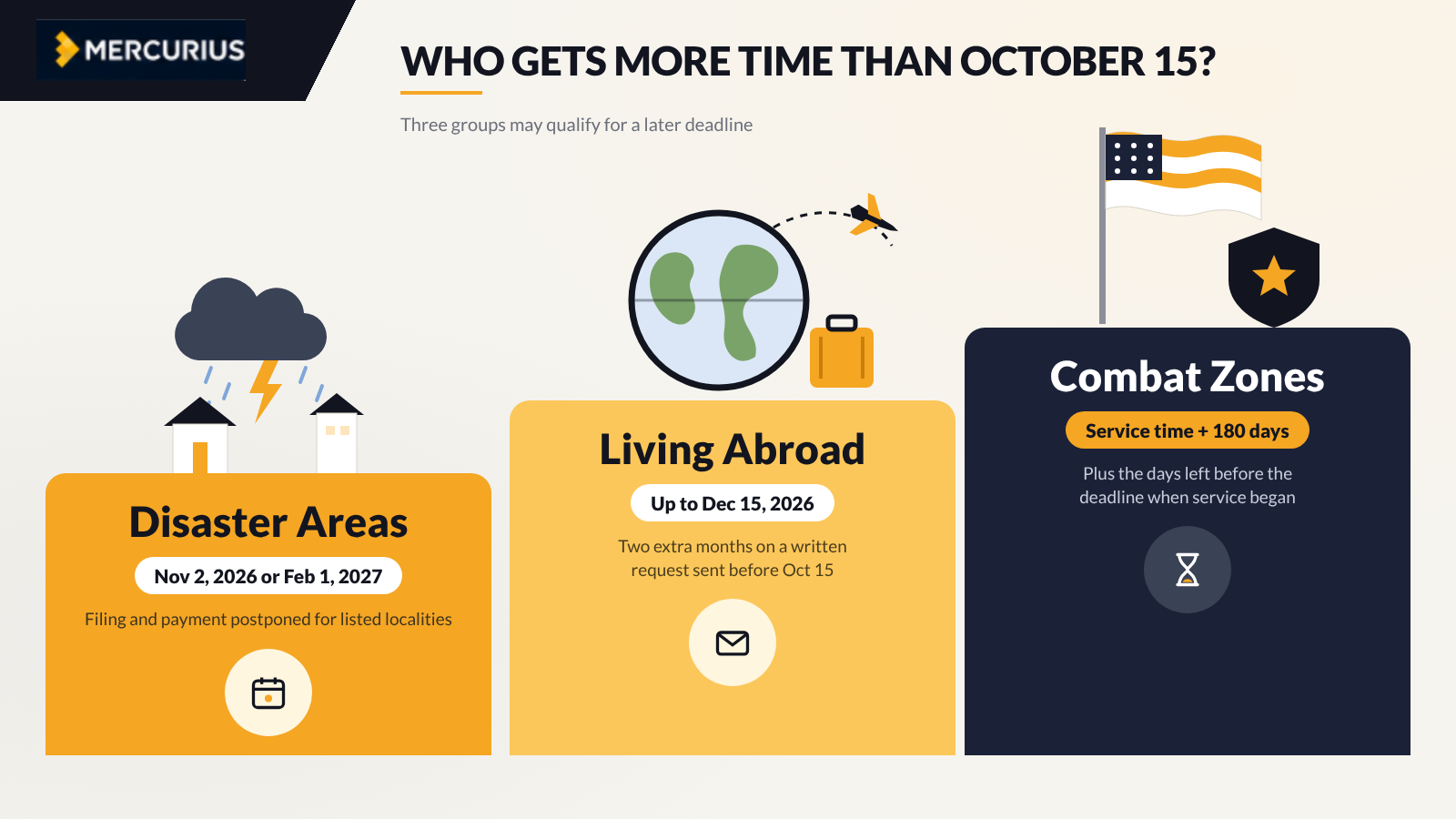
Three groups may have a later deadline: taxpayers in federally declared disaster areas, military members in combat zones, and US taxpayers living abroad.
Taxpayers in Declared Disaster Areas
Taxpayers in designated disaster areas may receive extended deadlines for both filing returns and paying taxes. As of early October 2026, announcements include postponements to November 2, 2026 for parts of Louisiana, Michigan and Mississippi, and to February 1, 2027 for parts of Indiana, Nebraska, Washington and Hawaii. Each notice lists the covered localities, so check the IRS tax relief in disaster situations page before filing.
Military Members in Combat Zones
Combat zone duty can extend the deadlines for filing and tax payments. The extension equals time served in the combat zone, plus 180 days and the days remaining before the deadline when service began.
US Taxpayers Living Abroad
A further extension may be available to taxpayers overseas. The IRS may grant, at its discretion, two additional months to December 15, 2026, on a written request sent before October 15.
Do State Extended Deadlines Match October 15?
No. Most income-tax states use October 15, but some set a later date or require a separate extension request.
| State | Extended deadline (2026) |
|---|---|
| Virginia | November 1 |
| Iowa | October 31 |
| Louisiana | November 15 |
| Hawaii | October 20 |
New York requires its own extension form, Form IT-370, while California extends automatically. Confirm each date with the state revenue department before filing.
Which Last-Minute Tax Moves Are Still Available?
A valid extension leaves a planning window for certain retirement contributions and elections. SEP-IRA contributions, and the establishment of a new SEP, can generally be made up to the extended due date. Solo 401(k) employer contributions can also be made by then, but employee deferrals generally had to be elected by December 31, 2025. Some elections must be made on a timely filed return, which includes a return filed by the extended due date.
How Do You File Before the Tax Extension Deadline?
E-filing is the fastest way to meet the deadline. Follow these steps:
-
- E-file and confirm acceptance. IRS Free File guided software covers taxpayers with 2025 adjusted gross income of $89,000 or less, and Free File Fillable Forms are available at any income level.
- File on time if a number is missing. Use the best information available, then amend with Form 1040-X if a late K-1 or corrected 1099 changes the return.
- Pay what you can. Options include IRS Direct Pay, an IRS Online Account, debit or credit card, or a payment plan.
- Complete a final check of four items:
- every K-1 and corrected 1099 has been received;
- the April extension payment is reported on Schedule 3 (Form 1040);
- all 2025 estimated payments and any 2024 overpayment are applied;
- the FBAR is filed separately.
What Happens If You Miss the Deadline or Never Filed an Extension?
If You Never Filed Form 4868
The deadline to file a tax extension was April 15, 2026, and a request can no longer be made. The return is late, so file as soon as possible.
If You Miss October 15
The failure-to-file penalty begins once the extended deadline passes, and a second filing extension generally cannot be requested. The penalty is 5% of unpaid tax per month, or 4.5% when the late payment penalty also applies, up to 25%. Returns filed more than 60 days late, which means after December 14, 2026, face a minimum penalty of the lesser of $525 or 100% of the tax due. See the IRS guidance on getting an extension and filing your tax return for next steps.
Conclusion
October 15, 2026 is the final federal tax extension deadline for most extended 2025 returns, with limited exceptions for disaster areas, combat zones, and taxpayers abroad. Extended filers must submit the return by that date; the extension does not cover payment, estimated tax, or the earlier partnership and S corporation due dates. Maspartner supports US tax filing, accounting, and bookkeeping, and its Tax Filing Services page describes the filing support available. Book your free consultation today to confirm your filing position before the deadline.
FAQs
When is the tax extension deadline in 2026?
The tax extension deadline for 2025 federal individual returns is Thursday, October 15, 2026, for taxpayers who filed Form 4868 by April 15.
Can I still file a tax extension now?
No. Extension requests were due April 15, 2026. Taxpayers without one should file the return as soon as possible.
Does a tax extension also extend the payment deadline?
No. An extension gives more time to file only. Tax for 2025 was due April 15, 2026, and interest accrues on any unpaid balance.
Can you file a second tax extension after October 15?
Generally no. The failure-to-file penalty applies after October 15, though taxpayers living abroad may request a discretionary additional two months to December 15, 2026.
Is the October 15 deadline the same for business tax returns?
Not always. Calendar-year C corporations share October 15, but Forms 1065 and 1120-S were due September 15 and Form 1041 September 30.
Is the FBAR also due on October 15?
Yes. FinCEN Form 114 has an automatic extension to October 15, 2026, and is filed separately through BSA E-Filing, not with the tax return.
Who gets more time than October 15 to file?
Taxpayers in federally declared disaster areas, military members in combat zones, and some taxpayers abroad may receive additional time, depending on their circumstances.