


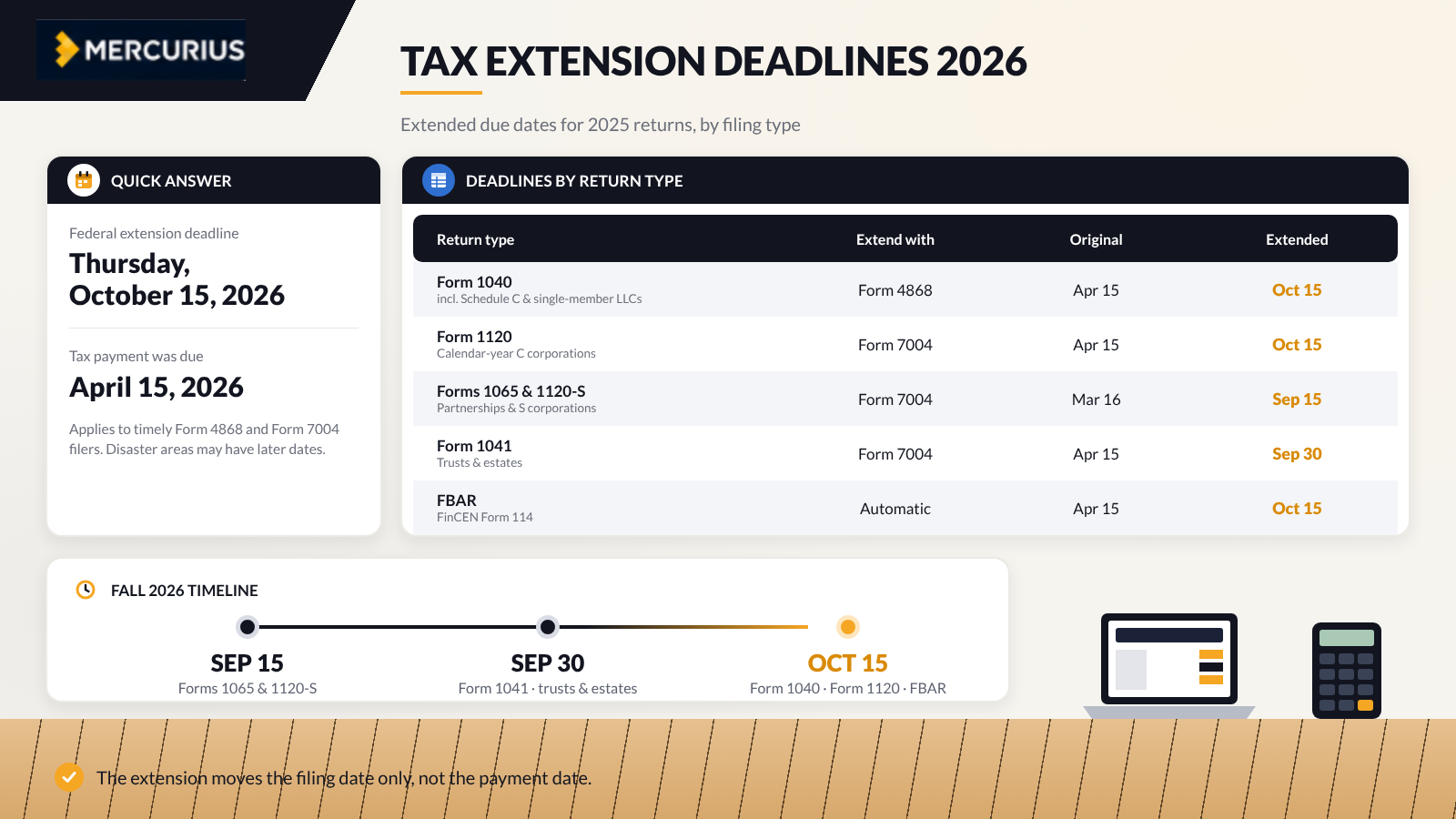
For calendar-year businesses, a timely Form 7004 extended the tax year 2025 filing deadline to September 15, 2026, for partnerships (Form 1065) and S corporations (Form 1120-S), and October 15, 2026, for C corporations (Form 1120). For tax year 2026, the corresponding extended deadlines are September 15 and October 15, 2027. A business tax extension gives you additional time to submit your return, but any tax owed must still be paid by the original deadline.
This guide covers key filing dates for 2026 and 2027, Form 7004 requirements, payment rules, fiscal-year variations, and potential penalties.
Business Tax Extension Due Dates for 2026 and 2027
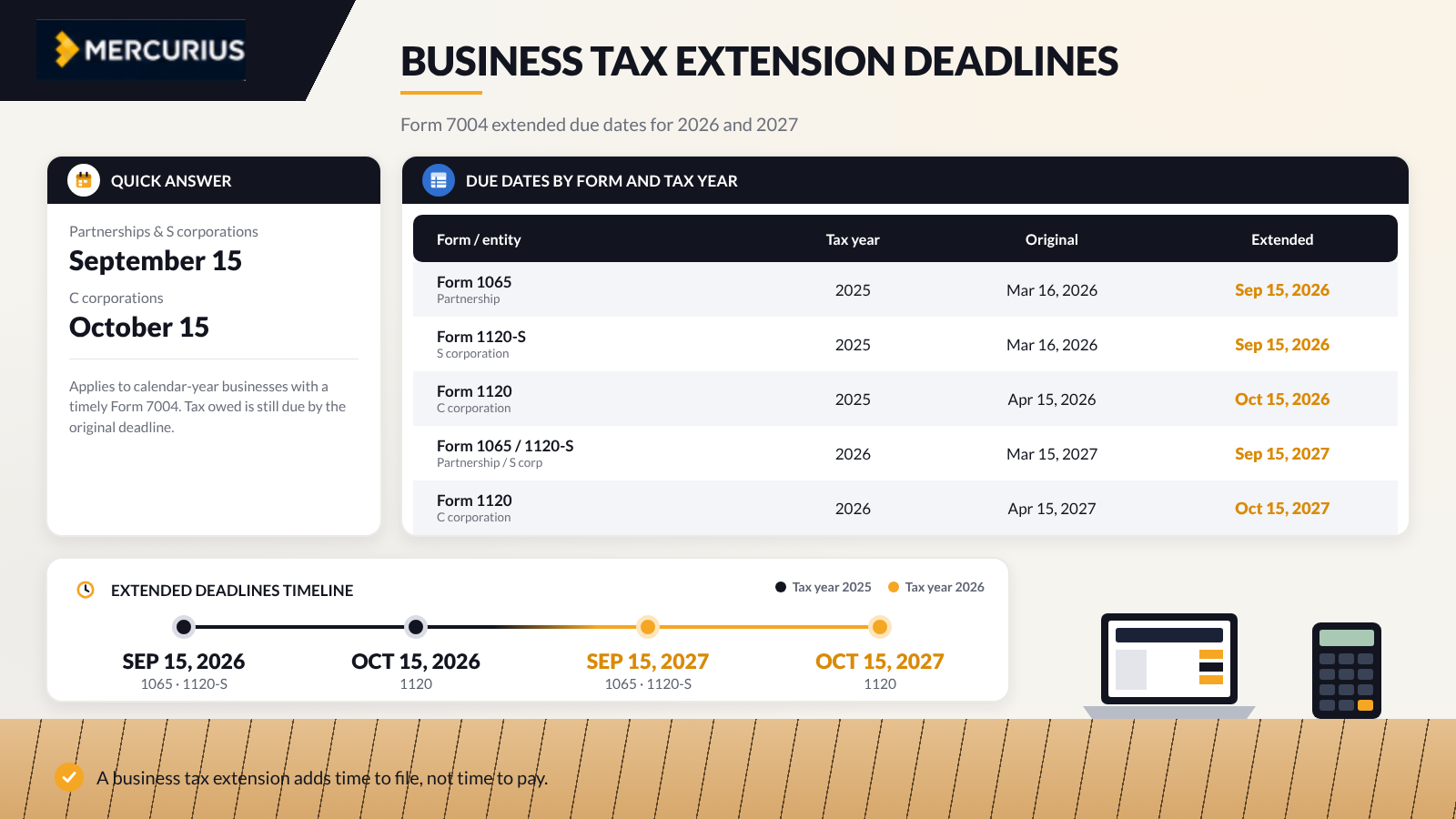
Deadlines depend on the entity’s tax classification and accounting year. This table compares original and extended deadlines for calendar-year businesses with valid extensions.
| Form | Entity | Tax year | Original deadline | Extended deadline |
|---|---|---|---|---|
| 1065 | Partnership | 2025 | March 16, 2026 | September 15, 2026 |
| 1120-S | S corporation | 2025 | March 16, 2026 | September 15, 2026 |
| 1120 | C corporation | 2025 | April 15, 2026 | October 15, 2026 |
| 1065 / 1120-S | Partnership / S corporation | 2026 | March 15, 2027 | September 15, 2027 |
| 1120 | C corporation | 2026 | April 15, 2027 | October 15, 2027 |
Fiscal-year entities follow different schedules. Sole proprietors (including single-member LLCs reporting on Schedule C) generally use Form 4868 instead. Calendar-year estates and trusts filing Form 1041 also use Form 7004, which provides a 5½-month extension, generally to September 30.
How Is the Six-Month Extension Period Measured?
A timely Form 7004 generally adds six months from the statutory filing deadline. Weekend and holiday rules can shift the original due date without changing the extended date.
For example, March 15, 2026, was a Sunday, moving the original partnership and S corporation deadline to March 16. Their extension still ended September 15, 2026. See IRS Publication 509 and the Form 7004 instructions.
Form 7004 Filing Instructions for Business Tax Extensions
Businesses filing Forms 1065, 1120-S, or 1120 generally request an automatic filing extension through Form 7004. Submit it by the original return deadline; electronic filing is available. A separate Form 7004 is required for each return.
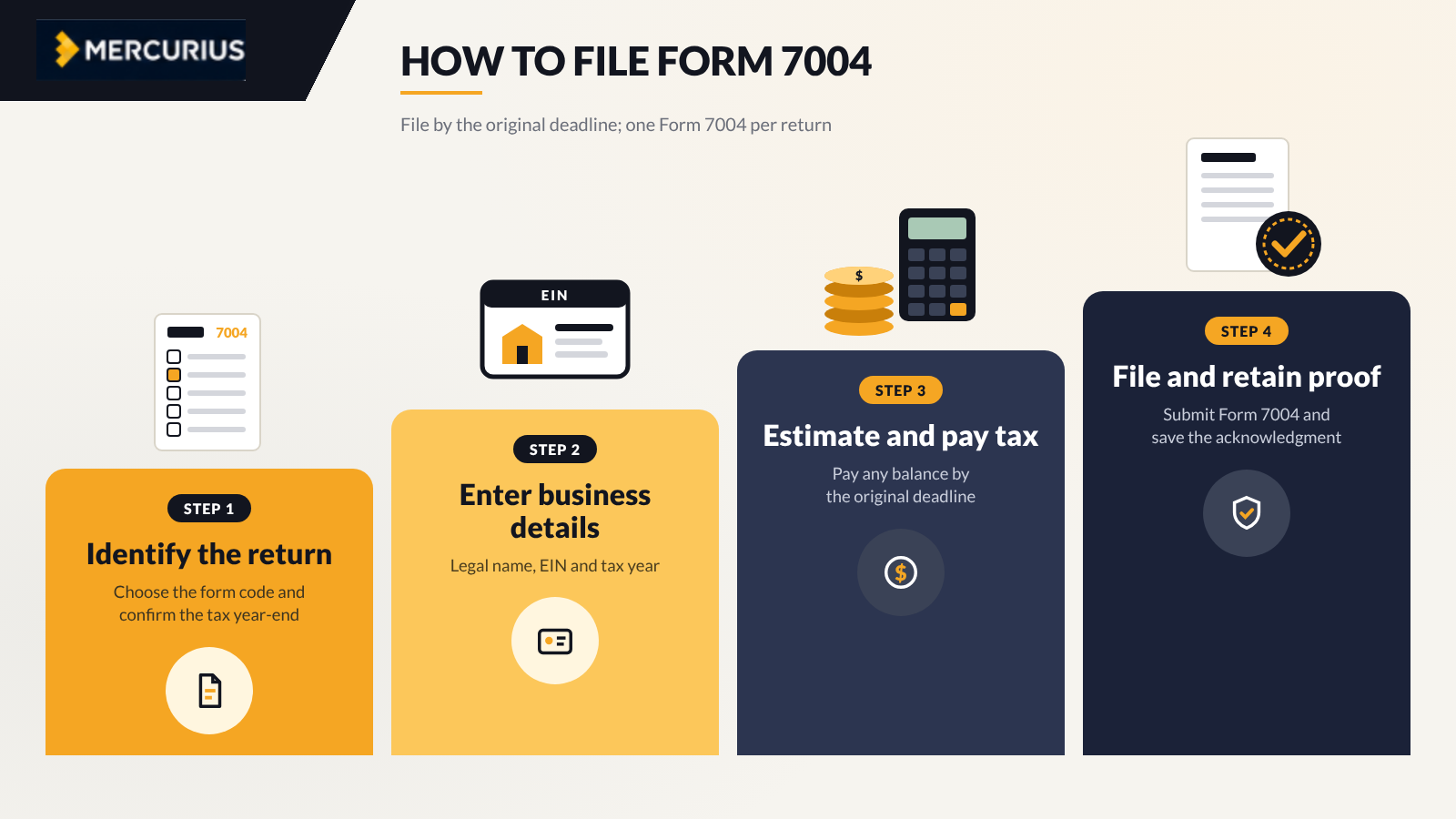
- Identify the return: Choose the appropriate form code and confirm the tax year-end.
- Enter business details: Provide the legal name, Employer Identification Number (EIN), and tax year.
- Estimate and pay tax: Calculate any outstanding liability and pay by the original deadline.
- File and retain proof: Submit Form 7004 and save the acknowledgment.
If the IRS rejects a timely e-filed Form 7004, you generally have five calendar days to correct and resubmit it and still have it treated as timely. Review IRS rejection notices promptly.
Our Form 7004 filing guide offers further instructions. The following sections cover the specific filing obligations and reporting rules for different business entities.
When Do Partnerships and S Corporations Have to File?
Partnerships filing Form 1065 and S corporations filing Form 1120-S generally have a March 15 deadline for calendar-year returns, extendable to September 15. Weekend and holiday adjustments may apply.
These entities generally pass income, deductions, and credits through to owners rather than paying federal income tax on all earnings at the entity level. Certain entity-level taxes can still arise. Timely filing also helps owners.
How Does a Late Entity Return Affect the Owners?
Partners and shareholders typically need Schedule K-1 to report their shares of business activity on individual returns. Delayed K-1s can prevent them from completing personal filings. Individual owners who need more time can request their own extension using Form 4868.
Organized bookkeeping services can support timely K-1s. See our extension guide.
What Is the Extended Deadline for C Corporations Filing Form 1120?
Calendar-year C corporations ordinarily file Form 1120 by April 15 and may extend the filing date to October 15 with Form 7004. Unlike pass-through entities, C corporations generally pay federal income tax at the corporate level.
What Tax Is Due With Form 7004?
C corporations pay federal income tax at a flat 21% rate. Corporations requesting an extension must estimate their liability, subtract payments already made, and pay any remaining amount by the original due date. The extension does not replace quarterly estimated tax requirements.
What Changes for June 30 Fiscal-Year Corporations?
Special transition rules apply to C corporations with a June 30 year-end. For tax years beginning before January 1, 2026, the return is due on the 15th day of the third month after year-end, and Form 7004 generally provides a seven-month extension. For tax years beginning on or after January 1, 2026, the standard C corporation rules apply: the return is due on the 15th day of the fourth month, with a six-month extension.
For a June 30, 2026 year-end, the original deadline is generally September 15, 2026, extended to April 15, 2027. For a June 30, 2027 year-end, the original deadline moves to October 15, 2027, extended to April 15, 2028. Check IRS instructions.
How Do Fiscal-Year Businesses Calculate Their Extension Deadline?
Fiscal-year businesses calculate deadlines from their own year-end.
Counting Months From Year-End
- Forms 1065 and 1120-S: Generally due on the 15th day of the third month after year-end.
- Form 1120: Generally due on the 15th day of the fourth month after year-end, with exceptions for certain corporations.
A timely Form 7004 generally adds six months, subject to special rules.
Worked Example
For a full tax year ending September 30, 2026:
- Partnerships and S corporations: December 15, 2026 original deadline; June 15, 2027 extended deadline.
- C corporations: January 15, 2027 original deadline; July 15, 2027 extended deadline.
Weekend and legal-holiday deadlines generally shift to the next business day. IRS disaster relief can also postpone deadlines for taxpayers in federally declared disaster areas.
Does a Business Tax Extension Also Extend the Payment Date?
No. Form 7004 postpones filing, not payment. Businesses should estimate tax due and pay it by the original deadline to limit interest and penalties.
How Do Interest and Late-Payment Penalties Apply?
Unpaid tax generally accrues interest from the original payment deadline. For October–December 2026, the IRS underpayment interest rate is 7% annually, compounded daily; large corporate underpayments (generally C corporation underpayments over $100,000) carry a 9% rate.
A failure-to-pay penalty may also apply, generally 0.5% of the unpaid tax for each month or part of a month it remains unpaid after the original due date, up to 25%. Review IRS rules when calculating charges.
Are Estimated Tax Payments Affected?
No. Required quarterly estimated tax installments remain due on their usual dates. Treat the annual filing extension and installment schedule as separate obligations.
Consequences of Missing a Business Tax Extension Deadline
Late-filing penalties depend on return type, delay, and unpaid tax.
Partnerships and S Corporations
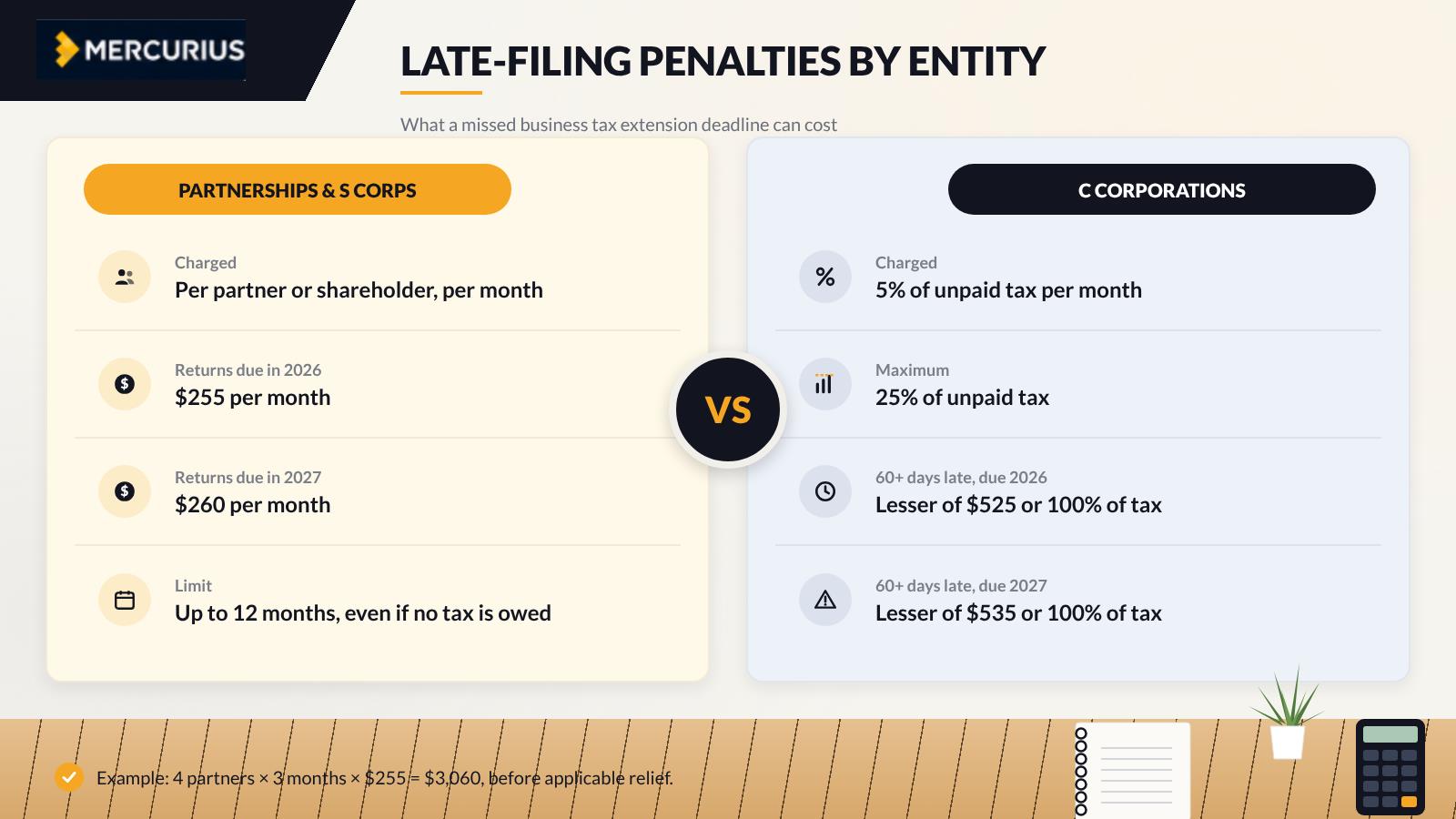
For Forms 1065 and 1120-S, penalties are generally calculated per partner or shareholder for each month or part of a month late, up to 12 months. The penalty is $255 per partner or shareholder, per month, for returns due in 2026 and $260 for returns due in 2027. It can apply even when the entity owes no tax.
Example: A four-partner partnership filing three months late for a return due in 2026 could owe 4 × 3 × $255 = $3,060, before applicable relief.
C Corporations
Form 1120 late-filing penalties generally equal 5% of unpaid tax per month or part of a month, up to 25%, with adjustments when failure-to-pay penalties overlap. For returns due in 2026 and filed more than 60 days late, the minimum is generally the lesser of $525 or 100% of unpaid tax; the corresponding 2027 figure is $535.
Schedule K-1 Penalties
Separate penalties may apply when required Schedules K-1 are late, missing, or incorrect. These costs are separate from late-return penalties.
Is Penalty Relief Automatic?
Certain taxpayers may be eligible for administrative penalty relief from the IRS. The Automatic Exemption from Penalty (AEP) program, which the IRS began rolling out in summer 2026, applies to eligible original returns beginning with tax year 2025. It can prevent failure-to-file and failure-to-pay penalties from being assessed, without a separate request, for taxpayers with three prior years of timely filing and payment. Eligible returns include Forms 1065, 1120, and 1120-S. AEP fully replaces First Time Abate for returns with original due dates on or after January 1, 2027; during the transition, some taxpayers may still need to request First Time Abate.
Other taxpayers may request reasonable-cause relief where applicable. Penalty relief does not remove the underlying tax, and interest on unpaid tax generally continues to accrue. Review IRS penalty relief guidance and our AEP guide.
Do States Require a Separate Business Tax Extension?
State requirements differ. Many states recognize a federal extension, while others require separate forms, payments, or earlier deadlines. Review the official guidance published by each state’s revenue agency.
Business Tax Extension Checklist
Before the Original Filing Deadline
- Confirm entity type, year-end, and return form.
- Estimate tax liability and identify outstanding balances.
- File Form 7004 on time and retain the acknowledgment.
- Settle the required tax amount and preserve proof of payment.
Before the Extended Filing Deadline
- Reconcile accounts and finalize financial records.
- Review income, expenses, and supporting documents.
- Prepare Schedules K-1, where required.
- Check applicable state requirements and submit the return.
Our Accounting Services can support the year-end close and record preparation.
Conclusion
Meeting business tax extension deadlines requires careful planning, accurate records, and an understanding of entity-specific requirements. Whether your business files Form 1065, 1120-S, or 1120, preparing documentation early can reduce delays and potential penalties.
At Maspartner, we help US businesses navigate these requirements through accounting, bookkeeping, and tax compliance services. Explore our Tax Filing Services and book your free consultation today to discuss your filing needs.
Frequently Asked Questions
What Is the Business Tax Extension Deadline?
For calendar-year 2025 returns, valid extensions ended September 15, 2026, for Forms 1065 and 1120-S, and October 15, 2026, for Form 1120.
What Is Form 7004 Used For?
It requests an automatic filing extension for eligible business returns and generally must be submitted by the original filing deadline.
Does a Tax Filing Extension Also Extend the Payment Deadline?
No. Tax payments remain due by the original deadline, regardless of a filing extension.
When Are Business Tax Returns Due After an Extension in 2027?
For calendar-year 2026 returns, Forms 1065 and 1120-S extend to September 15, 2027; Form 1120 extends to October 15, 2027.
What Is the Penalty for Filing Late?
Partnership and S corporation penalties are generally owner-based; C corporation penalties typically depend on unpaid tax and how long the return is late.
How Do Fiscal-Year Businesses Calculate Their Deadlines?
They count from their own tax year-end under the applicable return rules and generally receive a six-month extension when Form 7004 is filed on time (seven months for certain June 30 year-end C corporations).
Do States Require Separate Extensions?
Some do. Check the applicable state agency for filing, payment, and extension requirements.


