

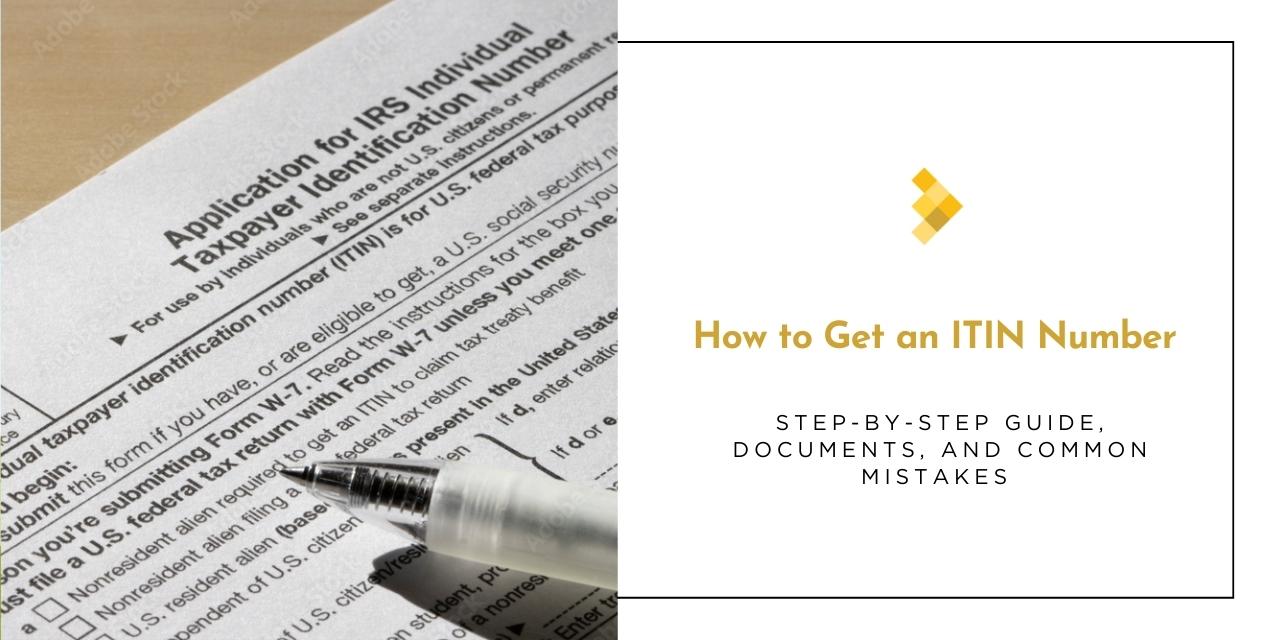
If you’re earning income in the U.S. but don’t qualify for a Social Security Number, you’ll still need a valid way to meet your tax obligations. That’s where the Individual Taxpayer Identification Number (ITIN) becomes essential.
For many individuals, especially nonresidents or dependents, applying for an ITIN can feel complicated. But once you understand the process, it’s actually quite straightforward.
In this guide, we’ll walk you through how to get an ITIN number step-by-step, explain the documents you’ll need, and highlight the most common mistakes to avoid, so your application moves smoothly and gets approved on time.
What is an ITIN and Why You Need One?
An ITIN (Individual Taxpayer Identification Number) is a nine-digit tax processing number issued by the U.S. Internal Revenue Service (IRS) to individuals who are not eligible for a Social Security Number (SSN) but still need to file a U.S. federal tax return or report income. It serves as an identification tool that allows nonresidents, dependents, and other foreign individuals to comply with U.S. tax laws, open certain financial accounts, and fulfill reporting obligations just like citizens and residents do.
You might need an ITIN if you are:
• Earning U.S.-source income but don’t qualify for an SSN
• Claiming tax treaty benefits
• Filing U.S. tax returns as a nonresident
• Claiming as a dependent or spouse on someone’s U.S. tax return
Getting an ITIN allows you to comply with U.S. tax laws, claim certain tax credits, and maintain financial activity in U.S. jurisdictions where tax reporting is required. Knowing how to get an ITIN number can help you avoid delays during the tax season.
Step-by-Step Guide to Obtain an ITIN
Here’s a clear process you can follow if you’re learning how to apply for an ITIN to get your ITIN:
Step 1: Determine if you’re eligible and required to apply
You’re eligible if:
• You’re not eligible for a Social Security Number
• You have a U.S. federal tax filing requirement (or qualify for an exception)
• You need the ITIN for a qualifying tax return, dependent claim, or other IRS-recognized reason.
• If your ITIN expired or was never used on a return for three consecutive years, you may need to renew it instead of applying for a new one.
Step 2: Get the Correct Form
The application process for an ITIN starts with Form W-7 (Application for IRS Individual Taxpayer Identification Number), available on the official IRS website. This is the form you’ll submit to request your ITIN.
You’ll need to provide your personal details such as your name, date of birth, and mailing address, along with the reason for applying (for example, filing a tax return, claiming a treaty benefit, or being listed as a dependent). If you’re applying while filing your taxes, attach your completed federal tax return to the W-7 form.
Knowing how to get an ITIN number includes understanding what information belongs in each section of Form W-7 to prevent rejections.
Step 3: Prepare Your U.S. Federal Income Tax Return
Along with your Form W-7, you’ll generally need to submit a completed U.S. federal income tax return. This can be Form 1040 (U.S. Individual Income Tax Return) or Form 1040-NR (U.S. Nonresident Alien Income Tax Return), depending on your filing status.
When filling out your tax return:
• Leave the SSN field blank for each ITIN applicant; the IRS will later fill in your assigned ITIN and forward the tax return for processing.
• If you’re applying for your spouse or dependents, attach a separate Form W-7 for each person to the front of your tax return.
• Include any required schedules or forms to claim eligible tax benefits, such as dependent or treaty-based credits.
• If you meet certain exceptions, you may not need to attach a return at the time of application. You can check those exceptions directly on the IRS website.
• Some applicants may also qualify for free tax preparation services through IRS-certified programs, such as VITA (Volunteer Income Tax Assistance) and TCE (Tax Counseling for the Elderly).
This step is essential for obtaining your ITIN correctly, as missing tax forms often lead to processing delays.
Step 4: Gather supporting identification documents
You must prove both identity and foreign status.
• A valid passport is the only document that can serve as both identity and foreign status.
• If you don’t have a passport, submit certified copies of other documents (from a list of 13 acceptable documents) such as national ID cards, foreign driver’s licenses, birth certificates, or visa records.
• The IRS requires original documents or copies certified by the issuing agency; notarized copies are not acceptable.
Submitting accurate and complete documents is essential to ensure your ITIN is processed without delays.
Step 5: Choose Your Submission Method
Once you’ve completed Form W-7 and gathered all supporting documents, you can submit your ITIN application in one of the following ways:
1. By Mail:
Send your Form W-7, supporting identification documents, and your federal tax return to the address listed in the form instructions on the IRS website. Make sure to use a secure, trackable mailing option if you’re sending original documents.
2. Through a Certified Acceptance Agent (CAA):
A CAA is an IRS-authorized representative who can verify your identity and documentation. This allows you to avoid mailing your original documents directly to the IRS, reducing risk and saving time.
3. In Person at an IRS Taxpayer Assistance Center (TAC):
You can also schedule an appointment at a local TAC to have your documents reviewed and your application submitted in person.
If you’re outside the United States, check with nearby U.S. consulates or embassies; some provide ITIN assistance or can forward applications to the IRS.
Step 6: Wait for processing and verification
Patience and accuracy are key in how to get an ITIN number approved smoothly.
Step 7: Receive Your ITIN and Start Using It
Once your application is approved, the IRS will send you a notice containing your 9-digit Individual Taxpayer Identification Number (ITIN), typically formatted as 9XX-XX-XXXX. Keep this notice safe, as you’ll need this number for all future tax filings and correspondence with the IRS.
You’ll use your ITIN in place of a Social Security Number (SSN) when filing federal tax returns, reporting income, or handling other official tax-related matters in the U.S. However, it’s important to note that an ITIN does not authorize you to work in the United States or make you eligible for Social Security benefits; it’s strictly used for tax identification and compliance purposes only.
If you later become eligible for an SSN, you should stop using your ITIN and notify the IRS to link your past tax records to your new number.
Common Mistakes and How to Avoid It
Even small errors can delay your ITIN application. Here are a few to watch out for:
• Using notarized copies instead of certified ones: The IRS only accepts originals or certified copies from the issuing agency.
• Submitting expired identification: Always ensure your passport or ID is valid before applying.
• Selecting the wrong reason on Form W-7: Review each option carefully to choose the correct one.
• Forgetting to attach your tax return: Unless you qualify for an exception, include your federal tax return with the form.
• Sending originals by regular mail: Use trackable mail or a Certified Acceptance Agent to avoid document loss.
• Missing renewal deadlines: ITINs expire if unused for three years, so renew early to avoid delays.
Avoiding these simple mistakes is a crucial part of how to get an ITIN number quickly and correctly. Getting your ITIN right the first time can save weeks of waiting, so if you’re unsure about any document or eligibility detail, it’s always wise to have an expert review your application before submission.
Tips & Extra Considerations
These tips simplify how to get an ITIN number and keep your tax filings on track.
Final thoughts
Applying for an ITIN may seem complex at first, but with the right preparation, it becomes a smooth and manageable process. Paying attention to each step of how to get an ITIN number helps you avoid errors, stay compliant, and receive your approval without unnecessary delays.
While an ITIN doesn’t grant work authorization or Social Security benefits, it ensures you stay compliant with tax laws, claim eligible credits, and maintain financial activity within the United States.
If you’re unsure where to start or want expert help preparing your application, our team can guide you through the process from start to finish. Book your free consultation today and get your ITIN application done accurately and on time.
FAQs
1. Can I apply for an ITIN from outside the United States?
Yes. If you’re wondering how to get an ITIN number while living abroad, you can apply by mailing your Form W-7 and supporting documents to the IRS or by working with a Certified Acceptance Agent (CAA) authorized to process international ITIN applications.
2. What is a Certified Acceptance Agent (CAA) and how can they help?
A CAA is authorized by the IRS to verify your documents and submit your application for ITIN on your behalf. This makes the process of ITIN application easier, as it helps you avoid mailing original identification documents directly to the IRS.
3. What should I do if I lose my ITIN?
If you lose your ITIN number, you can contact the IRS to retrieve it after verifying your identity. In case it has expired, you’ll need to renew it using Form W-7 as part of the standard ITIN application process.
4. How long does the ITIN application process usually take?
It typically takes about 7 to 11 weeks, though processing times may vary depending on the season and submission method.
5. Are there exceptions to submitting a tax return with my ITIN application?
Yes. Some individuals, such as dependents, students, or those claiming treaty benefits, may qualify for exceptions and can submit their application for ITIN without attaching a tax return. Reviewing the IRS guidelines on how to apply for an ITIN can help determine if you qualify for these exceptions.