

For corporations, corporate tax deadlines are more than just dates on a calendar; if missed, they can mean thousands of dollars in penalties. But with reports pending and records unfinished, meeting the IRS deadline isn’t always possible. The IRS allows corporations to request a tax extension to avoid unnecessary fines.
The solution is simple: a corporate tax extension. With Form 7004, businesses can secure extra time to file their returns accurately, protect cash flow, and avoid unnecessary fines.
This guide explains what corporate tax is, why extensions matter, and the exact steps to file Form 7004 so your company stays compliant and penalty-free.
What Is a Corporate Tax?
Corporate tax is the tax that a business pays on its profits. When a company earns money, it deducts its expenses (like salaries, rent, supplies, depreciation) to calculate taxable income. The government then applies a tax rate to that income.
Understand What a Corporate Tax Extension Is
A corporate tax extension is a formal request for more time to file your return. It is submitted using IRS Form 7004 and typically grants up to six additional months.
Key facts to remember:
• An extension applies to filing, not to paying. Estimated taxes must still be paid by the original deadline.
• It allows corporations to finalize records, close books, and avoid errors in rushed filings.
• It gives shareholders, partners, and auditors time to provide critical information that affects returns.
By filing an extension, corporations signal to the IRS that they are committed to compliance, even if they need additional time to file their corporate tax return.
Know Which Corporations Need to File Extensions
Extensions are not required for every business, but many corporations benefit from them, especially when approaching the corporate tax deadline. Situations where an extension is useful include:
• Financial records are not finalized by the deadline.
• Shareholders or partners need additional time for Schedule K-1s.
• The company is undergoing restructuring or mergers.
• Businesses want more time for tax planning strategies.
Take a look at which business entities can file Form 7004:
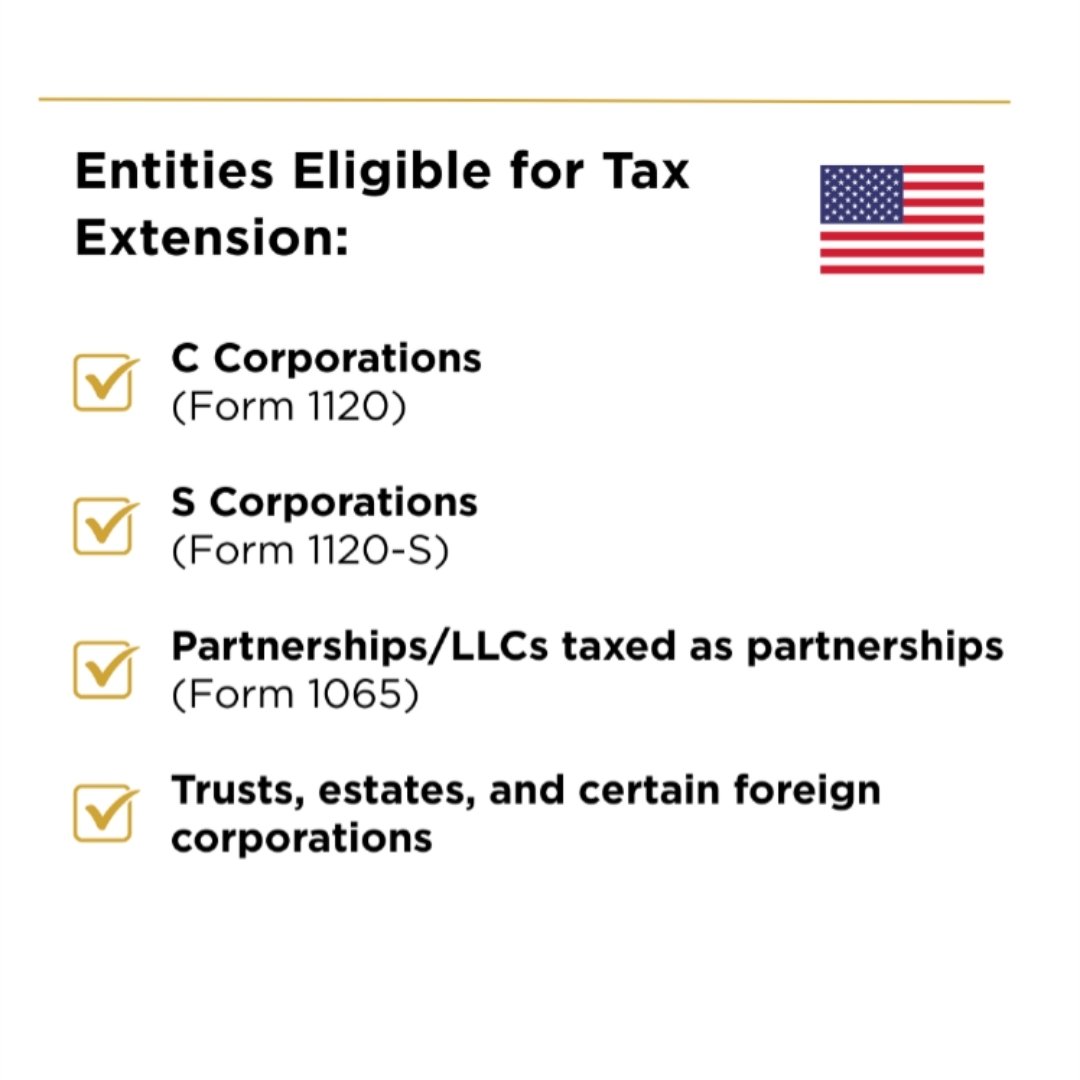
This flexibility makes corporate tax extensions valuable for both large corporations and smaller businesses.
Gather Essential Information Before Filing
To file Form 7004 successfully, prepare the following information:
• Business details: Legal name, EIN, and registered address.
• Return type: The specific form being extended, such as 1120, 1120-S, or 1065.
• Estimated tax liability: A realistic estimate of the taxes your business expects to owe.
• Payments already made: Include quarterly estimated taxes, withholdings, and prior-year credits.
• Balance due: Any remaining balance between your estimated tax liability and prior payments must be paid with the extension.
Accurate information helps ensure the corporate tax extension is approved without complications.
Steps for Filing Form 7004
Filing Form 7004 is the official way to request extra time to file corporate tax returns. Below is a detailed breakdown of each step to make the process straightforward.
Step 1: Identify the Return Type and Code
• Form 7004 covers dozens of different returns (1120, 1120-S, 1065, 1041, etc.).
• Each return type has a two-digit clode that must be entered in Part I of Form 7004.
• Example: Code 12 for Form 1120 (C Corporations), Code 09 for Form 1120-S (S Corporations), Code 08 for Form 1065 (Partnerships).
Using the wrong code is one of the most common mistakes, so double-check before filing.
Step 2: Fill Out Business Information
• Enter the exact legal business name, address, and EIN (Employer Identification Number).
• The information must match IRS records precisely. Even a slight mismatch (like “Inc.” vs “Incorporated”) could delay processing.
Step 3: Choose Tax Year Information
• Indicate whether you are filing for a calendar year or a fiscal year.
• For fiscal-year corporations, the filing deadline may differ, so confirm dates carefully.
Step 4: Provide Tax Liability Estimates
• In Part II, enter your corporation’s estimated tax liability for the year.
• Make sure the estimate is reasonable. Reporting “0” without justification can be flagged by the IRS.
• Use accounting records, financial statements, and projections to arrive at a reliable estimate.
Step 5: Report Prior Payments and Credits
• List any estimated tax payments already made during the year.
• Include any applicable tax credits or carryovers from the previous year.
Step 6: Calculate and Pay Balance Due
• Subtract payments already made from your estimated liability.
• If a balance is due, it must be paid with the extension filing.
• Remember, filing for an extension gives you more time to file, not to pay.
• Accepted payment methods: EFTPS, IRS Direct Pay, check, or money order.
Step 7: File Form 7004 Electronically
• Use the IRS Modernized e-File (MeF) system or IRS-approved tax software.
• E-filing is strongly recommended because it provides instant confirmation of receipt.
• Paper filing is slower and riskier due to mailing delays.
Step 8: Confirm and Save Records
After submission, keep:
• A copy of your submitted Form 7004.
• Proof of e-filing confirmation or mailing receipt.
• Proof of payment (EFTPS confirmation, Direct Pay receipt, or canceled check).
• These documents support your corporate tax compliance if the IRS raises questions.
Pay Any Estimated Tax Due
Even if you file Form 7004, the IRS still requires payment of estimated taxes by the original due date. Payment options include:
• EFTPS (Electronic Federal Tax Payment System).
• IRS Direct Pay.
• Check or money order by mail.
Late payments lead to penalties and interest, regardless of extension approval.
Keep Track of Deadlines
Here are the filing and extended deadlines:
• C Corporations (Form 1120): Due April 15. Extended deadline October 15.
• S Corporations (Form 1120-S): Due March 15. Extended deadline September 15.
• Partnerships (Form 1065): Due March 15. Extended deadline September 15.
• Trusts and estates: Extensions usually grant 5½ months.
• Foreign corporations: Must file by the 15th day of the 6th month after year-end if no U.S. office exists.
Maintain Documentation for Compliance
Always keep:
• A copy of filed Form 7004.
• Proof of IRS e-filing confirmation.
• Evidence of payments made.
• Financial statements used for estimates.
Proper recordkeeping is important to provide documentation if the IRS requests it.
Understand State Corporate Tax Extensions
Filing Form 7004 only applies to federal returns with the IRS. Many businesses overlook the fact that states have their own rules for corporate tax extensions. A federal extension does not always mean you are covered at the state level.
Key Points to Remember
• Some states grant automatic extensions if you file a federal extension, but you may still need to pay state taxes by the original due date.
• Other states require you to file a separate extension form for state taxes.
• States often have different penalties and interest rules, which can be harsher than federal ones.
Examples
California:
Corporations automatically receive a state extension (usually 7 months) without filing a separate form. However, this extension only applies to filing the return. All state taxes owed must still be paid by the original due date to avoid penalties and interest.
New York:
Corporations must actively file Form CT-5 to request an extension of time to file their state tax return. New York does not automatically accept the federal extension. Filing CT-5 also requires paying any tax due by the original deadline.
Other States:
Rules vary widely. For example:
• Texas: Requires a specific form and timely payment to receive an extension.
• Illinois: Accepts a federal extension but may require separate payment vouchers.
• Florida: Requires corporations to file Form F-7004 for state extensions.
Why This Matters
If a corporation assumes the federal extension covers the state return and fails to meet the state’s requirements, it may face late-filing penalties, interest charges, or even loss of good standing with the state.
The safest approach is to check your state’s Department of Revenue or Taxation website each year for corporate tax compliance.
Common Mistakes to Avoid
• Believing that extensions delay tax payments is a common mistake. Taxes remain due on the original filing deadline.
• Underestimating liability can trigger penalties and interest.
• Forgetting state filing requirements.
• Filing paper without tracking confirmation increases the risk of lost or delayed submissions.
Avoiding these mistakes helps corporations file accurate corporate tax returns with confidence.
Final Thoughts
A corporate tax extension is more than a safety net. It is a practical strategy for businesses that need time to file accurate returns while avoiding compliance risks. By filing Form 7004 correctly, paying estimated taxes on time, and maintaining thorough records, corporations can reduce stress and penalties during tax season.
Need help with your corporate tax extensions filing? Our experts handle Form 7004, payments, and compliance to keep your business penalty-free and stress-free. Book your free consultation today to make tax season simple.
FAQs
1. How do I file a corporate tax extension with Form 7004?
You can file a corporate tax extension by submitting IRS Form 7004 through IRS-approved e-file software or by mail. The form requires your business name, EIN, return type, estimated corporate tax liability, and payments already made. As long as Form 7004 is filed by the corporate tax deadline, the extension is automatically granted.
2. Does a corporate tax extension give more time to pay taxes?
No. Filing a corporate tax extension only gives more time to file, not to pay. Estimated corporate tax must still be paid by the original deadline to avoid penalties and interest. The IRS considers late payments even if the extension was filed correctly.
3. Which business entities can file Form 7004 for a tax extension?
Form 7004 is available to many entities, including C Corporations, S Corporations, partnerships, and foreign corporations. Each must use the correct return code when filing. It’s one of the most commonly used corporate tax extensions for businesses that need additional time to finalize records.
4. How long does a corporate tax extension last?
Most corporations receive a six-month extension after submitting Form 7004.
Examples include:
• C Corporations: April 15 → October 15
• S Corporations & Partnerships: March 15 → September 15
These extended dates help businesses meet the corporate tax deadline without rushing their filings.
5. Do statesautomatically accept the federal corporate tax extension?
Not all states accept the federal extension. Some honor it automatically, while others require their own forms for corporate tax extensions. Even when the extension is accepted, state taxes may still be due by the original deadline, depending on your state’s rules.