

As businesses prepare for the 2026 filing season, many are facing uncertainty around how recent legislative updates will affect their corporate tax filings. While the One Big Beautiful Bill Act (OBBBA), enacted in 2025, does not change the structure of corporate tax reporting, it introduces important updates to how key tax provisions are applied and calculated, directly impacting how corporations prepare Form 1120.
These changes have created practical challenges, particularly in areas such as depreciation, research expenses, and interest deductions under evolving corporate tax law, all of which influence how businesses approach Form 1120 tax reporting. Many businesses are unsure whether their existing tax strategies still align with the updated rules or require adjustment.
In this environment, accurate reporting and proactive tax planning have become more important than ever. This guide outlines the key aspects of Form 1120 and explains how the latest updates under the OBBBA impact corporate tax planning for 2026.
What is Form 1120?
Form 1120 is the U.S. Corporation Income Tax Return used by C corporations to report their income, deductions, gains, losses, and tax liability to the IRS. Unlike pass-through entities, C corporations are taxed at the entity level, which means the corporation itself is responsible for paying income taxes.
Accurate reporting on Form 1120 is critical, as it directly determines the corporation’s tax liability and compliance status.
Who Needs to File Form 1120?
Form 1120 must be filed by:
• Corporations classified as C corporations and operating in the U.S.
• Foreign corporations with U.S.-sourced income
• Limited Liability Companies (LLCs) that have elected to be taxed as C corporations
Ensuring proper classification and timely filing is essential to avoid penalties and maintain compliance.
Key Filing Deadlines for 2026
• Standard Filing Deadline: For calendar-year corporations, Form 1120 must be filed by April 15, 2026.
• Extension Filing: Corporations can request a Form 1120 extension by filing Form 7004, which extends the deadline to October 15, 2026.
• Weekend or Holiday Adjustments: If the due date falls on a weekend or holiday, the deadline shifts to the next business day.
Early preparation allows businesses to file Form 1120 for C corporations efficiently while ensuring accuracy and compliance.
Understanding the Impact of OBBBA on Corporate Tax Planning
As businesses approach the 2026 filing season, it becomes increasingly important to move beyond routine compliance and evaluate how tax changes influence broader financial decisions. These updates require corporations to reconsider how they calculate deductions, manage taxable income, and plan capital investments, all of which directly impact cash flow and overall tax liability.
The One Big Beautiful Bill Act (OBBBA), enacted in 2025, introduces targeted changes that affect how corporations compute deductions and apply tax provisions.
These updates do not alter the structure of Form 1120 but modify how certain elements such as depreciation, research expenses, and interest deductions are calculated. These updates do not alter the structure of Form 1120 but modify how certain elements, such as depreciation, research expenses, interest deductions, and charitable contributions are calculated. As a result, corporations must revisit their tax positions and align with the latest instructions for Form 1120 to ensure accuracy and efficiency in reporting.
1. Restoration of 100% Bonus Depreciation
Under the OBBBA, 100% bonus depreciation is reintroduced for eligible property placed in service after January 19, 2025, pursuant to IRC §168(k). Prior to this change, bonus depreciation had been phasing down under the TCJA, only 40% was available for property placed in service in 2025. The OBBBA eliminates this phase-down entirely.
Here’s how this change applies:
• Immediate Deduction: Corporations can expense the entire cost of qualifying assets in the year they are placed in service.
• Example: If a corporation purchases equipment worth $500,000, the full amount can be deducted in the same year, significantly reducing taxable income.
This change supports capital investment while improving short-term cash flow by accelerating deductions.
2. Research & Experimental (R&E) Expense Relief
With the changes under the OBBBA, domestic R&E costs can now be fully deducted in the year they are incurred, starting with tax years beginning after December 31, 2024. Under the previous regulations set by the TCJA in 2022, domestic R&E costs had to be amortized over five years, rather than being deducted immediately in the year they were incurred.
Businesses also have the option to recognize domestic R&E costs gradually over no less than 60 months. For R&E costs that were unamortized from 2022 to 2024, businesses have the option of claiming a deduction in the first post-2024 tax year or spreading the expenses over a two-year period through amortization.
Important: Foreign R&E expenses must be capitalized and amortized over 15 years, as the immediate deduction option does not apply to them.
Here’s how this change applies:
• Immediate Deductibility Restored: Companies are permitted to claim the full amount of domestic R&E expenditures in the year incurred, instead of recovering the costs over a five-year timeline.
• Reporting Impact: These adjustments directly affect Line 26 (Other deductions) and Schedule M adjustments on Form 1120.
This update simplifies compliance and provides greater flexibility for corporations engaged in research and development activities.
3. Business Interest Deduction Changes (Section 163(j))
The OBBBA permanently restores the EBITDA-based method for calculating Adjusted Taxable Income (ATI) under Section 163(j), effective for tax years beginning after December 31, 2024. Since 2022, ATI was calculated using the more restrictive EBIT-based approach, which excluded depreciation and amortization add-backs and limited deductible business interest. This change reinstates the more favorable EBITDA-based calculation, allowing corporations to claim higher interest deductions.
Here’s how this change applies:
• Expanded Deduction Capacity: Corporations can now add back depreciation and amortization when calculating ATI, increasing their allowable business interest deduction.
• Impact on Financing Decisions: Businesses that rely on debt financing can benefit from improved deductibility of interest costs.
This change enhances financial flexibility and supports more efficient capital structuring.
4. Installment Election for Farmland Sales (IRC §1062)
A new provision under IRC §1062 allows eligible taxpayers who recognize gain from the sale of qualified farmland to a qualified farmer to pay the related tax liability in four equal annual installments, instead of paying the full amount in the year of sale. This provision applies to sales in tax years beginning after July 4, 2025 (for calendar-year taxpayers, starting January 1, 2026).
To qualify, the property must be U.S. farmland that has been used for farming, or leased to a qualified farmer, for substantially all of the 10-year period preceding the sale. In addition, the property must be subject to a legally enforceable covenant restricting non-farm use for 10 years after the sale, and the buyer must be actively engaged in farming.
Here’s how this change applies:
• Deferred Tax Payments: Eligible taxpayers can spread capital gains tax liability over four years rather than recognizing it all at once. The first installment is due on the original return due date for the year of sale.
• C Corporation Note: For C corporations, unpaid installments may be accelerated if the corporation liquidates, ceases business, or undergoes certain similar events.
• Pass-Through Entities: For partnerships and S corporations, the election is made at the individual partner or shareholder level, not the entity. The entity must supply each owner with the information needed to calculate their share.
This provision is particularly beneficial for corporations involved in agricultural or land-related transactions.
5. New 1% Floor on Corporate Charitable Deductions (IRC §170(b)(2)(A))
A significant new provision under the OBBBA imposes a 1% of taxable income floor on charitable contribution deductions for C corporations, effective for tax years beginning after December 31, 2025. Prior law allowed corporations to deduct charitable contributions up to 10% of taxable income with no minimum threshold.
Here’s how this change applies:
• New Floor: Charitable contributions are deductible only to the extent they exceed 1% of the corporation’s taxable income for the year. Contributions below the 1% floor are permanently non-deductible in the year made.
• Existing 10% Ceiling Remains: The existing cap limiting the deduction to 10% of taxable income is unchanged. The 1% floor and 10% ceiling operate in tandem.
• Carry forward Rules: Amounts disallowed due to the 1% floor are generally permanently non-deductible and do not carry forward (unlike excess amounts above the 10% ceiling, which may be carried forward up to five years).
• Reporting Impact: This change affects Schedule A (Charitable Contributions) on Form 1120 and requires careful planning of annual giving levels.
Corporations with smaller charitable giving programs should review their contribution levels relative to taxable income to avoid permanently losing deductions.
Impact on Corporate Tax Planning
These changes collectively shift the focus of corporate tax planning toward timing, strategy, and financial alignment. Accelerated deductions through bonus depreciation can significantly reduce taxable income in the short term, while improved treatment of R&E expenses allows businesses to better manage innovation-related costs.
Revisions to the Section 163(j) interest deduction rules, including the return to an EBITDA-based ATI calculation, affect how corporations structure their financing. This makes it important to reassess capital structures with greater precision.
Additionally, the introduction of a 1% floor on corporate charitable deductions requires careful planning, as poorly timed or structured contributions may result in permanently lost deductions.
Instead of evaluating these provisions in isolation, corporations should adopt a comprehensive approach to their tax strategy to ensure all available benefits are fully optimized.
Other Important Filing Considerations for 2026
To ensure accurate filing and effective tax planning, corporations should focus on the following key areas:
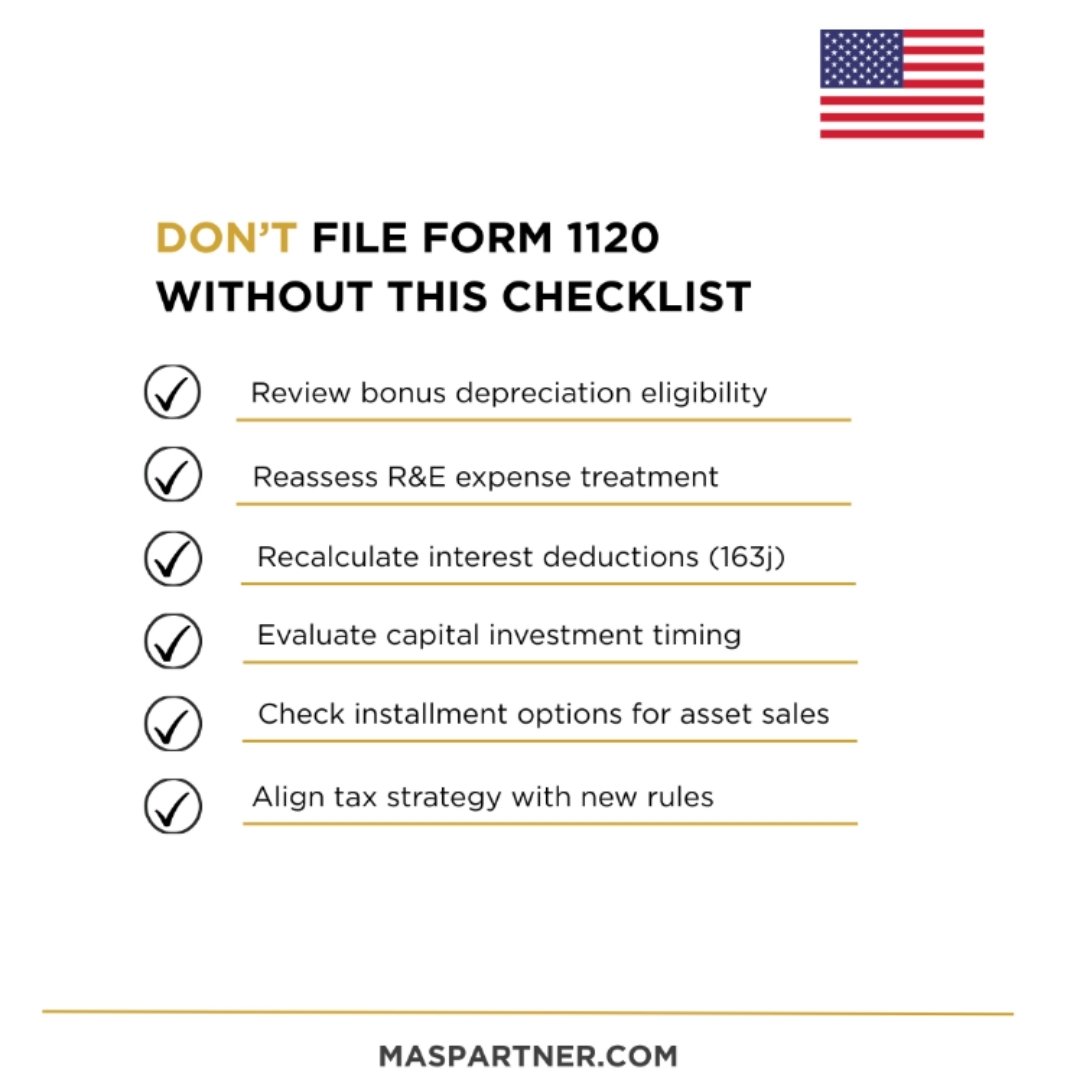
• Review financial statements to ensure updated tax treatments are correctly applied
• Reassess capital investments and depreciation strategies in light of 100% bonus depreciation
• Evaluate interest expenses under the restored EBITDA-based Section 163(j) limitation
• Review annual charitable giving levels against the new 1% floor to avoid permanently non-deductible contributions
• Assess R&E expenditure treatment and consider transition relief for 2022–2024 unamortized amounts
Addressing these areas proactively will help businesses strengthen compliance and avoid potential errors during the filing process.
Common Mistakes to Avoid
Despite these updates, many corporations may encounter common errors during filing, particularly if the changes are not fully understood.
• Miscalculating depreciation benefits under the new permanent 100% bonus depreciation rules
• Incorrect reporting of R&E expenses, including failure to apply transition relief for prior-year unamortized amounts
• Overlooking the restored EBITDA-based ATI calculation under Section 163(j)
• Failing to account for the new 1% floor on corporate charitable deductions, resulting in permanently lost deductions
• Applying the IRC §1062 farmland instalment election at the entity level for pass-through entities, rather than at the partner or shareholder level
Careful review and accurate reporting are essential to avoid compliance issues and ensure smooth filing.
Practical Steps for Businesses
To prepare effectively for the 2026 filing season, corporations should:
• Revisit capital expenditure plans in light of permanent 100% bonus depreciation
• Align accounting practices with updated R&E expense treatment and apply transition relief where applicable
• Recalculate Section 163(j) interest deduction limits using the restored EBITDA-based ATI formula
• Evaluate annual charitable contribution levels relative to the new 1% floor
• Maintain detailed records for R&E expenses
• Consult tax professionals to validate calculations and overall strategy
Taking these steps early can help businesses make informed decisions and avoid last-minute adjustments.
Conclusion
The One Big Beautiful Bill Act (OBBBA) introduces important updates that affect how corporations calculate deductions and manage taxable income for the 2026 filing season. While Form 1120 itself remains structurally unchanged, the underlying tax computations require careful attention and strategic planning.
By understanding these changes and integrating them into their tax strategies, corporations can strengthen compliance, optimize tax outcomes, and make more informed financial decisions.
A proactive approach to corporate tax planning will be key to navigating these updates effectively and ensuring a smooth and efficient filing process in 2026.
Book your free consultation today to ensure your business is fully prepared for the 2026 corporate filing season.
FAQs
1. What is Form 1120 and who needs to file it?
Form 1120 is the U.S. Corporation Income Tax Return, which must be filed by domestic and foreign C corporations, as well as LLCs taxed as C corporations.
2. What are the key tax changes for corporations in 2026?
Key changes for corporations in 2026 include updates to bonus depreciation, R&E expenses, and interest deduction limits, all of which are impacted by the OBBBA.
3. How does OBBBA affect bonus depreciation for C corporations?
The OBBBA restores 100% bonus depreciation for qualified property placed in service after January 19, 2025, allowing corporations to expense the entire cost of qualifying assets in the year they are placed in service.
4. How does OBBBA impact R&E expenses for corporations?
The OBBBA allows domestic R&E expenses to be fully deducted in the year incurred, rather than amortized over multiple years, offering more favorable tax treatment for research activities.
5. What are common mistakes to avoid when filing Form 1120 for 2026?
Common mistakes include: