


What do most C Corp owners have in common during tax season? It’s the simple fact that April 15 arrives before many corporations are fully ready. Financial statements may still be under review; outside documents may be pending, or strategic tax choices may need more time.
That is where extensions come in. Far from being an afterthought, it is a widely used tool that helps corporations stay compliant while keeping filings accurate.
In this blog, we explain what a C Corp extension is, how C Corps file taxes, and the key updates and practices you need to know to file accurately and on time.
What Is a C Corporation?
A C Corp is one of the most common business structures in the United States. It operates as a separate legal entity, which means the company (not its shareholders) is responsible for its own debts, liabilities, and taxes.
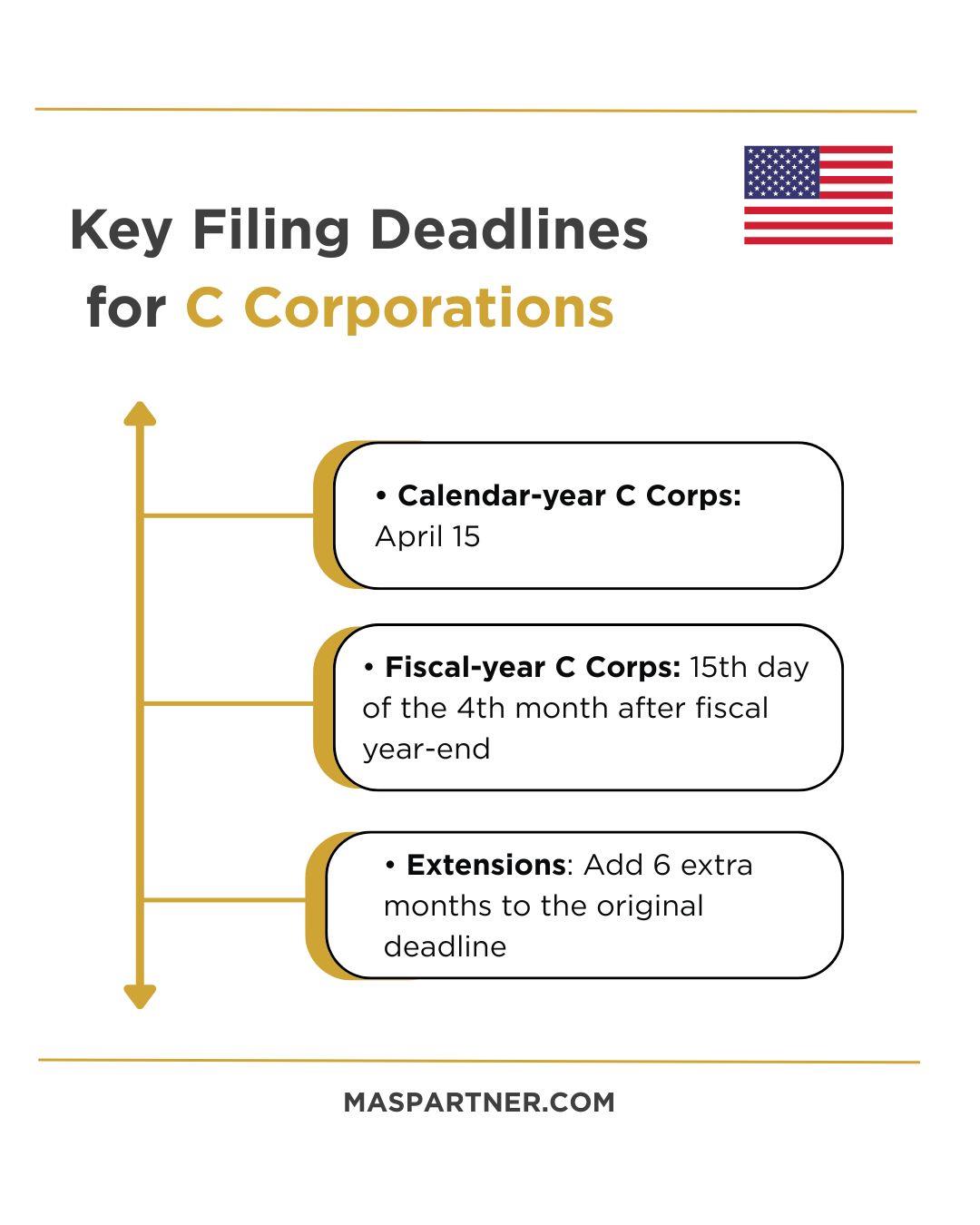
Here’s a quick overview of the key C Corporation filing deadlines to keep in mind.
Key features include:
• Separate legal identity – A C Corp has the authority to own assets, sign contracts, and function as a separate entity from its shareholders.
• Tax treatment – C corps file their own tax returns and pay corporate income tax at a flat 21% federal rate.
• Unlimited shareholders – C Corporations have no shareholder limits, unlike S Corporations. Individuals, companies, and even foreign investors can all own stock.
• Double taxation – Profits are subject to double taxation, at the corporate level and again upon distribution.
• Growth-friendly – With the ability to issue multiple classes of stock, C Corps are often favored by growing companies and startups raising capital.
• Perpetual existence – The corporation continues to exist even if ownership or management changes, offering long-term stability.
This structure gives businesses credibility, room to expand, and strong liability protection. However, it also comes with strict tax filing requirements, which is where extensions come into play.
What Is a C Corp Extension?
A C Corp files its annual federal tax return using Form 1120. The filing deadlines are:
• Calendar-year C Corps: File by April 15
• Fiscal-year C Corps: File by the 15th day of the fourth month after the fiscal year ends
If more time is needed, corporations can request an automatic six-month extension by filing Form 7004:
Why Do Businesses File Extensions?
Filing an extension is not a last-minute fix. For many corporations, it is a well-thought-out strategy to ensure financial accuracy and compliance. Here’s why a C Corp often files for one:
• Accuracy over speed – C corps often deal with complex structures, international operations, and multiple schedules. The extension gives breathing space to reconcile accounts thoroughly.
• Avoiding costly mistakes – Filing in a rush may result in missed deductions, compliance issues, or amended returns. Extra time reduces this risk.
• Waiting on external documents – Partnerships, subsidiaries, or vendors often deliver required information late. Extensions ensure the return is filed fully.
• Cash flow management – Businesses can pay estimated C Corp taxes in April while finalizing paperwork later, easing the pressure on working capital.
• Supporting audits and reviews – Companies undergoing audits or financial reviews often need more time before finalizing their filings.
• Strategic planning – Extensions provide an opportunity to explore deductions, depreciation options, and tax credits more carefully.
• Business growth transitions – Expansions, mergers, or acquisitions often require additional time to update financials, and an extension ensures these changes are recorded accurately.
Recent Updates for C Corporations
C Corporations continue to evolve under changing tax rules and oversight. In 2025, these updates matter most to every C Corp:
• Corporate tax rate remains at 21% – Introduced under the Tax Cuts and Jobs Act of 2017, this flat rate makes the C Corp structure appealing to both large companies and growing businesses.
• Enhanced IRS oversight – With more resources, the IRS is focusing on corporate filings, particularly those with international operations or significant deductions. Filing an extension shows responsibility and timeliness.
• State-level differences matter more than ever – Some states accept the federal extension automatically, while others require separate filings or different deadlines. Corporations must confirm state-specific rules to avoid penalties.
• Electronic filing becoming the standard – The IRS now strongly encourages e-filing for both Form 1120 and Form 7004. It provides instant confirmation and avoids the delays that often occur with paper filings.
• Stricter enforcement of penalties – Late payments are a key focus for the IRS, so corporations must estimate and pay taxes by April 15 to avoid penalties and interest. Staying aware of IRS tax extension deadlines is essential for ongoing compliance.
Corporations that need detailed filing instructions can refer to the IRS guidance for Form 7004, which outlines eligibility and filing requirements directly and accurately.
The Value of Filing an Extension
For a C Corp, filing an extension can offer several important benefits that support better financial and tax outcomes:
Common Mistakes to Avoid
Despite being simple, a C Corp can make critical mistakes when filing extensions:
Key Practices for a Smooth C Corp Extension
Here are the essential practices that help make your C Corp extension process seamless:
• Work with a tax professional early
• Pay more rather than less when estimating taxes
• Use the extra months proactively
• Keep shareholders and stakeholders informed
• Stay on top of state deadlines
• Use accounting software and e-filing tools
Practical Steps: Filing Form 7004 Electronically
To file an IRS tax extension form for your C Corp online:
Final Thoughts
Filing a C Corp extension is a smart way to ensure accuracy, and submitting Form 7004 on time gives you six extra months to prepare a complete, compliant return while reducing stress and minimizing errors.
With IRS scrutiny increasing, an extension has become a strategic advantage. It helps you avoid penalties, protect credibility, and ensure your return reflects your company’s true performance. File early, pay on time, and use the extra months to finalize a clean and accurate submission.
Ready to File Your Extension?
A C Corp extension is a simple yet powerful way to stay compliant and stress-free during tax season. If you’re unsure where to start, consult a CPA, review state rules, and follow official IRS guidance.
Need expert support? Book your free consultation today and get your C Corp extension done right.
FAQs
1. What does a C Corp extension actually do?
A C Corp extension gives your corporation six extra months to file Form 1120 using the official IRS tax extension form (Form 7004). It doesn’t extend the C Corp taxes payment deadline; it only extends the time to submit your completed return.
2. Does a C Corp still have to pay taxes if an extension is filed?
Yes. Even with an extension, a C Corp must estimate and pay its tax liability by the IRS tax extension deadline (April 15). Filing late or paying late can lead to penalties and interest.
3. How do I file Form 7004 for a C Corp extension?
A C Corp can file Form 7004 electronically through an IRS-approved e-file provider. You’ll need your EIN, tax year details, and estimated payment amount before submitting the IRS tax extension form online.
4. Do all states accept a federalC Corp extension automatically?
Not always. While some states accept the federal IRS tax extension, others require a separate form or have different deadlines. Every C Corp should verify its state-specific filing rules to stay compliant.
5. What happens if a C Corp files an extension late?
Missing the IRS tax extension deadline can lead to penalties, interest, and more scrutiny from the IRS. C Corp that files late risks additional compliance issues and may need to correct its C Corp taxes later.




36 Comments
Vikas Singh
Useful information
Team Maspartner
Appreciate your feedback. We’re glad the information helped.
Chetan Sharma
very informative.
Team Maspartner
Thank you, glad you found it informative.
Nirmit Kotnala
Informative
Team Maspartner
Appreciate the feedback. We’re glad the information was useful.
Lavika Sehgal
This is extremely informative.
Team Maspartner
Thanks for reading. Happy to know it was helpful.
Pranshu
Informative
Team Maspartner
Thank you, glad you found it informative.
Aarti
Very informative
Team Maspartner
Appreciate the kind words.
Aniket
Very informative
Team Maspartner
Thanks, that means a lot.
Ritika
Very informative and understandable
Team Maspartner
Thanks for the feedback.
Abhishek
Informative
Team Maspartner
Happy you found it useful.
Pooja Singhal
Useful information
Team Maspartner
Glad this added value.
Neeraj Kumar
Filing a C Corp extension isn’t about delay—it’s about accuracy and risk management.
This blog clearly explains deadlines, recent updates, and best practices that every corporation should understand heading into tax season.
Team Maspartner
Thank you for the thoughtful feedback. We’re glad the blog helped clarify deadlines and best practices.
Payal khandelwal
Factual explanation
Team Maspartner
Thank you, glad you found it clear.
Rajesh Singh
Great information and explanation.
Team Maspartner
We’re glad the explanation was useful.
Parul
Very useful.
Team Maspartner
Thank you for sharing your thoughts.
Manila Aneja
Very useful information. Appreciate the clarity!
Team Maspartner
Thank you, we’re glad the information was clear and helpful.
Vaishali Singh
Thanks for the information
Team Maspartner
Happy to know it was useful.
Muskan Ahuja
Clear explanation of C Corp extensions and filing deadlines. Very helpful.
Team Maspartner
Thank you, we’re glad the explanation was clear and helpful.
Shyama Aggarwal
Knowledgeable
Team Maspartner
Thank you, we appreciate the feedback.